A commercial general contractor manages every phase of a business construction project — from permits and subcontractor coordination to inspections and final punch list — so the property owner doesn't have to juggle dozens of moving parts alone. In North Texas, where commercial growth is accelerating and code requirements vary by municipality, hiring the right GC is the single biggest factor in whether a project stays on schedule and on spec.
If you're a business owner planning a build-out, renovation, or ground-up commercial project, understanding what a general contractor at the commercial level helps you ask better questions, evaluate bids more effectively, and avoid the mistakes that turn a six-month project into a twelve-month headache.
This guide covers how commercial contracting differs from residential work, what types of projects require a GC, how to evaluate contractors in the North Texas market, and what the process looks like from first meeting to final walkthrough.
A commercial GC coordinates the entire construction process: securing permits, hiring and managing subcontractors, ordering materials, scheduling inspections, enforcing code compliance, managing the budget, and keeping the project timeline on track. They're the single point of accountability between the business owner and every trade on the job.
Here's where business owners often get confused. On a residential project, a general contractor company might be a crew of five or six handling most of the work themselves. Commercial projects are different. The GC typically isn't swinging hammers — they're managing the entire operation so that electricians, plumbers, HVAC techs, concrete crews, and finish carpenters all show up in the right order and build to the right spec.
The scope of general contractor services on a commercial project includes:
Not every construction company handles every type of commercial work. The most common project categories in North Texas include:
| Project Type | Typical Scope | Key Complexity Factors |
| Tenant Build-Out | Interior customization of leased commercial space | Lease timelines, landlord approvals, existing systems |
| Office Construction | New build or major renovation of professional space | IT infrastructure, HVAC zoning, acoustic planning |
| Retail / Restaurant | Customer-facing spaces with heavy MEP needs | Health department, fire suppression, ADA access |
| Warehouse / Industrial | Large-footprint structural builds | Foundation engineering, clear-span design, dock access |
| Institutional | Public-use facilities with code-heavy requirements | Accessibility compliance, occupancy ratings, fire code |
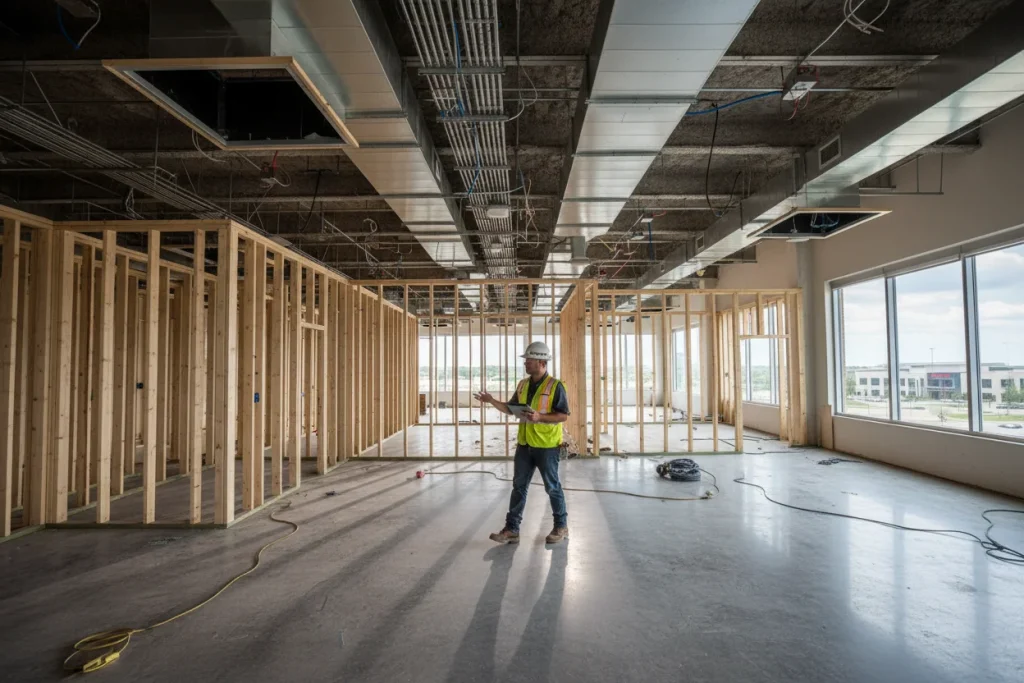
Commercial construction operates under stricter code requirements, more complex permitting, tighter timelines driven by business revenue needs, multi-trade coordination at a larger scale, and financial structures — like tenant improvement allowances and construction loans — that don't exist in residential work.
Business owners who've done a home renovation sometimes assume commercial projects work the same way, just bigger. That assumption causes problems. The differences aren't just about scale — they're about complexity, accountability, and the stakes involved when a delay means lost revenue instead of a late move-in date.
Residential construction in Texas follows the International Residential Code (IRC). Commercial projects fall under the International Building Code (IBC), which is significantly more demanding. Fire suppression systems, emergency egress planning, ADA accessibility, and occupancy load calculations all add layers of engineering and inspection that residential projects don't require.
In the Denton area specifically, commercial permits often require architectural and engineering stamps, fire marshal review, and multiple inspection phases before a certificate of occupancy is issued. A general construction company that primarily does residential work may not have the experience or relationships needed to navigate that process efficiently.
Commercial projects frequently involve tenant improvement (TI) allowances from landlords, SBA loans, or commercial construction loans with draw schedules. The GC needs to understand how these financial structures work because payment timing, documentation requirements, and lender inspection protocols all affect how the project gets managed.
This is one area where construction management companies that specialize in commercial work earn their fee — they know how to structure billing, manage draw requests, and document progress in ways that satisfy both the business owner and the lender.
When a residential remodel runs two weeks late, the homeowner is inconvenienced. When a commercial build-out runs two weeks late, the business owner may be paying rent on a space they can't use, losing revenue from a delayed opening, or breaching a lease deadline. That pressure demands a GC who manages timelines proactively — not one who reacts to problems after they've already caused delays.
| Factor | Residential | Commercial |
| Primary Code | IRC (International Residential Code) | IBC (International Building Code) |
| Permitting Complexity | Building permit, basic inspections | Multiple permits, fire marshal, ADA review |
| Financial Structure | Mortgage, cash, home equity | TI allowance, SBA loan, construction draws |
| Timeline Stakes | Inconvenience | Lost revenue, lease obligations |
| Subcontractor Volume | 3-8 trades typical | 10-20+ trades on larger projects |
| Inspection Phases | 2-4 inspections typical | 6-12+ inspections including specialized |
Evaluate a commercial general contractor based on five criteria: verified insurance and bonding, documented commercial project experience in your specific project type, transparent project management systems, strong subcontractor relationships with consistent trade partners, and a clear communication structure that keeps you informed without requiring you to manage the build yourself.
Sound familiar? The vetting process for a commercial GC mirrors residential contractor selection in some ways — but the bar is higher and the consequences of getting it wrong are more expensive.
Any GC bidding on commercial work should carry general liability insurance, workers' compensation coverage, and — depending on the project — a performance bond or payment bond. Don't accept a certificate of insurance at face value. Call the carrier and verify it's current, the coverage limits are adequate for your project size, and the policy covers commercial construction specifically.
A contractor might be excellent at kitchen remodels and still be completely unprepared for a 5,000-square-foot medical office build-out. Ask specifically about projects similar to yours — same type, similar square footage, comparable complexity. Request references from those projects and actually call them.
Local general contractors who've been working in the Denton County commercial market understand things that out-of-area contractors don't: which municipalities have faster permitting, which inspectors are thorough about specific systems, and which subcontractors deliver consistent commercial-grade work.
Ask how the GC tracks and communicates project progress. Contractors using platforms like JobTread or similar construction services management tools give you real-time visibility into scheduling, budgets, change orders, and inspection results. If a contractor's project management approach is "I'll call you when something comes up," that's a red flag on a commercial job where dozens of moving parts need daily coordination.
Here's something most business owners don't think to ask about: how long has the GC been working with their core subcontractors? A building construction company that uses the same electrical, plumbing, HVAC, and concrete crews project after project delivers more consistent quality than one that hires the cheapest available sub for each job. Long-term trade relationships mean the subs know the GC's standards, communication style, and quality expectations — and the GC knows which crews to trust with commercial-grade work.
On a commercial project, you need a designated project manager — not the company owner who's also managing three other jobs and answering sales calls. Ask who your day-to-day contact will be, how often you'll receive progress updates, and what the escalation process looks like when problems arise. Clear communication structure prevents the most common complaint business owners have about construction: feeling left in the dark.
| Evaluation Criteria | What to Ask | Red Flag |
| Insurance & Bonding | "Can I verify your commercial GL and WC coverage?" | Hesitation or expired certificates |
| Commercial Experience | "Show me 3 similar projects you've completed locally" | Only residential portfolio, no commercial references |
| Project Management | "What platform do you use for scheduling and budget tracking?" | "I'll keep you updated by phone" with no system |
| Sub Relationships | "How long have your core subs been working with you?" | Different crews on every project |
| Communication | "Who is my dedicated project manager?" | Owner handles everything personally |
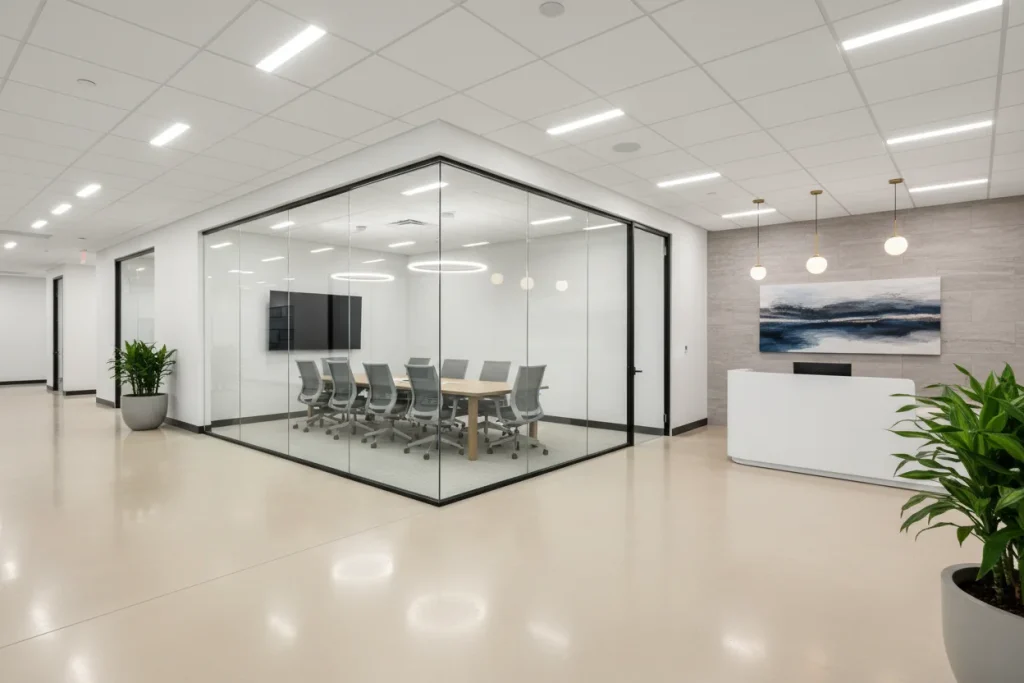
A commercial build typically moves through six phases: discovery and scope definition, design and engineering, permitting, construction, inspections and systems testing, and final walkthrough with punch list completion. Each phase has specific milestones that the GC manages — and specific decision points where the business owner needs to be involved.
Understanding this process before you start helps you plan your business operations around the build timeline and know when your input is critical versus when the GC should be handling things independently.
The GC meets with you to understand the business use, occupancy requirements, budget parameters, and timeline goals. For tenant build-outs, this phase also involves reviewing the lease, understanding the landlord's requirements and TI allowance, and identifying any existing conditions in the space that affect the build plan.
This is also where a good commercial GC starts earning their fee. They'll walk the space (or review the site for ground-up projects), identify potential issues — like outdated electrical panels, insufficient HVAC capacity, or plumbing that won't support your intended use — and flag them before they become mid-project surprises. That upfront discovery work prevents the most common source of commercial construction budget overruns: change orders driven by conditions nobody bothered to investigate before the contract was signed.
Depending on the project, this may involve architects, structural engineers, MEP (mechanical, electrical, plumbing) engineers, and interior designers. The GC coordinates these professionals and translates the design into a buildable scope of work with a detailed estimate. This is where a general construction company with commercial experience adds real value — they catch constructability issues before they become change orders during the build.
The GC submits plans to the relevant municipality, manages the review process, responds to plan review comments, and secures all required permits. In the Denton area, this timeline can range from two weeks for straightforward projects to several months for complex builds requiring fire marshal or engineering review.
Active building begins. The GC manages the daily schedule, coordinates subcontractor sequencing, handles material deliveries, enforces quality standards, and manages the budget. Regular progress updates — through a project management platform and scheduled site meetings — keep the business owner informed without requiring them to be on site daily.
This is the phase where subcontractor coordination makes or breaks the timeline. Electrical rough-in needs to happen before drywall. Plumbing has to be inspected before the slab gets poured. HVAC ductwork needs clearance before the ceiling grid goes in. A commercial GC who's managed dozens of these projects knows the sequencing intuitively and builds buffer into the schedule for the inspections and approvals that inevitably take longer than expected in North Texas municipalities.
Municipal inspections happen at multiple points throughout construction, but the final round is the most critical. The GC coordinates fire suppression testing, HVAC commissioning, electrical certification, and any specialized inspections required for the business type. A medical office has different final inspection requirements than a restaurant, and the GC needs to know those differences.
The GC and business owner walk the completed space together, documenting any items that need correction or completion. The punch list gets addressed, final inspections are passed, and the certificate of occupancy is issued. At that point, the space is ready for the business owner to move in and begin operations.
A commercial GC manages stricter code compliance (IBC vs. IRC), more complex permitting, larger subcontractor teams, and financial structures like tenant improvement allowances that don't exist in residential work. The coordination demands are significantly higher.
Tenant build-outs, office construction, retail and restaurant spaces, warehouse builds, and institutional projects all benefit from GC oversight. Any project involving multiple trades, municipal permitting, and code compliance should have a general contractor managing the process.
Timelines vary by scope. A basic office build-out might take eight to twelve weeks. A restaurant or medical office with specialized systems can run four to six months. Permitting adds two to eight weeks depending on the municipality.
If the project involves permitting, multiple trades, or code compliance, a GC adds value even on smaller projects. The coordination alone — scheduling subs, managing inspections, handling change orders — justifies the management overhead.
The landlord provides a TI allowance as part of the lease. Your GC works within that budget to build out the space. If the build exceeds the TI allowance, the tenant covers the overage. The GC structures billing to align with both the lease terms and the construction draw schedule.
At minimum: general liability, workers' compensation, and commercial auto. Larger projects may require performance bonds and payment bonds. Verify coverage limits match your project's scope and that the policy specifically covers commercial construction work.
Compare scope of work detail, not just total price. Look at what's included for permitting, project management, subcontractor qualifications, material specifications, and warranty terms. The most detailed bid usually comes from the most experienced contractor.
Requirements vary by project type and municipality. Typically: building permit, electrical permit, plumbing permit, mechanical permit, and potentially fire marshal review and ADA compliance certification. Your GC should handle all permit applications and inspections.
Yes, but verify that they have documented experience in both. The skills overlap, but commercial projects carry additional complexity in code compliance, subcontractor coordination, and financial management that not all residential GCs can handle.
Choosing based on the lowest bid without verifying commercial-specific experience, checking insurance adequacy, or understanding the contractor's project management approach. The cheapest bid on a commercial project almost always leads to the most expensive outcome.
Commercial construction in North Texas carries more complexity, higher stakes, and tighter timelines than residential work — and it demands a general contractor who understands those differences. From navigating municipal permitting variations across Denton County to managing fifteen or more subcontractors on a single project, the right commercial GC turns a complicated build into a structured, transparent process.
If you're planning a commercial build-out, renovation, or new construction project in the North Texas area, contact TriStar Built to discuss your project. We bring construction services experience across both residential and commercial projects, and we'd rather walk you through the process upfront than have you discover surprises mid-build.


Whether you’re remodeling a home, expanding a business, or starting from the ground up, TriStar Built is here to guide you every step of the way. With a focus on craftsmanship, communication, and results that last, we make the construction process clear, smooth, and worth every investment.

LOCATION: 2126 James Street, Denton, TX 76205
PHONE: (940) 381-2222
© 2025 TRISTAR BUILT - ALL RIGHTS RESERVED | WEB DESIGN & SEO BY: Authority Solutions®