
Maintaining a concrete driveway in North Texas requires a consistent routine of seasonal cleaning, sealer application every two to three years, prompt crack repair before moisture penetrates, control joint maintenance, and stain management — all calibrated for the region's expansive clay soils, extreme heat, and severe weather cycles.
A properly installed concrete driveway should last 25 to 50 years. But that lifespan isn't automatic — it's earned through maintenance. And in North Texas, where the weather actively works against every exterior surface on your property, the maintenance your driveway needs is different from what a homeowner in Michigan or Arizona would do.
Denton County driveways deal with summer surface temperatures exceeding 140 degrees, clay soils that shift with every wet-dry cycle, hailstorms that can pit and chip the surface, and freeze-thaw events that exploit every unsealed crack. Ignore these conditions, and a 30-year driveway becomes a 15-year driveway. Address them with a simple, consistent maintenance routine, and your concrete driveway stays functional and attractive for decades. This guide covers everything North Texas homeowners need to know — cleaning, sealing, crack repair, stain removal, seasonal care, and knowing when maintenance isn't enough and professional repair is the right call.
Regular cleaning is the foundation of concrete driveway maintenance — removing dirt, organic growth, automotive fluids, and surface contaminants before they penetrate the concrete and cause staining or degradation that's far harder to address later.
Cleaning sounds basic, and it is. But the difference between a driveway that looks worn after five years and one that still looks sharp after fifteen often comes down to whether the homeowner cleaned it regularly or let contaminants accumulate season after season.
For standard maintenance cleaning, a garden hose with a fan-tip nozzle handles loose dirt, dust, and light debris. Hit the entire surface, working from the garage end toward the street so you're pushing contaminants downhill and away from the home. For driveways with tree coverage — common in Denton neighborhoods like Idiot's Hill, Robson Ranch, and the older streets near TWU — leaf tannins and organic staining build up faster. A stiff-bristle push broom followed by a thorough rinse keeps those stains from setting.
Once per quarter, apply a concrete-specific cleaner (readily available at any Denton hardware store) to the full surface. These cleaners are formulated with a slightly alkaline pH that breaks down organic films without damaging the concrete. Apply with a pump sprayer, let it dwell for ten to fifteen minutes, scrub with a stiff broom, and rinse thoroughly. Avoid muriatic acid or harsh degreasers for routine cleaning — they strip the surface and accelerate wear.
Once a year — ideally in early spring before sealing season — a thorough pressure washing restores the concrete surface to near-original condition. For residential concrete driveways, a pressure washer in the 2,500 to 3,000 PSI range with a 25-degree fan tip delivers effective cleaning without damaging the surface. Keep the nozzle at least 12 inches from the surface and work in consistent, overlapping passes to avoid streaking.
A surface cleaner attachment (the disc-style accessory that houses two spinning nozzles) produces the most uniform results and covers ground faster than a wand alone. For driveways with concrete driveways near me that show embedded stains or significant biological growth, a pre-treatment with a concrete degreaser or a sodium hypochlorite solution (diluted appropriately) breaks down tough contaminants before the pressure wash.
Professional concrete pressure washing services are worth considering if your driveway has stamped or decorative finishes. High-pressure water can damage stamped patterns or dislodge color hardener if applied incorrectly. A professional crew knows which pressure settings, tips, and techniques protect decorative surfaces while still delivering a deep clean.
| Cleaning Method | Frequency | Equipment | Best For |
| Garden hose rinse | Monthly | Hose with fan-tip nozzle | Loose dirt, dust, light debris |
| Concrete cleaner + broom | Quarterly | Pump sprayer, stiff-bristle broom | Organic staining, tannin buildup, surface films |
| Pressure washing | Annually (early spring) | 2,500-3,000 PSI washer with 25-degree tip | Deep cleaning, embedded stains, pre-seal preparation |
| Professional pressure wash | As needed | Commercial equipment with surface cleaner | Stamped/decorative concrete, severe staining, large surfaces |
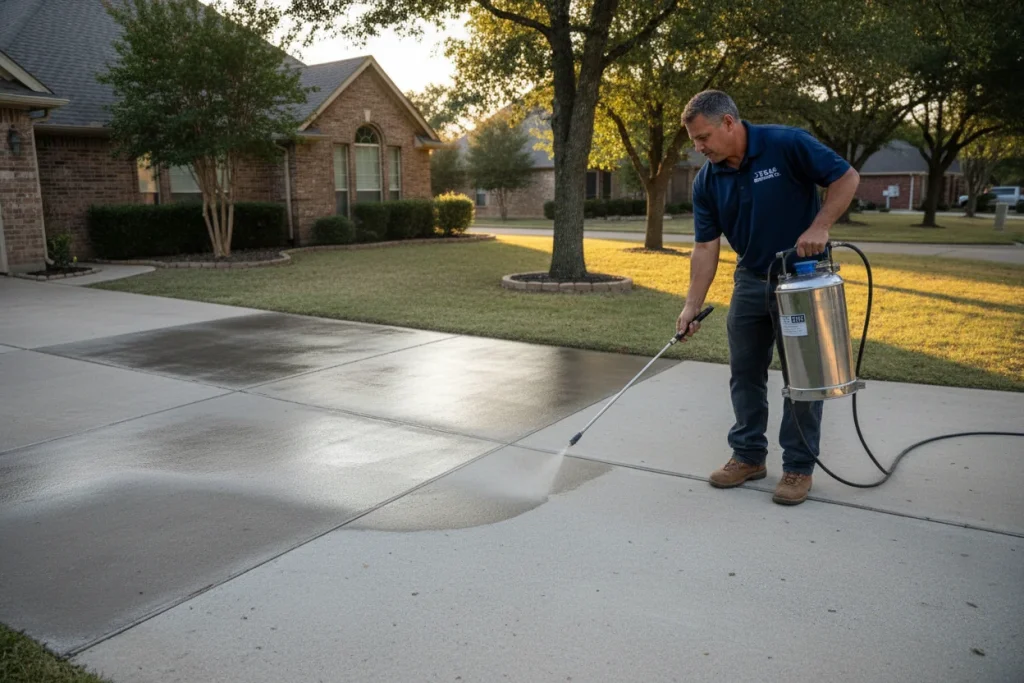
Sealing your concrete driveway every two to three years in North Texas creates a protective barrier against moisture penetration, UV damage, staining, and the freeze-thaw cycling that causes surface scaling — making it the single most impactful maintenance step you can take.
If cleaning is the maintenance foundation, sealing is the insurance policy. A quality concrete sealer fills the microscopic pores in the surface, preventing water from absorbing into the slab where it can freeze, expand, and pop off the top layer (a process called scaling or spalling). It also blocks automotive fluid penetration, reduces UV degradation of colored or stamped surfaces, and makes routine cleaning significantly easier.
Penetrating sealers (silane and siloxane formulations) absorb into the concrete rather than forming a film on top. They don't change the appearance of the surface, don't create a slippery finish when wet, and provide excellent moisture protection for three to five years per application. For standard broom-finish driveways in Denton County, penetrating sealers are the most practical choice.
Topical sealers (acrylics) form a visible film on the surface that enhances color and creates a slight sheen. They're popular on stamped and decorative concrete because they bring out the color and texture of the finish. The trade-off is that topical sealers require reapplication every one to two years in North Texas sun, and they can become slippery when wet unless you add a non-slip additive during application.
Polyurethane and epoxy sealers provide the highest level of protection but are typically reserved for garage floors and commercial applications rather than exterior driveways. They're more expensive, require meticulous surface preparation, and can yellow under UV exposure if the wrong formulation is used.
Timing matters more in North Texas than in milder climates. Apply sealer when the concrete surface temperature is between 50 and 90 degrees Fahrenheit. In Denton County, that typically means early to mid-spring (March through April) or early fall (late September through October). Avoid summer application — a 140-degree surface temperature causes the sealer to flash dry before it can penetrate, resulting in uneven coverage and poor adhesion.
The concrete must be completely dry for at least 48 hours before application. In North Texas, where afternoon thunderstorms can pop up with minimal warning during spring, check the extended forecast before scheduling your sealing day. Two dry days before and 24 hours of dry weather after application is the minimum.
Clean the driveway thoroughly first — sealer applied over dirt, oil, or organic residue traps those contaminants under the surface and creates adhesion failures. A pressure wash followed by 48 hours of drying is the ideal prep sequence. Apply the sealer with a pump sprayer for penetrating products or a roller for topical products. Work in thin, even coats — two thin coats outperform one heavy coat. Allow the first coat to absorb fully before applying the second, typically 30 to 60 minutes depending on temperature and humidity.
| Sealer Type | Best For | Appearance Change | Reapplication Interval | North Texas Suitability |
| Penetrating (silane/siloxane) | Standard broom-finish driveways | None — invisible protection | Every 3-5 years | Excellent — best all-around choice for Denton County |
| Topical (acrylic) | Stamped and decorative concrete | Enhances color, adds slight sheen | Every 1-2 years | Good — requires more frequent maintenance under Texas sun |
| Polyurethane/Epoxy | Garage floors, commercial applications | High gloss, significant color enhancement | Every 3-5 years | Not recommended for exterior driveways — UV yellowing risk |
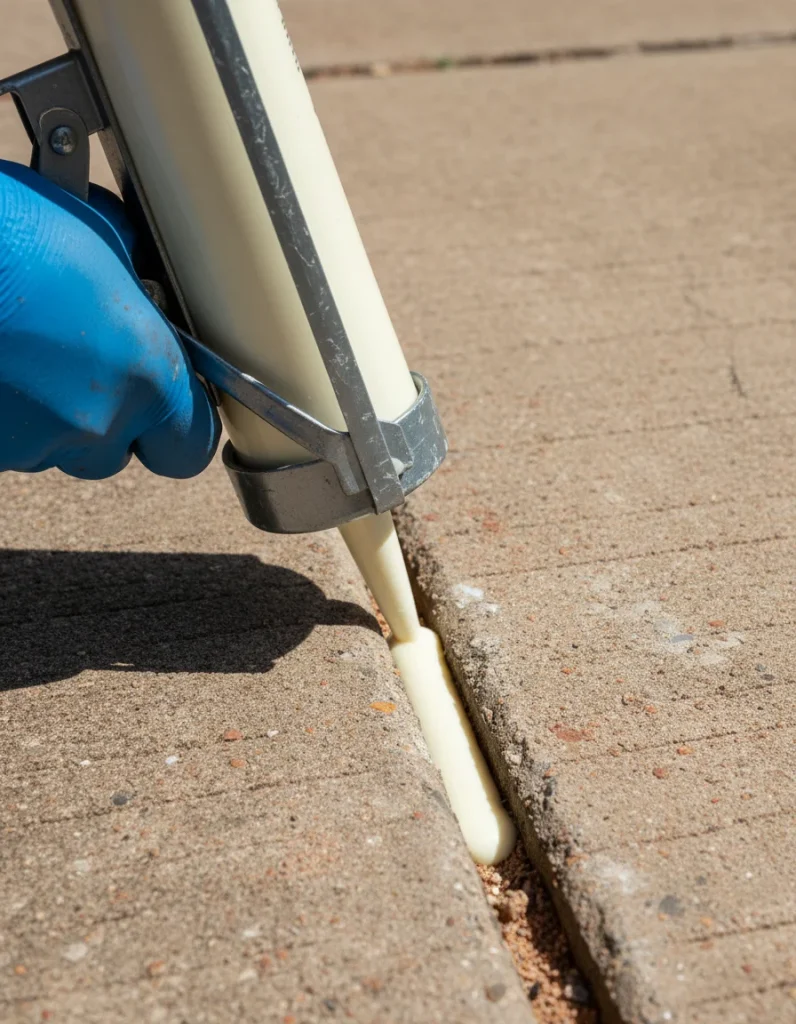
Cracks in a concrete driveway are inevitable — but their severity, location, and cause determine whether they need simple caulk, professional repair, or signal a deeper issue with the subgrade or foundation that requires expert evaluation.
Every concrete driveway will crack. The goal of maintenance isn't to prevent all cracks — it's to address them before they grow into structural problems. In North Texas, where clay soils shift with every weather cycle, crack management is particularly important.
Hairline cracks (less than 1/8 inch wide) are normal shrinkage cracks that develop as concrete cures and ages. They're cosmetic, not structural, and rarely require more than monitoring. If they don't grow over a year of observation, they're stable.
Control joint cracks are cracks that form along the tooled or saw-cut joints in your driveway — exactly where they were designed to appear. These joints create intentional weak points so that when the concrete contracts, it cracks neatly at the joint rather than randomly across the surface. Control joint cracks are normal and expected. They do need to be filled with a flexible sealant to prevent water infiltration, but they're not a defect.
Settlement cracks occur when the subgrade beneath the concrete shifts or compresses unevenly. In Denton County, this is almost always caused by expansive clay soils that shrink during dry periods and create voids beneath the slab. Settlement cracks are typically wider on one side, accompanied by a height difference between the two sides of the crack, and indicate that a section of the driveway has dropped. These require professional evaluation from experienced concrete driveway contractors near me — the crack itself is a symptom, not the underlying problem.
Structural cracks — wide, deep, or running in patterns that suggest the slab has broken into separate sections — indicate either a subgrade failure, insufficient reinforcement during original installation, or excessive loading. These are beyond DIY repair territory and require a professional assessment to determine whether the affected section can be repaired or needs replacement.
For hairline and control joint cracks up to 1/4 inch wide, a flexible polyurethane or silicone concrete caulk provides a durable, waterproof seal. Clean the crack thoroughly with a wire brush and compressed air to remove debris, then apply the caulk level with or slightly below the surrounding surface. Avoid rigid fillers like Portland cement patches — they crack again within a season because they can't flex with the concrete's thermal movement.
For cracks between 1/4 and 1/2 inch wide, use a foam backer rod inserted into the crack first, then apply the flexible caulk on top. The backer rod controls the depth of the sealant and creates the proper sealant-to-width ratio that allows the filler to flex without failing.
Call a professional when cracks are wider than 1/2 inch, when one side of the crack is higher than the other (indicating settlement), when cracks are expanding noticeably over time, or when you see a pattern of multiple cracks suggesting the slab has broken into separate sections. These conditions point to subgrade issues or structural failures that cosmetic repairs won't solve.
| Crack Type | Width | Cause | DIY or Professional | Action |
| Hairline | Less than 1/8 inch | Normal shrinkage during curing | Monitor (DIY) | Observe for one year — fill only if growing |
| Control joint | Varies | Designed weak point working correctly | DIY | Fill with flexible polyurethane caulk to prevent water entry |
| Settlement | 1/4 inch+ with height difference | Clay soil shrinkage creating voids | Professional | Requires subgrade evaluation — mudjacking or section replacement |
| Structural | Wide, deep, or patterned | Subgrade failure, insufficient reinforcement, or overloading | Professional | Assessment for section replacement or full rebuild |
North Texas weather creates a distinct four-phase maintenance cycle for concrete driveways — spring deep cleaning and sealing, summer stain management and heat protection, fall pre-winter preparation, and winter freeze-thaw vigilance.
Each season in Denton County brings specific threats to your concrete driveway. Rather than reacting to problems as they appear, a seasonal maintenance approach keeps you ahead of damage and avoids the expensive repairs that come from deferred maintenance.
Spring is your most important maintenance window. Start with a thorough pressure wash to remove winter grime, salt residue from any ice treatment, and organic buildup. Inspect all control joints and repair any that have opened or lost their existing filler. Apply sealer after the surface has dried for at least 48 hours — this is the ideal window before summer heat makes application impractical.
Summer maintenance focuses on stain management and protecting the surface from extreme heat. Clean oil and automotive fluid drips immediately — they penetrate unsealed or worn concrete within hours in 100-degree heat. If your driveway gets heavy tree sap or bird waste deposits, rinse weekly to prevent permanent staining. Avoid running a garden hose on hot concrete for extended periods — the rapid temperature change can cause surface stress, especially on older driveways.
Early fall provides a secondary sealing window if you missed spring. Clear fallen leaves promptly — tannins from live oak and pecan leaves (both common in Denton County) create stubborn brown stains if left sitting on wet concrete. Inspect all cracks and joints before winter arrives. Any crack that allows water entry will become a larger problem during freeze-thaw events.
Denton County typically experiences two to five freeze-thaw cycles per winter. Avoid using rock salt (sodium chloride) or calcium chloride de-icers on concrete — both accelerate surface scaling and spalling. If ice treatment is necessary, use sand for traction instead. Shovel or broom-sweep snow promptly to prevent meltwater from pooling in cracks and refreezing. Watch for any new cracks that appear during or after freeze events and address them in spring.
Apply a penetrating sealer every two to three years for standard broom-finish driveways. Topical acrylic sealers on stamped or decorative concrete require reapplication every one to two years due to faster UV degradation under North Texas sun.
Early to mid-spring (March through April) or early fall (late September through October) when surface temperatures are between 50 and 90 degrees. Avoid summer — surface temperatures exceeding 140 degrees cause sealer to flash dry and adhere poorly.
No. Rock salt and calcium chloride accelerate surface scaling and spalling on concrete. Use sand for traction instead. If ice treatment is absolutely necessary, magnesium chloride is the least damaging chemical option, but sand remains the safest choice.
Apply a concrete degreaser or a poultice of kitty litter and dish soap to fresh stains immediately. For set-in stains, use a commercial concrete oil stain remover with a stiff brush, let it dwell according to product directions, and rinse with a pressure washer.
Hairline cracks under 1/8 inch are normal and rarely need attention. Be concerned when cracks are wider than 1/4 inch, when one side is higher than the other (indicating settlement), or when multiple cracks form a pattern suggesting the slab has broken into sections.
Yes, but with caution. Use no more than 2,000 PSI with a wide fan tip, and maintain at least 18 inches of distance from the surface. Better yet, hire a professional who specializes in decorative concrete cleaning to avoid damaging the stamped pattern or color.
With proper maintenance, a well-installed concrete driveway in North Texas typically lasts 25 to 50 years. Without maintenance, the lifespan drops significantly due to moisture penetration, surface scaling, and crack expansion from the region's soil movement and weather cycles.
Surface flaking (spalling) is typically caused by moisture trapped in the concrete that freezes and expands, poor curing during original installation, excessive use of chemical de-icers, or applying sealer over a damp surface. Once spalling begins, professional resurfacing or section replacement is usually required.
Absolutely. Sealer applied over dirt, oil, or organic residue traps those contaminants under the surface, causing adhesion failures and uneven protection. A thorough pressure wash followed by 48 hours of drying is the ideal preparation before any sealer application.
Inspect control joints annually and refill any that have lost their existing caulk. Clean the joint with a wire brush and compressed air, insert foam backer rod for joints wider than 1/4 inch, and apply flexible polyurethane caulk level with the surrounding surface.
Maintaining a concrete driveway in North Texas isn't complicated — but it is specific to this region's conditions. The combination of expansive clay soils, extreme summer heat, severe weather, and winter freeze-thaw cycles creates maintenance demands that generic guides from other parts of the country don't address. A consistent routine of quarterly cleaning, annual pressure washing, sealer application every two to three years, and prompt crack repair keeps your driveway performing and looking its best for decades.When maintenance reveals something beyond a DIY fix — settlement cracks, widespread surface scaling, or structural issues — that's when a professional evaluation makes the difference between a targeted repair and a full replacement. If your concrete driveway needs professional assessment or repair, schedule a consultation with a Denton County concrete team that understands what these driveways go through and how to keep them lasting.


Whether you’re remodeling a home, expanding a business, or starting from the ground up, TriStar Built is here to guide you every step of the way. With a focus on craftsmanship, communication, and results that last, we make the construction process clear, smooth, and worth every investment.

LOCATION: 2126 James Street, Denton, TX 76205
PHONE: (940) 381-2222
© 2025 TRISTAR BUILT - ALL RIGHTS RESERVED | WEB DESIGN & SEO BY: Authority Solutions®