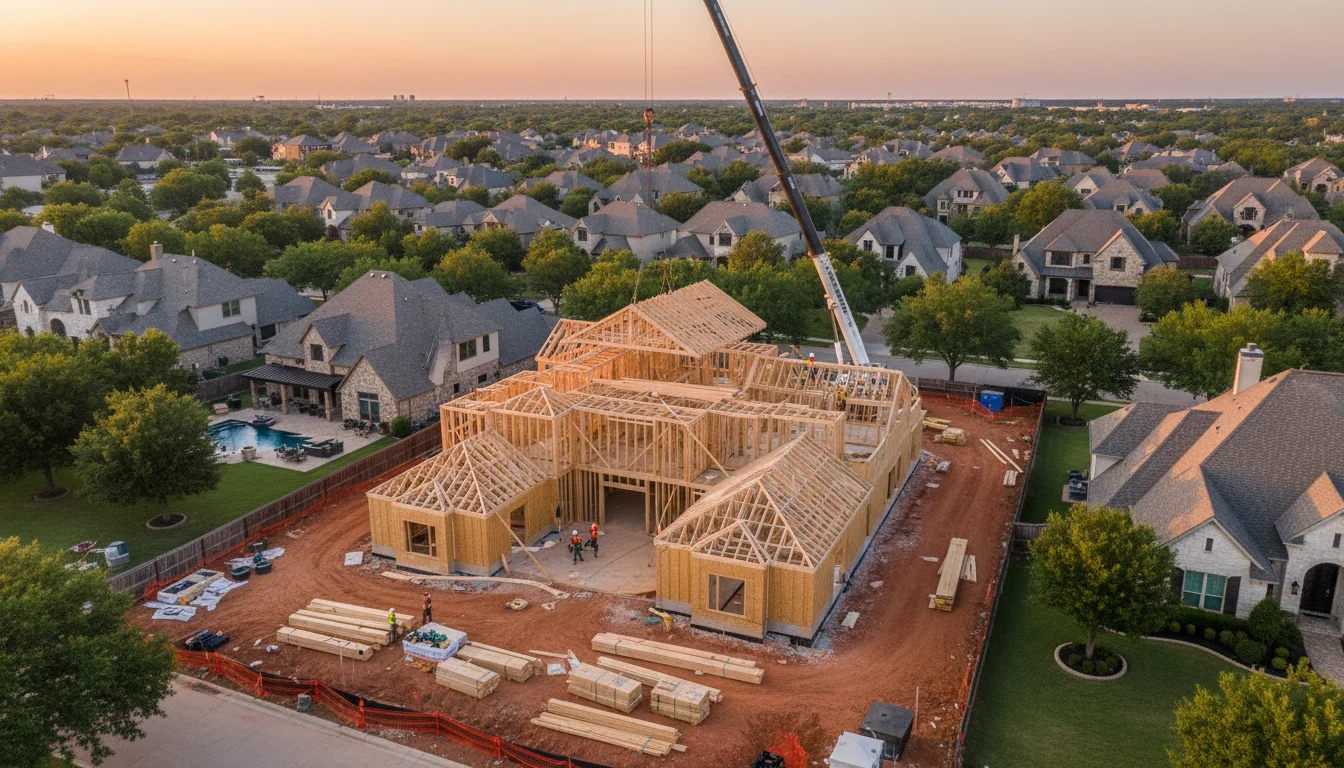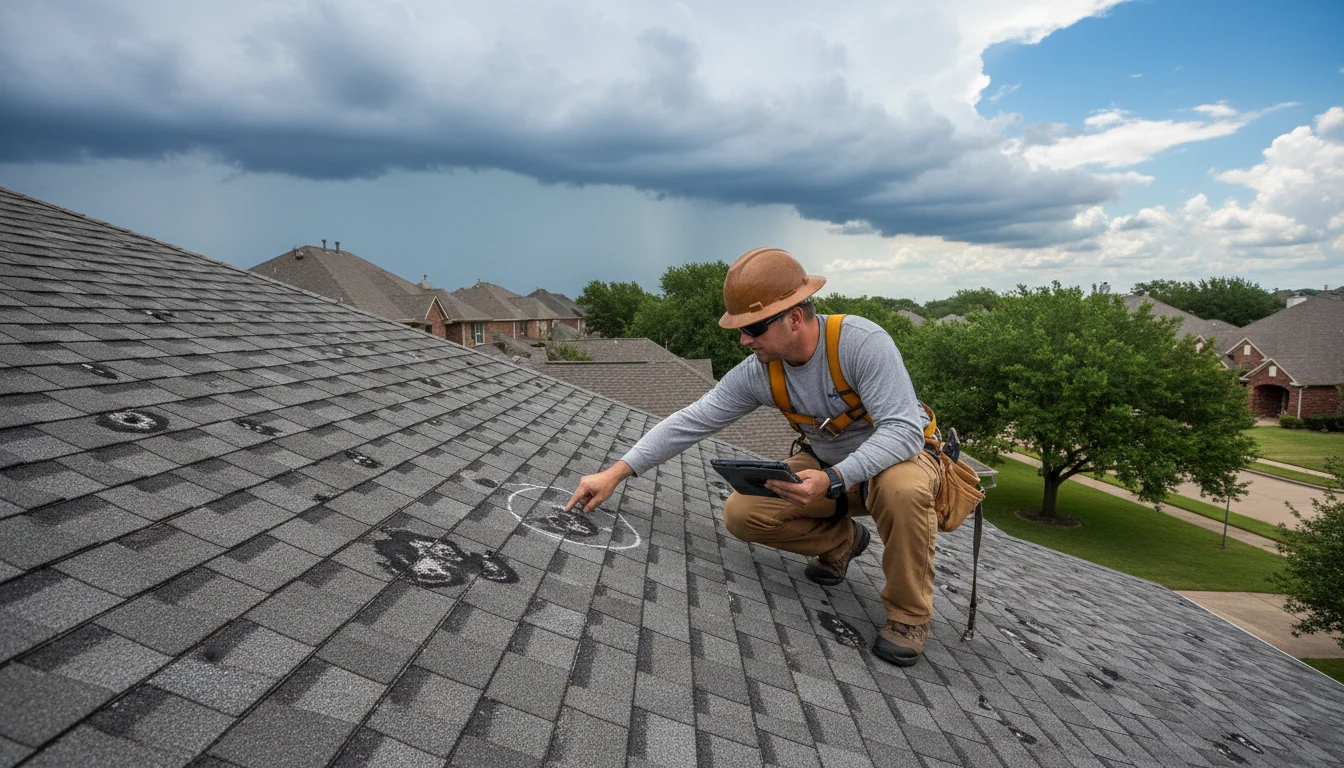
After hail damages your roof in Denton, TX, you should avoid walking on the roof yourself, document all visible ground-level damage with photos, contact your insurance company within 24 hours, and schedule a professional roof inspection with a local roofing contractor who can identify both visible and hidden hail damage before your adjuster arrives.
Hail is the single most destructive weather event for roofs in Denton County. Not tornadoes. Not straight-line winds. Hail. The region sits in one of the most active severe storm corridors in the country, and every spring and early summer brings multiple rounds of hail-producing supercells that can move through in twenty minutes and leave a trail of roofing damage across entire neighborhoods.
The challenge with hail damage is that it doesn't always announce itself. A tornado rips shingles off in sheets — you know immediately. Hail damage can be far more subtle. Shingles that look fine from the ground may have lost their protective granule coating, sustained hairline fractures in the fiberglass mat, or had their weatherproofing seal broken — all of which compromise the roof's ability to keep water out during the next rain. This guide covers exactly what to do after hail hits your Denton home, how to assess the damage, how the insurance claim process works for roofing repairs and replacement, and how to choose a contractor who won't leave you worse off than the storm did.
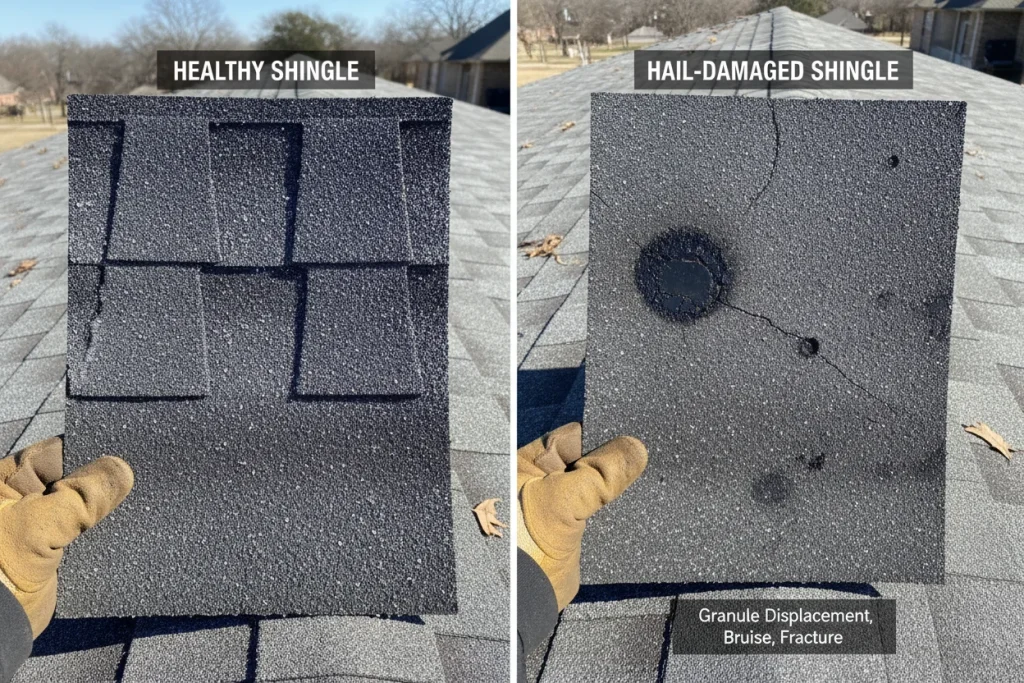
Hail damages asphalt shingles by displacing the protective granule layer, fracturing the underlying fiberglass mat, breaking the adhesive seal between shingle tabs, and denting or cracking flashing and ventilation components — much of which is invisible from ground level.
Understanding what hail actually does to a roof helps you see why professional inspection matters and why some damage that looks minor can cause serious long-term problems.
Every asphalt shingle is coated with ceramic granules that serve as the roof's first line of defense against UV radiation and water penetration. When hailstones strike, they knock these granules loose — exposing the asphalt layer underneath. Exposed asphalt degrades rapidly under the North Texas sun, accelerating the shingles' aging from a 25- to 30-year lifespan to a fraction of that. You can often spot granule loss from the ground by checking your gutters and downspout splash blocks for granule accumulation after a storm.
Beneath the granule coating and asphalt layer lies the fiberglass mat — the shingle's structural backbone. A hard enough hail impact fractures this mat, creating a weak point that allows water to penetrate through the shingle. The fracture is often not visible on the surface. It takes a trained inspector performing a hands-on evaluation — pressing on the shingle to feel the softened or broken mat beneath — to identify this type of damage.
Asphalt shingles are held in place by both nails and an adhesive seal strip that bonds each shingle tab to the one below it. Hail impacts can break this bond. Once the seal fails, the shingle tab is free to lift in the wind, exposing the nail heads and underlayment to direct rain. This is one of the most common pathways from "minor hail damage" to "active roof leak" — and it can happen weeks or months after the original storm event.
Hail doesn't only hit shingles. Metal flashing around chimneys, skylights, vent pipes, and roof-to-wall transitions absorbs impacts too. Dented or displaced flashing creates gaps that allow water to enter the roof system. Ridge vents, turbine vents, and pipe boots are also vulnerable — a cracked pipe boot from a hail strike is a direct pathway for water into your attic.
| Damage Type | What Happens | Visible from Ground? | Long-Term Consequence |
| Granule displacement | Protective coating knocked off, exposing asphalt layer | Sometimes — check gutters for granule accumulation | Accelerated UV degradation, premature shingle failure |
| Fiberglass mat fracture | Structural backbone of shingle cracked beneath surface | No — requires hands-on inspection | Water penetration through the shingle at fracture point |
| Seal strip failure | Adhesive bond between shingle tabs broken by impact | No — tabs may appear flat but are no longer bonded | Shingle tabs lift in wind, exposing nail heads and underlayment |
| Flashing and component damage | Metal dented or displaced, pipe boots cracked | Partially — large dents visible, cracks often are not | Direct water entry at penetration points into attic or wall cavity |
You can perform a ground-level assessment to spot obvious hail indicators — dented gutters, cracked siding, and damaged outdoor equipment — but a professional roof inspection is the only reliable way to identify the full scope of damage to shingles, flashing, and roofing components.
After a hailstorm passes through Denton, your first instinct may be to climb a ladder and inspect the roof yourself. Don't. Walking on a hail-damaged roof can worsen existing fractures, void manufacturer warranties, and create a safety hazard on compromised surfaces. Instead, work through a systematic ground-level check first, then bring in a professional.
Walk the perimeter of your home and look for these indicators. Dented gutters and downspouts are the easiest tell — if hail hit hard enough to dent aluminum gutters, it hit your shingles too. Check your AC condenser unit for dents on the top and sides. Look at painted wood surfaces, such as fence posts, deck rails, and window trim, for impact marks. Examine any outdoor furniture or vehicles for hail dings. Check siding for cracked or chipped sections. All of these ground-level signs correlate with roof damage above.
Look at your roof from across the street if possible. Use binoculars or your phone's zoom function. You're looking for visible missing shingles, shingles that appear darker than surrounding ones (indicating granule loss), lifted edges, or exposed underlayment. If you see any of these, the damage is already significant.
A professional hail damage inspection involves a trained inspector walking the roof surface, examining shingles at close range, testing for mat fractures by hand, checking seal strip integrity, inspecting every flashing point and penetration, and documenting findings with photographs and measurements that your insurance adjuster needs for claim processing.
Experienced roofing contractors in Denton who've worked through dozens of hail seasons know what damage patterns look like on different shingle types, brands, and ages. A five-year-old architectural shingle shows hail damage differently than a fifteen-year-old three-tab. Knowing those distinctions matters when determining whether your insurance claim covers repair, partial replacement, or full replacement.
Most reputable local roofing companies offer free hail damage inspections. They have a financial incentive to find damage, but a legitimate company documents honestly rather than exaggerating. If a roofer tells you that your roof needs full replacement after every storm, regardless of severity, find a different roofer. If they provide detailed documentation with measurements and photos showing specific damage patterns, you're working with someone you can trust.
| Assessment Level | Who Does It | What It Covers | What It Misses |
| Ground-level homeowner check | You | Dented gutters, cracked siding, AC unit damage, and visible missing shingles | Granule loss patterns, mat fractures, seal failures, flashing cracks |
| Professional roof inspection | Qualified roofing contractor | Full shingle-by-shingle evaluation, flashing, components, and photo documentation | Nothing — this is the comprehensive assessment |
| Insurance adjuster inspection | Carrier-assigned adjuster | Scope and pricing for approved claim using Xactimate | May miss damage your contractor identified, which is why both should be present |
Filing a successful hail damage roofing claim in Denton requires prompt reporting, thorough professional documentation, understanding your wind and hail deductible, and having your roofing contractor present during the adjuster's inspection to ensure the full scope of damage is captured in the estimate.
Insurance is what makes most hail damage roof repairs and replacements financially manageable. But the claims process has specific requirements, timelines, and nuances that homeowners often don't learn until they're already in the middle of a dispute. Here's how to navigate it correctly from the start.
Contact your insurance carrier within 24 hours of the storm. You don't need a professional inspection before filing — you just need to report that you believe your property sustained hail damage and request an adjuster assignment. Provide the storm date, your policy number, and the ground-level documentation you gathered. The carrier assigns a claim number and schedules an adjuster visit, which can range from a few days to several weeks during major storm events.
Here's where the process either works for you or against you. The adjuster inspects your roof and prepares an estimate using Xactimate. Your roofing contractor should also prepare their own Xactimate estimate. When your contractor is present during the adjuster's inspection, they can walk the roof together, identify damage the adjuster might miss, and discuss the scope in real time. This collaboration typically results in more accurate initial estimates and fewer supplements down the road.
If the adjuster's estimate comes in lower than your contractor's, you have options. Your contractor can submit a detailed supplement — additional documentation showing damage or scope items the adjuster's estimate didn't include. Most carriers have a formal supplement review process. If that fails, your policy likely includes an appraisal clause for unresolved disagreements.
This is the number that catches many Denton homeowners off guard. Most Texas homeowner's policies now carry percentage-based wind and hail deductibles — typically one to two percent of the dwelling coverage amount. On a home insured for $450,000, a two percent deductible means $9,000 out of pocket before insurance coverage applies. That's significantly higher than the flat $1,000 or $2,500 deductibles that used to be standard.
Know your deductible before storm season. It affects whether a claim is worth filing (if the damage estimate barely exceeds your deductible, filing may not make financial sense) and how to budget for the homeowner's share of the repair cost.
Insurance carriers approve roof repairs when hail damage is limited to a specific area and the rest of the roof remains intact. They approve full replacement when damage is widespread across enough of the roof surface that repairs can't restore the system to its pre-storm condition. The threshold varies by carrier and policy, but the determining factor is always whether the damage compromises the roof's functional integrity — not just its cosmetic appearance.
For roof replacement contractors near me searches after a major hailstorm in Denton, understand that a full replacement often includes not just shingles but underlayment, flashing, ventilation components, drip edge, and pipe boots. A contractor who quotes only shingles is leaving critical components out of the scope.
| Claims Step | What Happens | Your Best Move |
| File the claim | The carrier assigns a claim number and an adjuster | File within 24 hours with ground-level documentation |
| Adjuster inspection | Adjuster walks the roof and prepares an Xactimate estimate | Have your roofing contractor present to ensure complete damage documentation |
| Estimate comparison | Adjuster's estimate may differ from the contractor's | Compare line-by-line and identify any missing items or scope gaps |
| Supplement if needed | Contractor submits additional documentation for the missed damage | Provide detailed photos, measurements, and Xactimate line items |
| Approval and payment | Carrier releases payment minus deductible | Confirm the approved scope covers all necessary components, not just shingles |
The right hail damage roofer in Denton is a locally established company that performs honest inspections, prepares Xactimate estimates aligned with your insurance carrier's process, installs quality materials rated for North Texas storms, and backs their work with both manufacturer and workmanship warranties.
This is the decision that determines whether your storm recovery goes smoothly or becomes a disaster of its own. After every significant hailstorm in Denton County, the competition for your roofing dollar intensifies dramatically — and not all competitors are playing the same game.
Out-of-town crews arrive within days of a major hail event. They canvass neighborhoods with door-knocks and yard signs, offering free inspections and assurances that "insurance covers everything." Some are competent companies that travel to storm-affected areas. But many cut corners on materials, rush installations to maximize volume, and disappear before warranty issues surface. Their business model depends on speed and volume, not on long-term quality or client relationships.
A local Denton roofing contractor operates on the opposite model. Their business depends on reputation, referrals, and repeat clients. They can't afford a bad installation because the homeowner lives in the same community — and so do their future clients. When you search for roof repair near me after a hailstorm, prioritize companies that meet every item on this checklist.
Verify current insurance with general liability and workers' compensation — call the carrier to confirm. Confirm a physical business address in Denton County that you can visit. Ask for references specifically from hail damage roofing projects, not just general roofing work. Confirm they prepare their own Xactimate estimates and are willing to be present during the adjuster's inspection. Ask what shingle products they recommend and why — the answer should include Class 4 impact-resistant options from recognized manufacturers. And verify their warranty terms: a manufacturer's warranty covers material defects, but a separate workmanship warranty from the contractor covers installation quality. You need both.
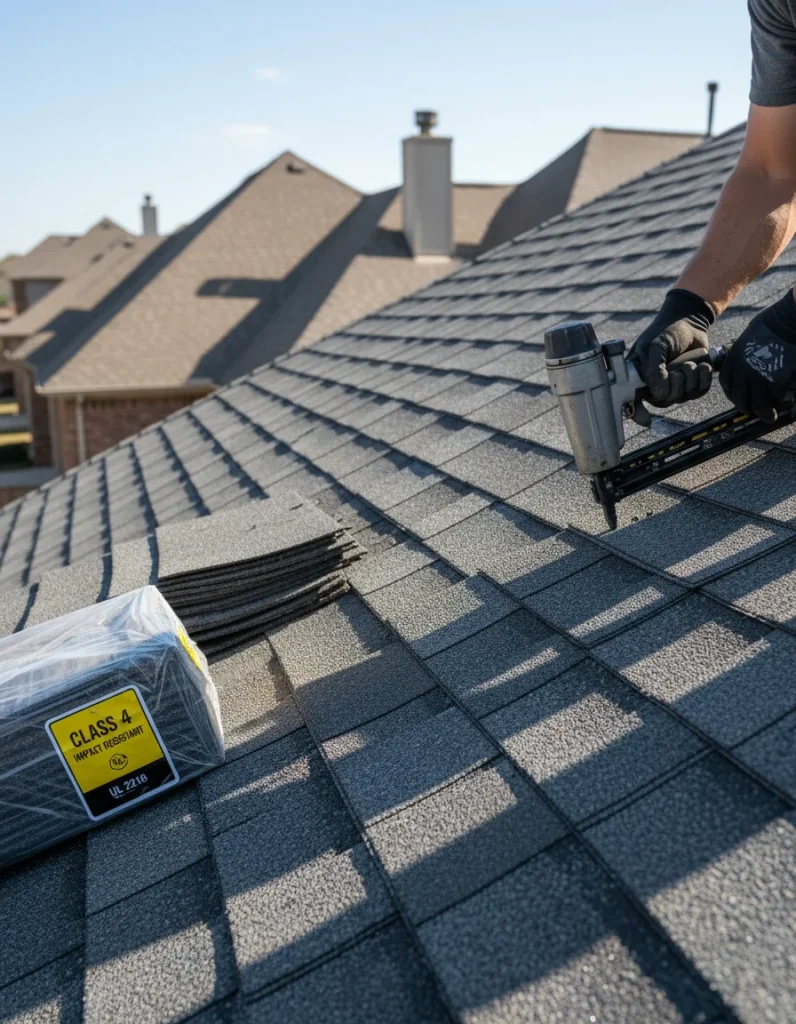
If your roof is being replaced after hail damage, this is your opportunity to upgrade to Class 4 impact-resistant shingles. These shingles are tested under UL 2218 standards, withstanding impacts from a two-inch steel ball dropped from 20 feet. In Denton County's hail-prone climate, Class 4 shingles provide measurably better protection against future storms and typically qualify homeowners for insurance premium discounts that help offset the incremental material cost over time.
Not every roofing contractor stocks or recommends Class 4 products. Some default to standard architectural shingles because they're cheaper and faster to source. A contractor who proactively recommends impact-resistant materials for a Denton County roof is one who's thinking about your long-term protection, not just closing the current job.
Check ground-level indicators first: dented gutters, cracked siding, dings on your AC unit, and granule accumulation in downspout splash blocks. From across the street, look for missing or dark-colored shingles. A professional roof inspection is required to identify hidden damage like mat fractures and seal strip failures.
No. Walking on a hail-damaged roof can worsen existing fractures, void manufacturer warranties, and create safety hazards. Perform a ground-level assessment and schedule a professional inspection with a qualified roofing contractor.
File within 24 hours of the storm. You don't need a professional inspection before filing a report that you believe hail damage occurred and request an adjuster. Prompt filing secures your place in the inspection queue during busy storm seasons.
Class 4 shingles are rated under the UL 2218 testing standard, meaning they withstand impacts from a two-inch steel ball dropped from 20 feet. They offer the highest hail resistance rating for asphalt shingles and often qualify Denton County homeowners for insurance premium discounts.
Insurance approves full replacement when hail damage is widespread enough that repairs can't restore the roof to its pre-storm functional condition. Limited or localized damage typically results in repair approval. Your contractor's documentation and the adjuster's assessment together determine the outcome.
Most residential roof replacements in Denton County take one to three days for the installation itself. The total timeline from storm to completion is longer — typically four to eight weeks when accounting for inspection scheduling, insurance processing, material ordering, and crew availability.
Instead of a flat dollar amount, your deductible is a percentage of your dwelling coverage. A two percent deductible on a $450,000 home means you pay $9,000 out of pocket. Check your policy declarations page for your specific wind and hail deductible percentage.
Yes. Your roofing contractor can identify damage the adjuster might miss, discuss scope in real time, and ensure the Xactimate estimate reflects the full extent of damage. This collaboration typically produces more accurate initial estimates and fewer disputes.
Verify a physical Denton County business address, check their Texas Secretary of State registration, confirm current insurance by calling the carrier directly, ask for local hail damage references from before the current storm event, and never sign a contract with anyone who appeared uninvited at your door.
A complete replacement includes tear-off and disposal, new underlayment, ice-and-water shield at critical areas, new shingles, all new flashing, drip edge, ridge vent, pipe boots, and ventilation components. A quote that only covers shingles is incomplete.
Hail damage is a fact of life for Denton County homeowners. The storms aren't going anywhere, and neither is the risk they pose to your roof. But the outcome — whether you end up with a properly restored roof that protects your home for decades or a rushed repair that fails at the next storm — depends entirely on the decisions you make in the days after the hail stops falling.Document the damage before you clean up. File your claim promptly. Get a professional inspection from a local roofer who knows what hail damage looks like on every shingle type common in this market. And choose a contractor whose business model depends on getting it right — not on getting it done fast and moving to the next storm-hit city. If your Denton home took hail damage and you want an honest assessment from a team that's been handling North Texas storm roofing since 2006, schedule your inspection.


Whether you’re remodeling a home, expanding a business, or starting from the ground up, TriStar Built is here to guide you every step of the way. With a focus on craftsmanship, communication, and results that last, we make the construction process clear, smooth, and worth every investment.

LOCATION: 2126 James Street, Denton, TX 76205
PHONE: (940) 381-2222
© 2025 TRISTAR BUILT - ALL RIGHTS RESERVED | WEB DESIGN & SEO BY: Authority Solutions®