Texas does not issue a state license for general or concrete contractors, so there is no license number to verify for most driveway work. Instead, verification means confirming three things: a registered business entity through the Texas Secretary of State, general liability insurance and workers' compensation through certificates issued directly by the contractor's insurance agent, and any city-level registration your municipality requires. The single most important step is getting a certificate of insurance straight from the agent, not a copy from the contractor's files.
One of the most common misunderstandings among North Texas homeowners is the belief that their concrete contractor holds a "state contractor's license." For most residential concrete work, that license does not exist. Texas does not license general contractors or concrete contractors at the state level, which surprises people who have moved here from states that do. That gap does not mean anything goes. It means the responsibility for verification shifts onto you, the homeowner.
TriStar Built has worked across Denton County since 2006, and we field this question constantly: how do I check that this contractor is legitimate? This guide walks through exactly what to verify in Texas, what documents to request, how to confirm they are real, and what to do when something does not check out. The process is straightforward once you know that licensing is not the lever. Insurance, business registration, and local rules are.
Texas regulates certain trades but not general or concrete contracting. Plumbers, electricians, and HVAC technicians must hold state licenses through the Texas Department of Licensing and Regulation or their respective boards. A concrete driveway contractor pouring a residential slab generally does not need a state trade license at all.
| Trade | State License Required? | Where to Verify |
|---|---|---|
| Electrician | Yes | Texas Department of Licensing and Regulation |
| Plumber | Yes | Texas State Board of Plumbing Examiners |
| HVAC | Yes | Texas Department of Licensing and Regulation |
| General contractor | No state license | Business registration, insurance, local rules |
| Concrete / driveway contractor | No state license | Business registration, insurance, local rules |
This is why "Are you licensed?" is the wrong opening question for a concrete contractor in Texas. The right questions are about business registration, insurance, and any city requirements. For the broader context on hiring under this no-license framework, our full guide to hiring a contractor in Texas lays out the bigger picture.

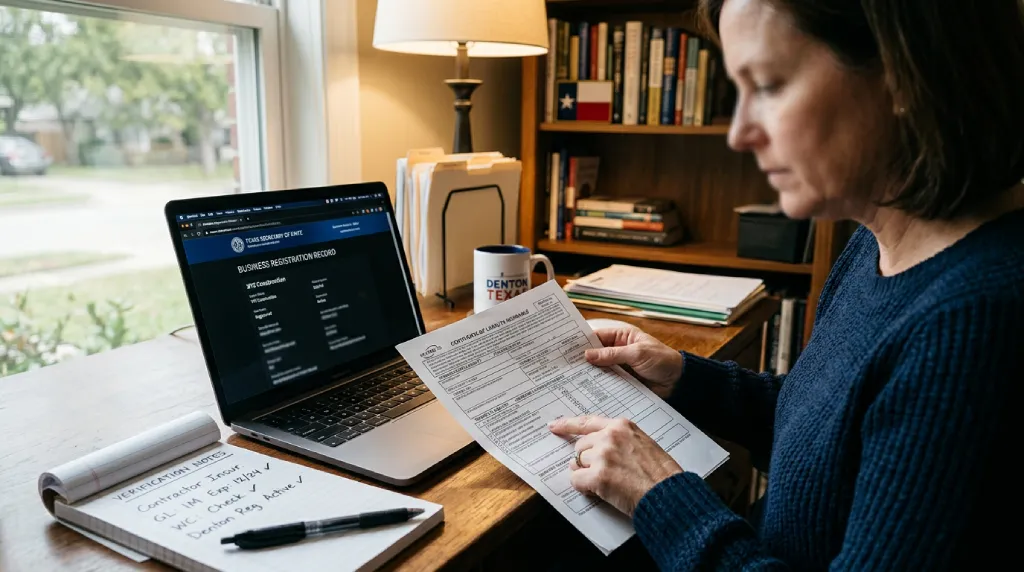
Start by confirming that the contractor is a registered business, not just a name on a truck. The Texas Secretary of State and the Texas Comptroller both maintain searchable records of registered entities.
Look for the legal business name (which may differ from the brand name), the entity type (LLC, corporation, sole proprietorship), the registration status (active vs forfeited), and how long the entity has existed. A company that has been registered and active for many years has a different risk profile than one formed last month. You can search business filings through the Texas Secretary of State and confirm franchise tax standing through the Texas Comptroller.
A registered, long-standing entity is not a guarantee of quality, but an unregistered "business," a forfeited entity, or a name that does not appear anywhere is a serious warning. It often means there is no real company standing behind the warranty or available for recourse if something goes wrong.
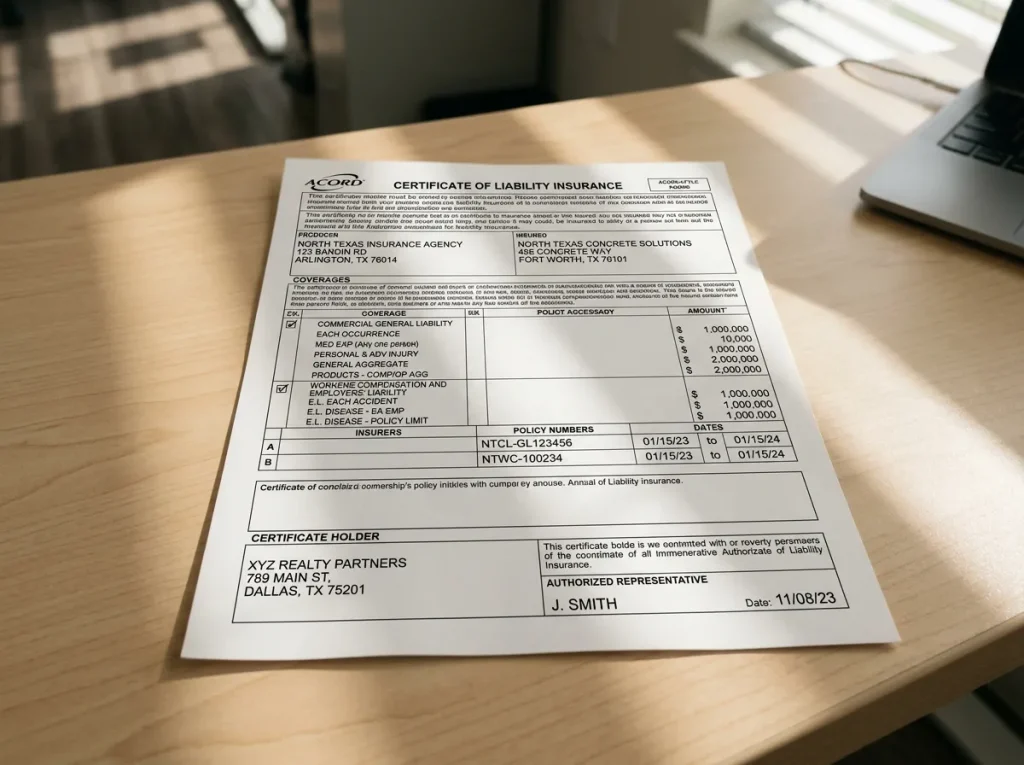
Insurance is the most important verification for a concrete contractor, and it is also the one most often faked or misrepresented. Two coverages matter:
The critical detail is how you verify it. Do not accept a PDF or paper copy that the contractor hands you, because those are easy to alter or expire. Instead, ask for a certificate of insurance (COI) issued directly by the contractor's insurance agent, sent to you, ideally naming you as a certificate holder for the duration of the project. The agent's certificate is a verifiable document. You can confirm the insurer itself is licensed in Texas through the Texas Department of Insurance.
A contractor who hesitates to have their agent send a certificate directly is showing you something important before any concrete is poured. This is one of the clearest signals separating professionals from fly-by-night operators, and it is one of the key questions every homeowner should ask before hiring.
While Texas has no state contractor license, individual cities sometimes require contractors to register locally or pull permits for certain work, and HOAs frequently require architectural review for driveway changes.
Requirements vary across Denton County. Some municipalities require a permit for new or expanded driveways or for work that changes drainage, while in-kind replacement may not need one. Many planned communities in Argyle, Flower Mound, Highland Village, Corinth, and Lantana require architectural review committee approval for driveway projects, especially decorative finishes. A professional contractor checks these requirements before bidding and either handles the permit or lists it as a line item.
Confirming local requirements does two things: it ensures your project is compliant, and it tests whether the contractor actually knows the local landscape. A contractor unfamiliar with your city's rules or dismissive of HOA review is one who has not worked in your area enough to be trusted with a 30-year investment.
Document verification should be paired with reputation verification. Once you have confirmed the business is registered and insured, check how the company actually performs:
Reputation research deserves its own careful process, which we cover in depth in our guide to checking a contractor's reviews and references. The point here is that documents and reputation are two halves of the same verification. A registered, insured company with a trail of unresolved complaints is still a problem.
If a contractor cannot produce an agent-issued certificate of insurance, cannot be found in business records, or refuses to discuss local permit requirements, treat those as decisive. You are not being difficult by asking; you are doing exactly what the absence of state licensing requires of Texas homeowners.
The cost of skipping verification is real. If an uninsured contractor damages your property or an uninsured worker is hurt on your lot, the financial exposure can dwarf the price of the driveway. If an unregistered "business" disappears after a bad pour, there is no entity to pursue and no warranty to enforce. Verification takes an afternoon. The consequences of skipping it can last for years.
No. Texas does not issue a state license for general or concrete contractors. Licensed trades in Texas include electricians, plumbers, and HVAC technicians, but a residential concrete driveway contractor generally needs no state trade license. This is why verification focuses on business registration, insurance, and local requirements rather than a license number.
Ask the contractor's insurance agent to send you a certificate of insurance (COI) directly, ideally naming you as a certificate holder for the project. The agent-issued certificate is the verifiable document; a PDF or paper copy from the contractor can be altered or expired. The certificate should show general liability of at least $1 million and, ideally, workers' compensation. You can confirm the insurer is licensed through the Texas Department of Insurance.
At minimum, general liability insurance with a $1 million limit, which protects you if the contractor damages your property. Workers' compensation is also valuable because it protects you if a worker is injured on your property. Texas does not require most private employers to carry workers' comp, so a contractor who does carry it is signaling a more serious, professional operation.
Search the Texas Secretary of State for the registered entity and the Texas Comptroller for franchise tax standing. Confirm the legal business name, entity type, active status, and how long it has existed. A long-established, active entity is far lower risk than a newly formed or forfeited one or a name that does not appear in any business records at all.
It depends on your municipality and the scope of work. Some Denton County cities require permits for new or expanded driveways or work that alters drainage, while in-kind replacement may not. Many HOAs also require architectural review for driveway changes. A professional contractor checks these requirements before bidding and either handles the permit or lists it as a line item.
Treat it as a decisive warning and do not proceed. A refusal to have their agent send a certificate of insurance usually means the coverage does not exist, is inadequate, or has lapsed. Hiring an uninsured contractor exposes you to liability for property damage and worker injuries that can far exceed the cost of the driveway itself.
In a state that does not license concrete contractors, verification is not optional homework. It is the protection that licensing would otherwise provide, and it falls to you. The good news is that it is quick and decisive: confirm the registered business, get an agent-issued certificate of insurance, check local requirements, and verify reputation. A legitimate North Texas contractor will make every one of those steps easy.
If you are vetting concrete contractors in Denton, Argyle, Flower Mound, Highland Village, Corinth, or anywhere across Denton County and want help knowing what to verify and how, TriStar Built is glad to help. When you are ready to talk to a verified, insured local team, meet our concrete driveway crew. Call (940) 381-2222 or visit www.tristarbuilt.com. We have been a registered, insured North Texas business since 2006, and we are happy to show you exactly what proper verification looks like.


Whether you’re remodeling a home, expanding a business, or starting from the ground up, TriStar Built is here to guide you every step of the way. With a focus on craftsmanship, communication, and results that last, we make the construction process clear, smooth, and worth every investment.

LOCATION: 2126 James Street, Denton, TX 76205
PHONE: (940) 381-2222
© 2025 TRISTAR BUILT - ALL RIGHTS RESERVED | WEB DESIGN & SEO BY: Authority Solutions®