Concrete slab pour day is a fast, choreographed sequence that turns months of planning into a permanent foundation in a single morning. On a Denton residential slab, the day runs from an early truck arrival through placement, screeding, bull floating, edging, jointing, and final finishing, often wrapped up by early afternoon. The homeowner's job is to understand the rhythm, know what a good pour looks like, and watch a few key quality checks: slump, timing, finishing discipline, and joint layout.
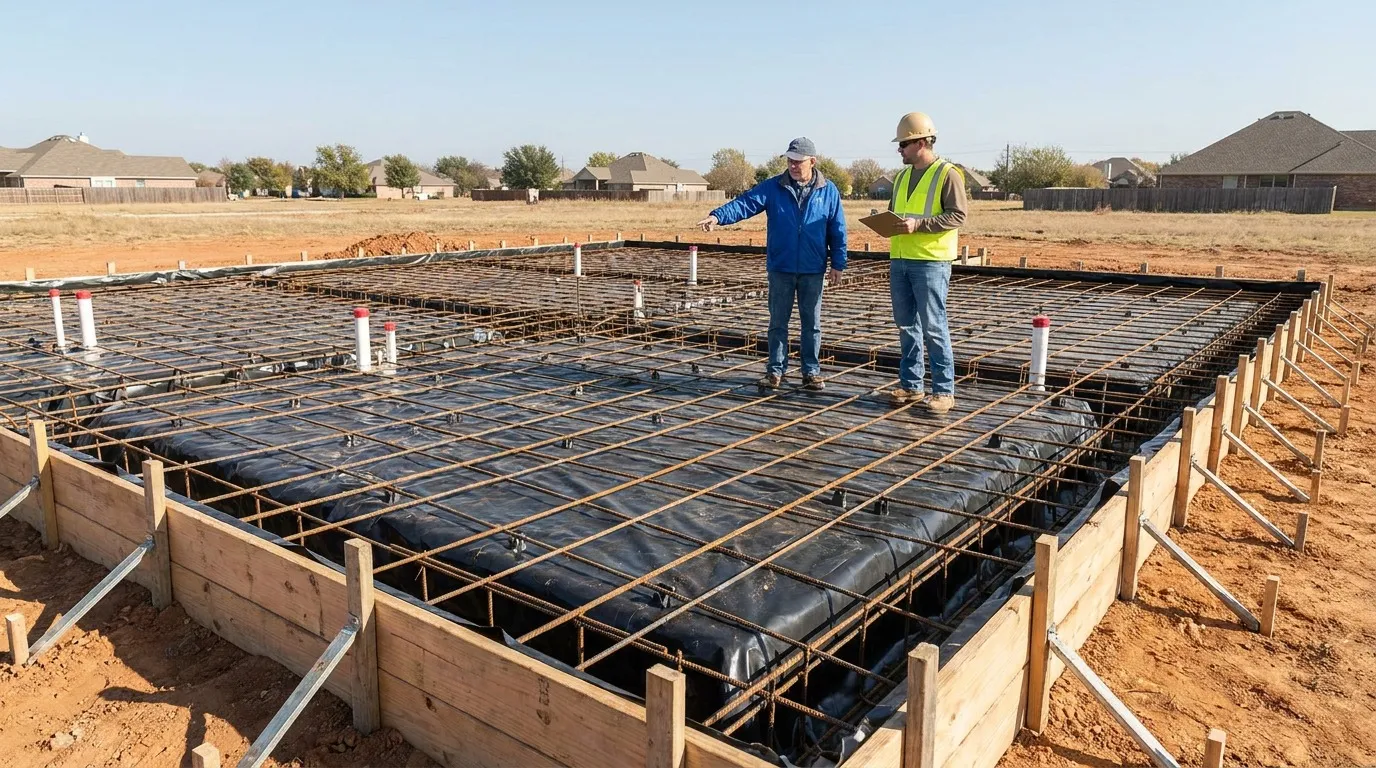
After the forms are set, the steel is tied, and the pre-pour inspection is signed off, pour day arrives with surprising speed. Concrete is a material on a clock. From the moment it leaves the batch plant, chemistry is running, and the crew has a limited window to place, consolidate, and finish it before it stiffens. To a homeowner watching for the first time, the scene can look like controlled chaos.
It is actually a well-rehearsed sequence, and knowing that sequence lets a homeowner tell the difference between a smooth, disciplined pour and a rushed one. This guide from TriStar Built walks through a Denton slab pour hour by hour, explains each finishing stage, and points out what is worth watching for, since the foundation carries the whole house once the trucks leave.
Pour day is one milestone in the larger sequence of how a slab foundation goes in start to finish, and everything about a good pour is decided before the first truck backs up. The forms and reinforcement are already verified, ideally at a documented pre-pour inspection the day before. The crew has confirmed the concrete order with the ready-mix supplier: the mix design, the total yardage, and the delivery timing so trucks arrive in a steady rhythm rather than all at once or with long gaps.
The team also has a placement plan. On a residential slab, that means deciding where the trucks will discharge, whether a pump or chutes will move the concrete, and the order in which the footprint gets filled. Weather is part of this planning too. Denton summers push the crew to start early, and the National Weather Service forecast for the Fort Worth area drives decisions about start time and evaporation control.
A residential slab pour moves through the same stages in the same order every time. Here is what each one looks like.
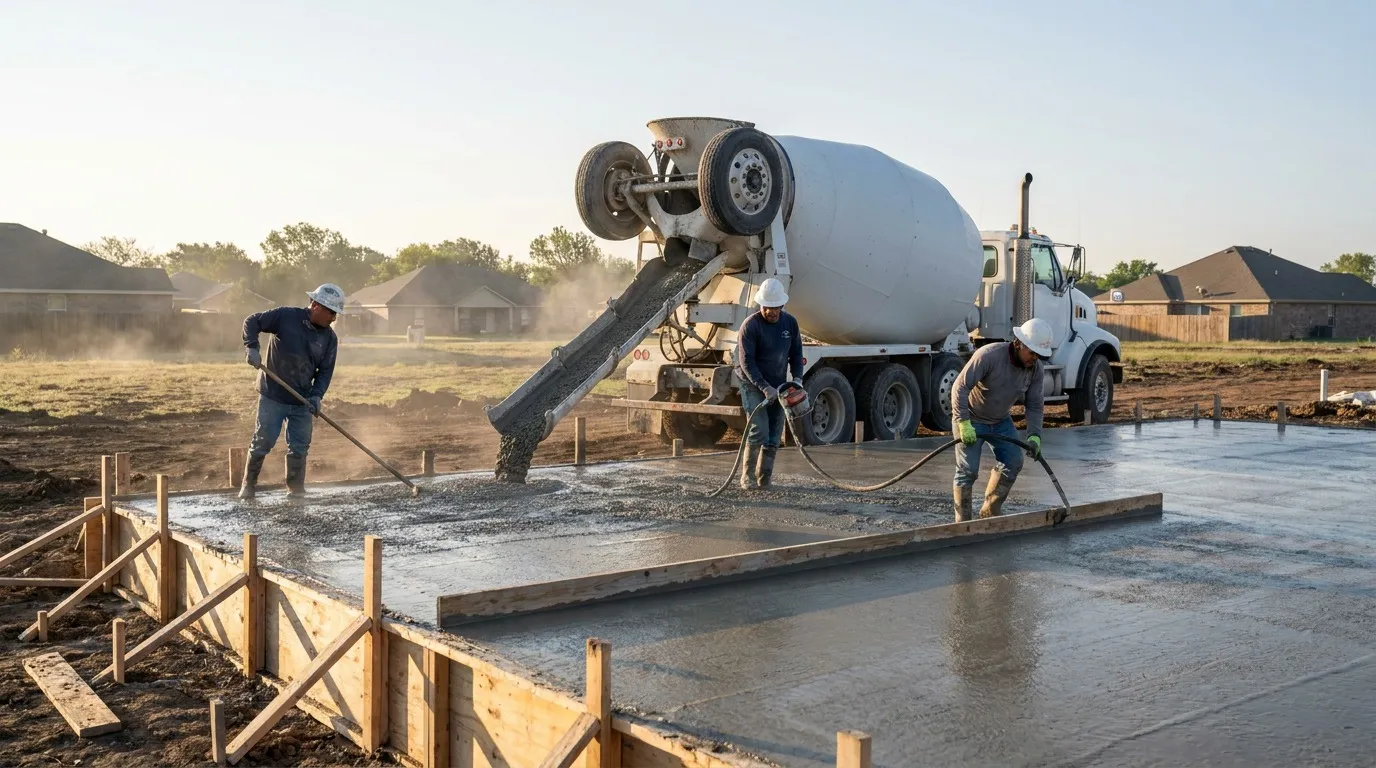
Concrete is discharged into the forms, guided by the crew, and roughly leveled with rakes and come-alongs. The goal is to fill the entire footprint to near the finished elevation without over-working the mix or letting it pile in one place. As concrete goes in, workers consolidate it, especially around grade beams and reinforcement, so there are no voids.
Once an area is filled, a straightedge (the screed) is drawn across the top of the forms to strike off the excess and bring the surface to the correct elevation. This is what makes a slab flat and level. Screeding happens continuously, right behind placement, because the concrete has to be worked while it is still plastic.
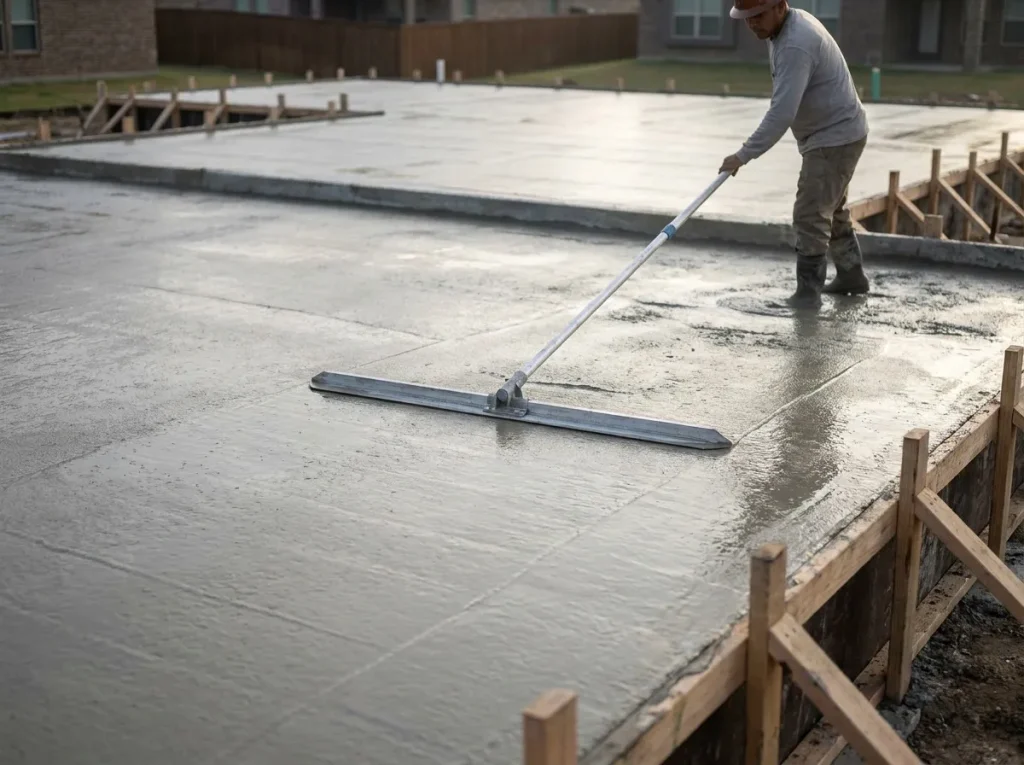
Immediately after screeding, a wide bull float is passed over the surface to knock down ridges, fill small low spots, and begin embedding the coarse aggregate just below the surface. This is the first smoothing pass and it has to happen before the surface starts to firm up.
The crew tools the slab edges for a clean, durable perimeter, then establishes control joints. Joints are the planned lines where the slab is allowed to crack as it shrinks during curing. Cutting or tooling them at the right spacing is how a builder controls cracking instead of leaving it to chance.
As the surface loses its sheen and firms up, the crew makes the final finishing passes. For most residential slabs that will be covered by flooring, a smooth float or trowel finish is standard; a broom finish adds slip resistance for exposed exterior slabs. Timing here is everything, because finishing too early traps bleed water and finishing too late is impossible.
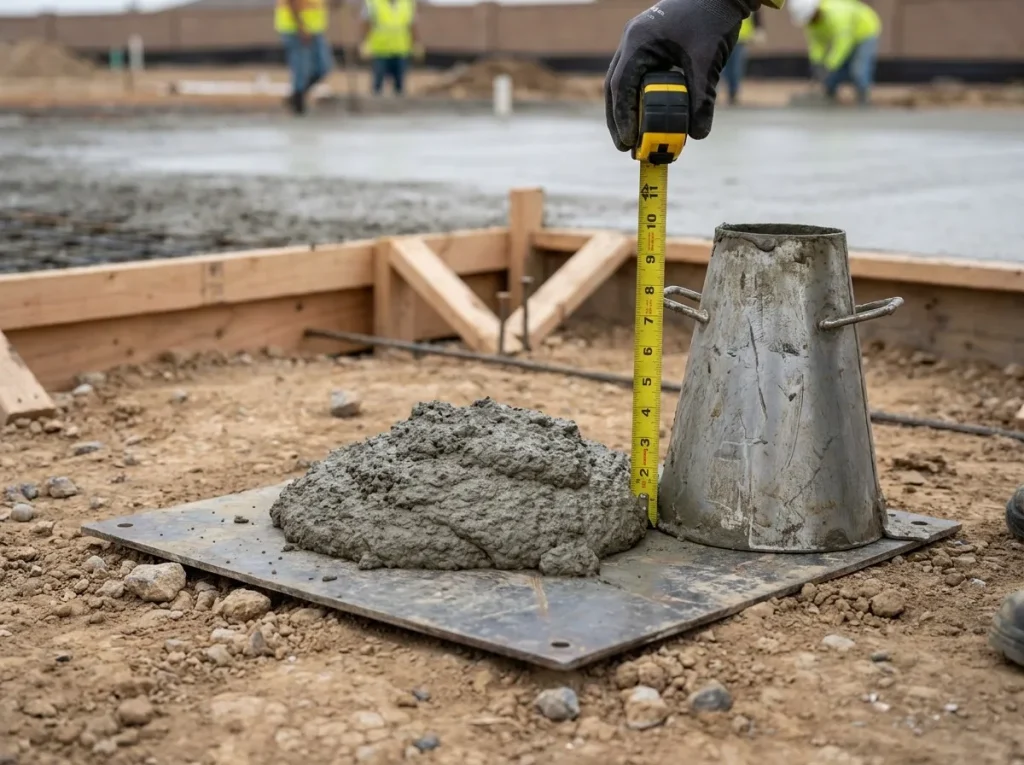
A homeowner does not need to run tests, but knowing which checks a good crew performs helps confirm quality.
| Check | What It Confirms | When It Happens |
|---|---|---|
| Slump test | The concrete has the specified workability and water content | At truck arrival, before placement |
| Test cylinders | Samples cast to verify strength at 7 and 28 days | Early in the pour, on spec jobs |
| Placement timing | Concrete placed within the allowable time from batching | Throughout the pour |
| Finishing timing | Each pass made at the correct stage of set | Continuously as the surface firms |
| Joint layout | Joints spaced to control shrinkage cracking | During jointing stage |
The slump test is the most visible one: the crew fills a cone with fresh concrete, lifts it, and measures how far the concrete "slumps." Too wet and the slab loses strength and durability; too dry and it is hard to place and finish. This is a routine reference in the American Concrete Institute standards that govern slab work, summarized on the American Concrete Institute site. On larger or engineered jobs, the crew also casts test cylinders that a lab breaks at 7 and 28 days to confirm the concrete reached its design strength.
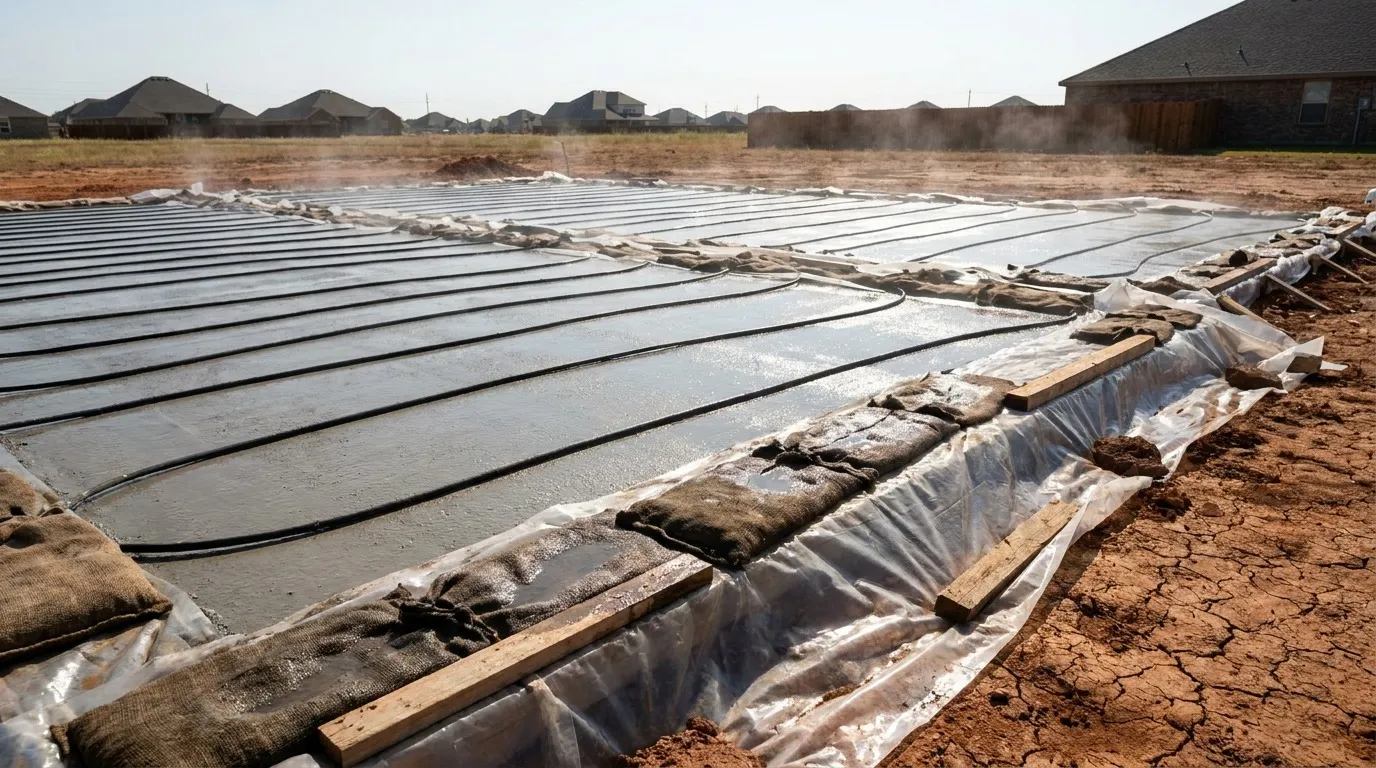
Summer in Denton is not a normal pour environment. High temperatures, low humidity, and wind all speed up evaporation and setting, which can cause plastic shrinkage cracking and make finishing a race against the clock. A disciplined crew adapts: starting at or before dawn, scheduling trucks tightly, keeping the subgrade damp, using evaporation retarders or fog spray, and being ready to begin curing the instant finishing ends.
This is exactly why the days after the pour matter as much as the pour itself. Curing a slab correctly in North Texas heat is its own discipline, covered in our guide to how the slab is cured afterward. A perfectly placed slab that is allowed to dry out too fast can still end up weaker at the surface than it should be.
Homeowners are welcome to watch a pour, and it is genuinely satisfying to see. A few ground rules keep everyone safe and the work clean:
Homeowners who want a disciplined crew on pour day can see how TriStar Built handles residential slab foundation services across Denton.
Most Denton residential slab pours are placed in a single morning, often within three to five hours from the first truck to final finishing. The exact time depends on the slab size, the number of trucks, and whether a pump is used.
The slump test measures the workability of fresh concrete by seeing how far a cone-shaped sample settles. It confirms the delivered mix matches the spec and has not been over-watered, which would reduce strength and durability.
Light conditions can be managed, but heavy rain during placement or finishing can damage the surface, and extreme heat requires special measures. A good crew watches the forecast and will reschedule rather than risk a compromised slab.
Concrete shrinks as it cures and will crack somewhere. Control joints give it planned lines to crack along, keeping cracks straight and hidden at the joint rather than appearing randomly across the surface.
Curing begins immediately. The crew starts moisture curing or applies a curing compound to control how fast the slab loses water, which is critical to reaching full strength, especially in North Texas heat.
Foot traffic is usually fine within 24 to 48 hours, but framing and full loading wait until the slab has gained enough strength, typically several days to a week depending on conditions. Your builder will confirm the schedule based on the mix and weather.
Pour day looks hectic, but it is one of the most disciplined mornings on the entire build. A homeowner who understands the sequence, from placement through screeding, floating, jointing, and finishing, and who knows to watch for the slump test and clean joint layout, can appreciate the craft and spot a rushed job. The slab that results is the platform the whole home depends on.
TriStar Built has been placing and finishing residential foundation slabs across Denton, Argyle, Corinth, Flower Mound, and the surrounding North Texas cities since 2006. To talk through your foundation or schedule a consultation, call TriStar Built at (940) 381-2222.


Whether you’re remodeling a home, expanding a business, or starting from the ground up, TriStar Built is here to guide you every step of the way. With a focus on craftsmanship, communication, and results that last, we make the construction process clear, smooth, and worth every investment.

LOCATION: 2126 James Street, Denton, TX 76205
PHONE: (940) 381-2222
© 2025 TRISTAR BUILT - ALL RIGHTS RESERVED | WEB DESIGN & SEO BY: Authority Solutions®