For Denton, TX, concrete driveway pours when ambient temperatures exceed 90 degrees Fahrenheit, the right protocol is an early-morning pour start, an ACI 305 hot-weather concrete mix with set retarders, evaporation-rate monitoring with a wind protection plan, and either wet curing for 7 days or a quality liquid curing compound applied within 30 minutes of finishing. Skipping any of these steps in the North Texas summer heat can produce plastic shrinkage cracks within hours and compromise the slab for the life of the driveway.
A concrete pour in Denton during July is a different operation than a pour in March. The chemistry of cement hydration is sensitive to temperature; the rate of moisture evaporation off a fresh slab can quadruple in summer wind, and the window from initial set to final finish shrinks dramatically. A contractor who pours the same way in 95-degree heat as they pour at 65 degrees produces a different driveway, one with surface scaling, plastic shrinkage cracks, and reduced long-term strength.
This guide explains what changes when concrete is poured in Denton's summer heat, the specific protocols TriStar Built uses to protect summer pours, and what homeowners should expect to see and ask about when scheduling a driveway pour from May through September. After 18 years of pouring in Denton County, we have learned that the difference between a summer driveway that performs and one that fails is the difference between a contractor who treats heat seriously and one who treats it as a minor inconvenience.
Hot weather affects fresh concrete in four distinct ways, each of which compromises slab quality if not managed correctly.
Cement hydration, the chemical reaction that hardens concrete, accelerates significantly with temperature. At 90 degrees, the reaction proceeds roughly 2.5 times faster than at 70 degrees. Faster hydration shortens the working window for finishing, increases internal slab temperature, and produces a different microstructure that is denser at first but more prone to long-term cracking and reduced ultimate strength.
Hot concrete needs more water than cold concrete to maintain the same workability. Water demand can rise by 5 to 10 percent on a 95-degree day compared to a 65-degree day. At the same time, the surface evaporation rate rises sharply with temperature and wind. The combination is brutal: the mix needs more water, the surface dries out faster, and the mismatch between water supply and water loss causes plastic shrinkage cracking.
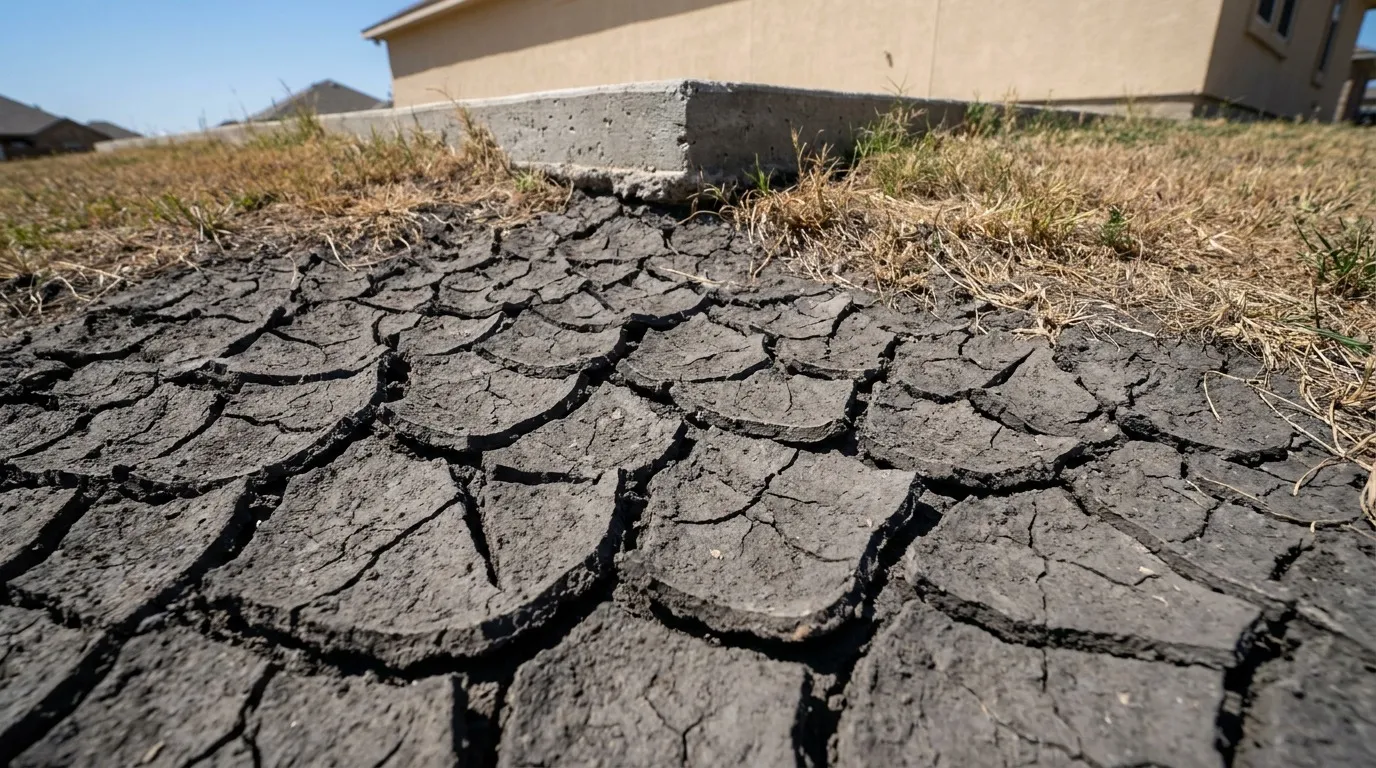
Plastic shrinkage cracks are the signature failure of hot-weather concrete. They appear within the first 1 to 6 hours after placement, when the concrete is still plastic but evaporation has exceeded the rate at which bleed water rises to the surface. The result is surface tension that pulls the still-soft concrete apart, leaving thin, often parallel cracks across the slab face. Once they form, plastic shrinkage cracks are essentially impossible to fully repair. They become entry points for water, debris, and freeze-thaw damage for the life of the slab.
Hot-weather pours that are not properly protected and cured typically achieve only 80 to 90 percent of the design 28-day compressive strength. A 4,000 psi mix that should hit 4,000 psi at 28 days may only reach 3,400 to 3,600 psi if the curing was compromised. That difference matters across the 25-to-30-year service life of the slab.
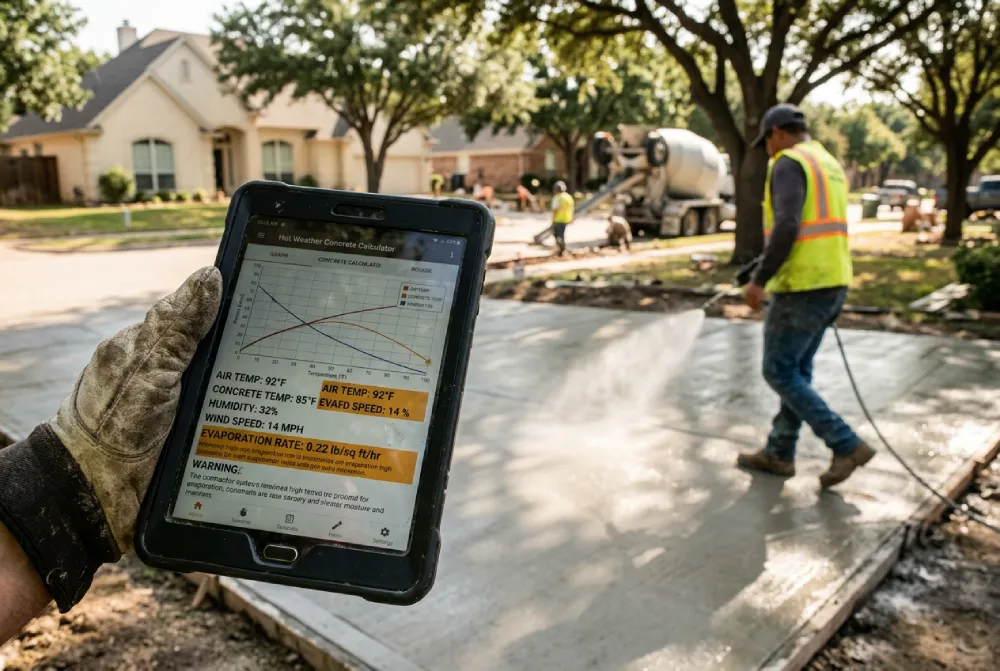
ACI 305 hot-weather concrete practice centers on a single calculated number: the evaporation rate, expressed in pounds per square foot per hour. The four inputs are:
Plug those into the ACI nomograph or a hot-weather concrete calculator app and you get the evaporation rate. The critical thresholds:
A typical Denton July afternoon (95 degrees, 30 percent humidity, 12 mph wind, 85-degree concrete) yields approximately 0.26 lb/sq ft/hr of evaporation. That is the danger zone. Without protection, plastic shrinkage cracking is virtually certain to occur.
For pours scheduled between May and September in Denton, TriStar Built follows a specific protocol that has produced consistent results over 18 years on North Texas driveways. The protocol has six steps.
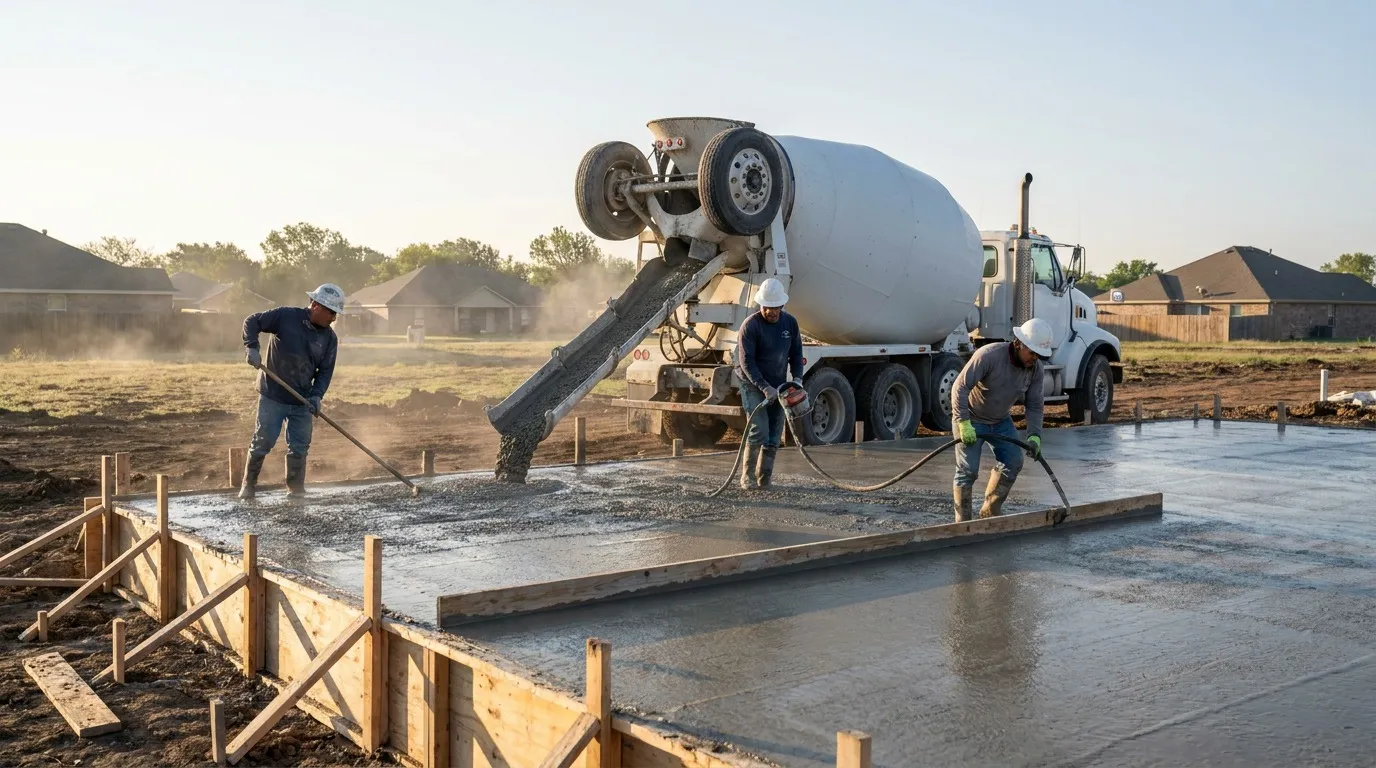
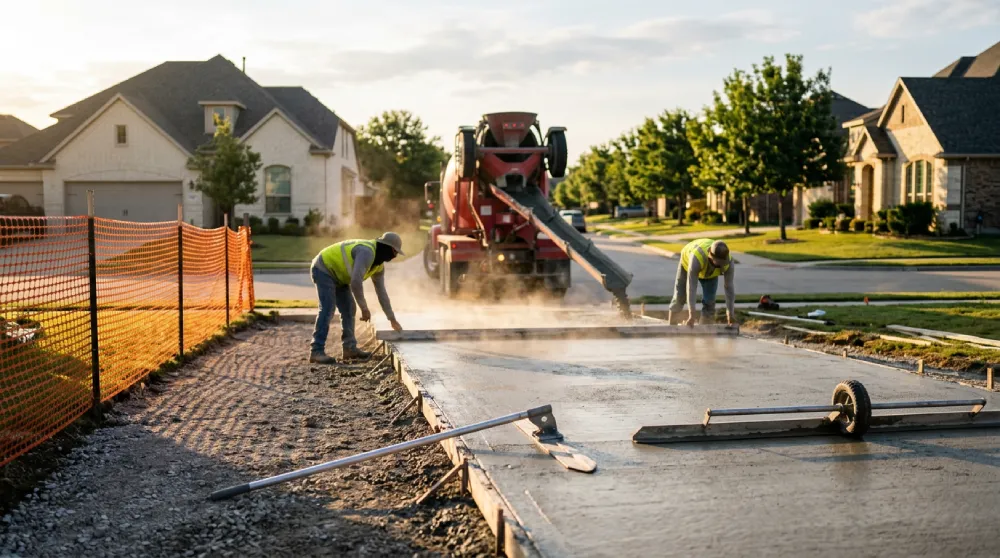
Summer pours start at first light. We arrange concrete delivery to coincide with the earliest possible truck departure from the plant, typically between 6:00 and 7:00 a.m. The goal is to have all concrete placed, screeded, and bull-floated before air temperature climbs above 85 degrees, which usually happens by 10:00 a.m. on a Denton July day. We do not schedule summer pours for afternoons. The risk-to-benefit math does not work.
The concrete arriving at the site is influenced by three temperatures: ambient air, mix water, and the subgrade and forms. We pre-cool by:
These measures can lower the as-placed concrete temperature by 8 to 12 degrees, materially reducing evaporation during the critical first hour after placement.
Wind matters at least as much as temperature for the evaporation rate. A 15 mph wind across a fresh pour doubles the evaporation rate compared to a 5 mph wind at the same temperature and humidity. The TriStar Built wind protection plan includes:
For pours with calculated evaporation rates above 0.15 lb/sq ft/hr, a fine fog spray of water mist is applied over the slab surface starting immediately after screeding. The mist saturates the air just above the slab and reduces the evaporation gradient. We use a low-pressure fan-spray nozzle to mist, not flood, the surface.
For evaporation rates above 0.20 lb/sq ft/hr, we also apply an evaporation reducer (monomolecular film product like Confilm, Eucobar, or similar) per ASTM C309. The film forms a temporary barrier that slows water loss until the bleed water cycle is complete.
The concrete mix for hot-weather pours differs from the standard residential mix in three ways:
This mix produces extended workable time, lower internal slab temperatures during the critical first 24 hours, and reduced risk of thermal cracking once curing begins.
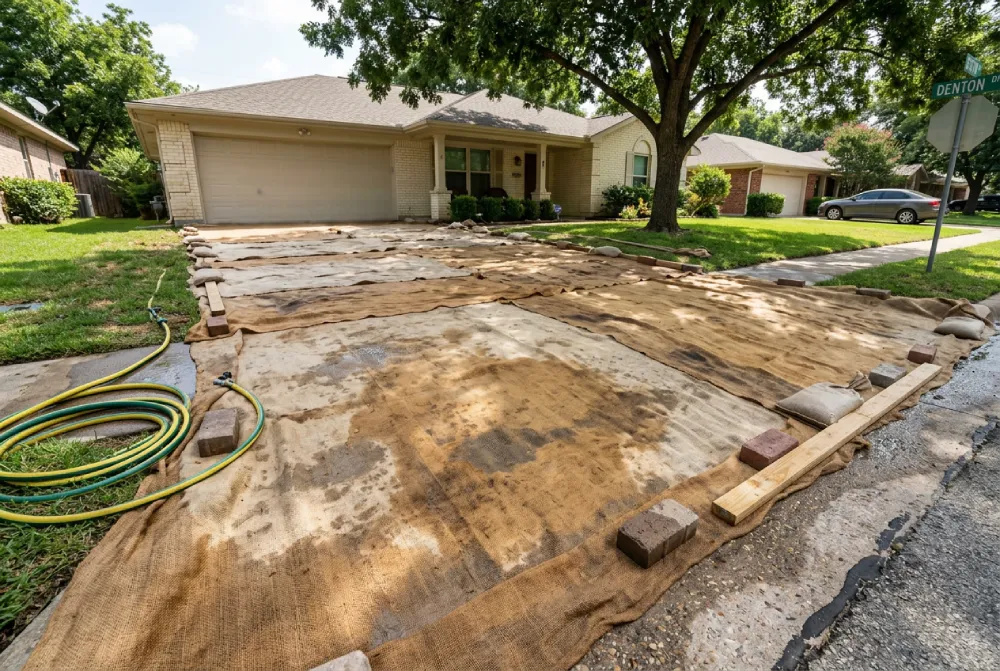
After the slab is finished, the curing method matters enormously. There are two options:
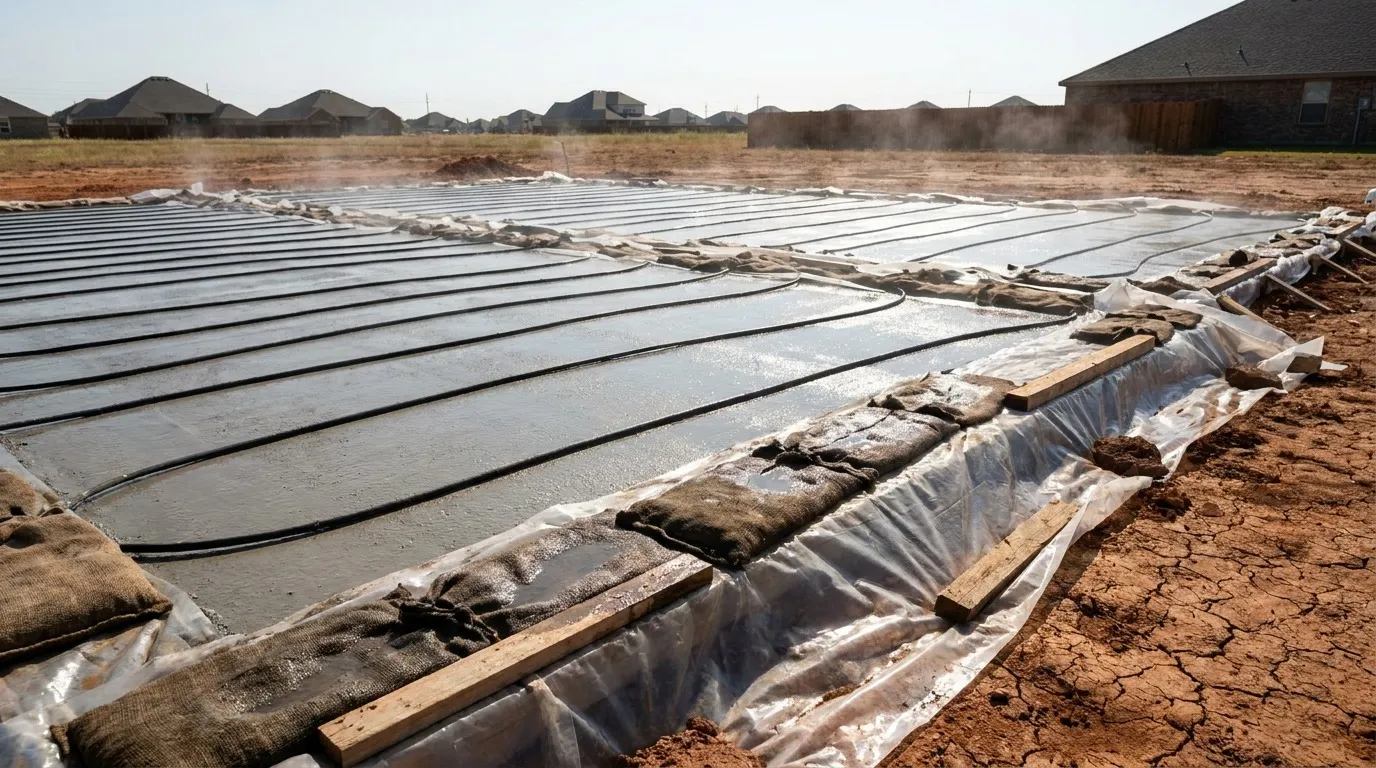
Wet Curing (preferred for hot weather): Wet burlap or wet curing blankets are placed over the slab and kept continuously wet for at least 7 days. This is the gold standard for hot-weather curing because it controls slab temperature, maintains hydration moisture, and prevents thermal shock.
Liquid Curing Compound: A high-quality ASTM C309 curing compound is sprayed over the finished slab within 30 minutes of finishing. The compound forms a film that retains moisture in the slab and reflects heat. This is acceptable for moderate heat (below 95 degrees) and works well when wet curing is impractical, but it is slightly less effective than continuous wet curing.
For pours in Denton when forecast highs exceed 95 degrees, TriStar Built specifies wet curing for the first 7 days.
If you are having a concrete driveway poured in Denton between May and September, here are the signals of a contractor who takes summer pours seriously:
The signals of a contractor who does not take summer pours seriously:
A properly protected summer pour costs more than a standard mild-weather pour. The premium is typically:
On a typical 600-square-foot Denton driveway, that translates to an additional cost of $270 to $570 compared to a March pour with the same crew. The TriStar Built standard practice is to include hot-weather protection in the base contract for summer pours rather than as a line-item add-on. We tell homeowners up front that a July pour costs more than a March pour, and we explain exactly what they are paying for.
To make the stakes concrete, here is what a Denton residential driveway looks like 18 to 24 months after a poorly executed summer pour:
These are not aging signs. These are signs of installation defects that appear within two years. They cannot be fully repaired. They are the long-term cost of a contractor who skipped hot-weather protocols.
ACI 305R, the Guide to Hot Weather Concreting, is the industry's primary reference for managing concrete pours in elevated temperatures. The full document is technical, but the core recommendations distill into a short list:
Every reputable Denton concrete contractor will be familiar with ACI 305 and will follow its core recommendations on summer pours. A contractor who does not recognize the reference or dismisses it as overcomplicated is a contractor who has not had to clean up a failed summer pour.
Yes, with proper protocols. The TriStar Built approach is an early-morning pour start, hot-weather mix design with set retarders, wind protection, fog spray during finishing, and 7-day wet curing. With these protocols in place, a July pour produces a slab equivalent in quality to a March pour. Without them, the July pour produces plastic shrinkage cracks and reduced long-term durability. The right answer is not to avoid summer pours but to insist on summer protocols.
Plastic shrinkage cracks are thin, often parallel cracks that form within the first 1 to 6 hours after concrete placement when surface evaporation exceeds bleed water rise. They appear as fine lines across the slab face, typically not aligned with control joints, often in groups of 2 to 6 parallel cracks. If your slab has these cracks visible within the first 24 hours after pour, plastic shrinkage was not prevented. The cracks cannot be fully repaired.
Because the only way to consistently produce quality concrete in Denton summer heat is to do the work before the heat arrives. By 10:00 a.m. on a July day, the air temperature is climbing through the 80s, the subgrade is heating up, and evaporation rates are rising fast. An early start lets the crew place, screed, finish, and begin curing before the worst heat hits. Crews that start at 10:00 a.m. or later in July are setting themselves up to fight the conditions rather than work with them.
Yes. Curing controls how the cement hydration completes over the first 7 to 28 days. Properly cured concrete reaches its full design strength. Poorly cured concrete reaches only 80 to 90 percent of design strength and has weaker surface durability. For hot-weather pours, wet curing with burlap or curing blankets is the gold standard because it both controls slab temperature and maintains moisture. Liquid curing compound is acceptable but slightly less effective for hot weather pours.
Mild weather pours are easier and produce excellent results. If your project timeline is flexible, scheduling the pour for September, October, or April is reasonable. But there is no reason a properly executed July pour cannot match the quality of an October pour. The choice depends more on your contractor's discipline with hot-weather protocols than on the calendar.
Cold-weather concreting (ambient below 40 degrees Fahrenheit) brings its own set of protocols (insulating blankets, heated water, set accelerators, longer cure times, frost protection). The cold-weather scenarios are rarer in Denton but do occur 5 to 15 days per winter. The principles are similar to hot weather, in that a competent contractor adapts the mix, the schedule, and the protection plan to the conditions. That topic deserves its own article.
Documentation is the answer. Reputable contractors photograph and log the curing setup, including the date and time wet curing began, the type of curing material used, the duration of moist conditioning, and any inspections during the curing window. Ask for the curing log as part of the project documentation. A contractor who cannot produce one almost certainly skimped on the curing process.
Pouring concrete in Denton summer heat requires more discipline, more equipment, and more time than pouring in mild weather. A contractor who handles summer pours with the same approach they use in March produces a different, inferior driveway, regardless of how the slab looks on the day of the pour. The protocols that make summer pours succeed (early starts, wind protection, fog spray, hot-weather mix, wet curing) are industry-standard, not exotic. The contractors who do them well are the contractors whose driveways last 30 years in North Texas.
If you have a driveway pour scheduled for the warm months in Denton, Argyle, Flower Mound, Highland Village, Corinth, or anywhere across Denton County, TriStar Built is happy to walk you through the protocol on your project. Call (940) 381-2222 or visit www.tristarbuilt.com.


Whether you’re remodeling a home, expanding a business, or starting from the ground up, TriStar Built is here to guide you every step of the way. With a focus on craftsmanship, communication, and results that last, we make the construction process clear, smooth, and worth every investment.

LOCATION: 2126 James Street, Denton, TX 76205
PHONE: (940) 381-2222
© 2025 TRISTAR BUILT - ALL RIGHTS RESERVED | WEB DESIGN & SEO BY: Authority Solutions®