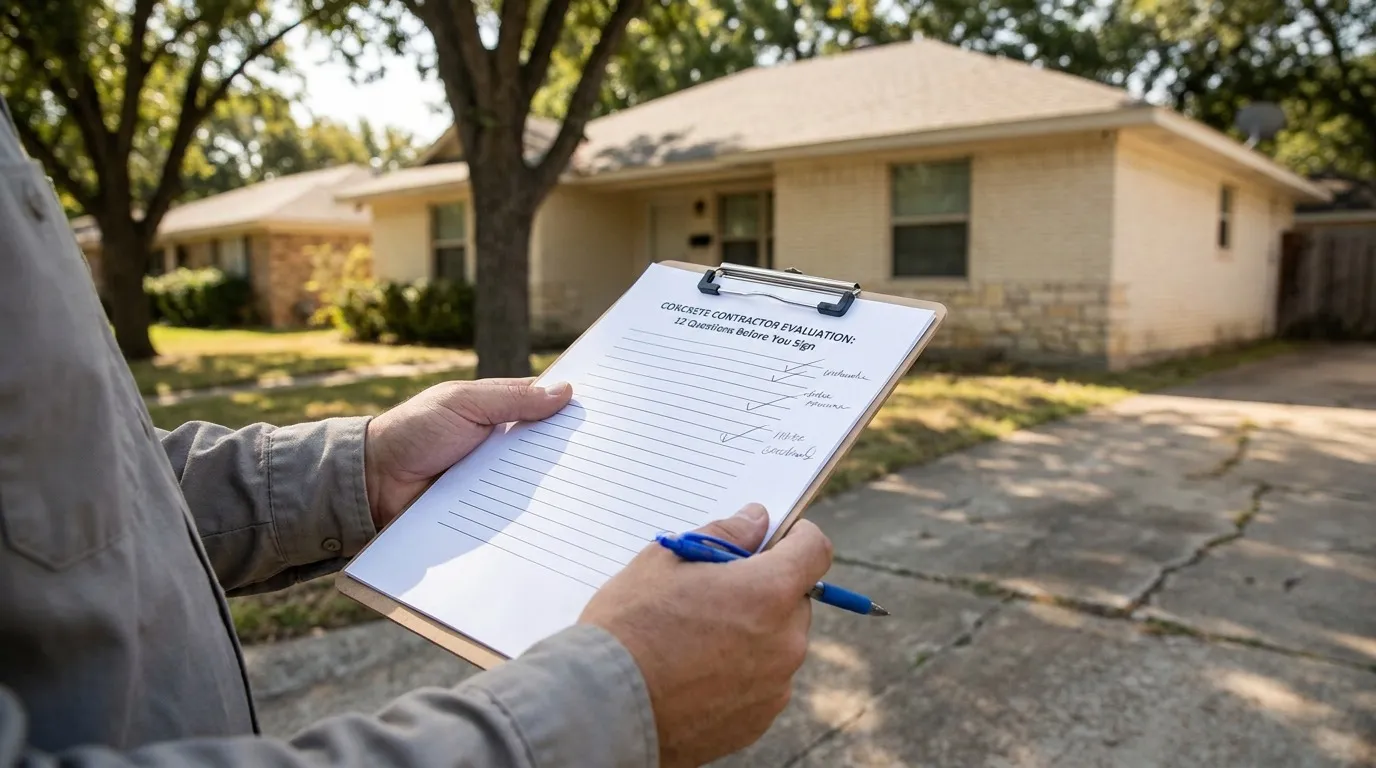
Before signing a concrete driveway contract in Denton, TX, ask the contractor 12 specific questions covering insurance, references, mix design, reinforcement, joint plan, subgrade prep, cure protocol, warranty, payment schedule, change order policy, crew supervision, and cleanup. The quality of the contractor's answers separates a 30-year driveway from a 10-year warranty headache. This guide explains what each question is really asking, what a good answer sounds like, and what answers should send you to the next bidder.
Hiring a concrete driveway contractor in Denton is one of those decisions where the wrong choice can cost $5,000 to $15,000 in repairs or replacements, while the right choice costs only a few percent more than the cheapest bid. The difference between a great contractor and a marginal one is rarely visible in the marketing material, the website, or the friendly first meeting. It is evident in the way they answer specific, technical questions about how they plan to do the work.
This guide is the question list TriStar Built homeowners ask us, and the question list we recommend you ask every concrete contractor you consider in Denton County. We have provided the question, what the question is actually testing, what a good answer sounds like, and the kind of answer that should make you keep looking. After 18 years of pouring driveways in North Texas, we know exactly which questions separate the professionals from the rest.
These 12 questions are meant to be asked in person or by phone, ideally after the contractor has visited your property and provided an initial bid. The goal is not to test their patience or to play "gotcha." It is to verify that the contractor has thought through your specific project and can explain their approach. Reputable contractors welcome these questions because the answers are how they win the job. Less reputable contractors get defensive or evasive, which is itself useful information.
You do not need to ask all 12 in a single sitting. Spread them across two or three conversations. Compare the answers across contractors. Document what you hear.
What this question tests: Whether the contractor is properly licensed and insured to do work on your property.
What a good answer sounds like: "Yes, I will email the certificates of insurance directly from our agent. Texas does not require a state-level concrete contractor license, but we carry $1 million general liability and full workers' comp coverage. Our agent can send the COIs naming you as additional insured for the duration of the project."
What should send you elsewhere: "Don't worry about it, we are insured." Or vagueness about workers' comp. Or any pushback on providing certificates of insurance directly from the insurance agent.
Texas does not have a state concrete contractor license requirement, which makes the insurance check more important, not less. A contractor without proper general liability and workers' comp transfers all the risk of accidents and property damage onto the homeowner.
What this question tests: Whether the contractor's work holds up over time. Year-one references are easy. Year-three references are the proof.
What a good answer sounds like: "Yes, I have three Denton-area references with driveways at least 3 years old. Two are within 5 miles of your home. I will send their addresses with permission so you can drive by and see the work yourself, and contact info so you can talk to them about how the slab has aged."
What should send you elsewhere: "We have references but they are all recent." Or "I cannot share references because of privacy." A 3-year-plus reference is the single most valuable verification tool a homeowner has. Refusal to provide one is a meaningful signal.
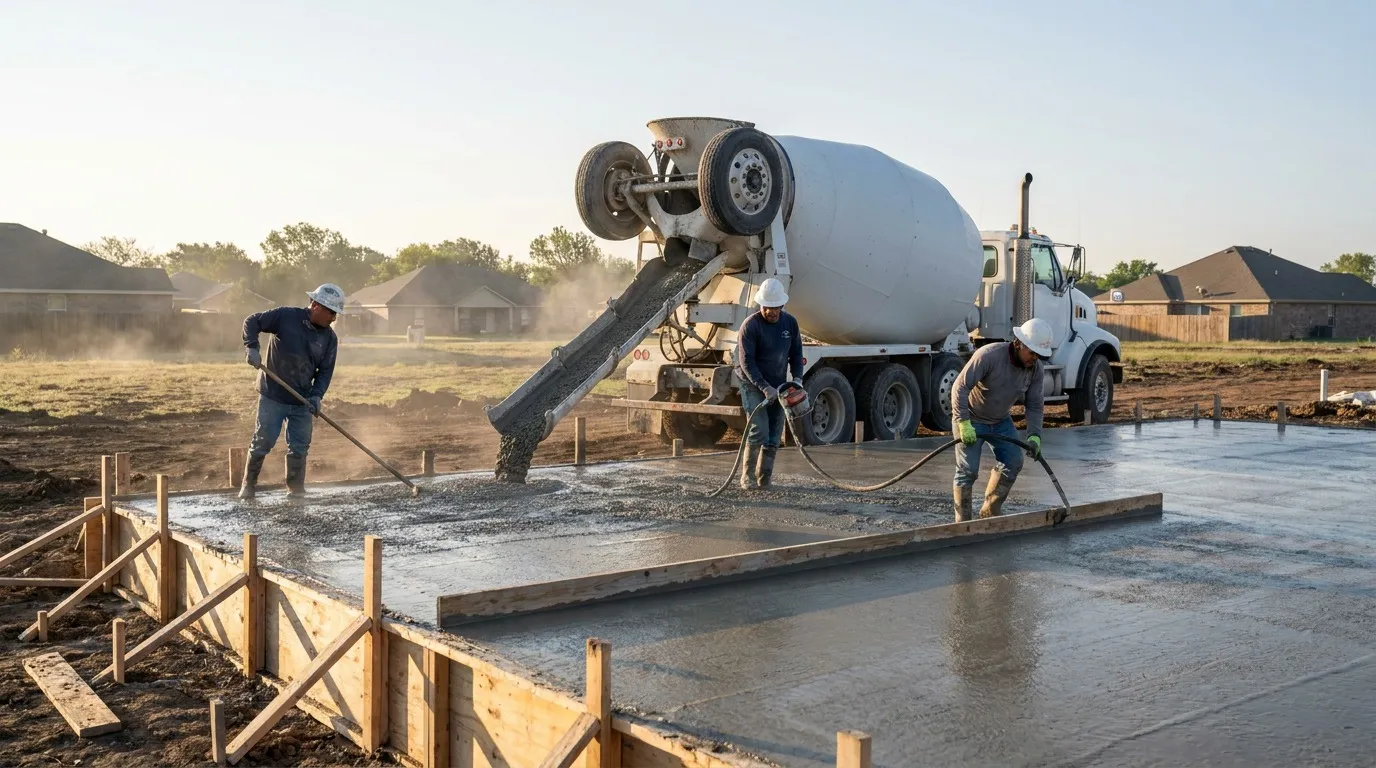
What this question tests: Whether the contractor has a defined concrete specification or just calls the ready-mix plant for "the usual."
What a good answer sounds like: "We use a 4,000 psi mix with 5 percent air content, 0.45 maximum water-cement ratio, 4-inch slump, and 4 lbs per cubic yard of macro fiber. The mix design number from our supplier will be on the contract, and I will show you the batch ticket on pour day."
What should send you elsewhere: "Standard residential concrete," or any answer without specific psi, air content, water-cement ratio, or admixture information. The mix is too critical to leave vague.
What this question tests: Whether the contractor uses proper reinforcement or substitutes cheaper alternatives.
What a good answer sounds like: "Grade 60 #4 deformed rebar at 16 inches on center each direction, elevated on plastic chairs to mid-slab depth, with 24-inch lap splices at all bar ends. I will not pour without that grid in place."
What should send you elsewhere: "We use wire mesh," or "Reinforcement is included," with no further specification. Or "We do not need reinforcement for a residential driveway." That last answer is a hard stop.
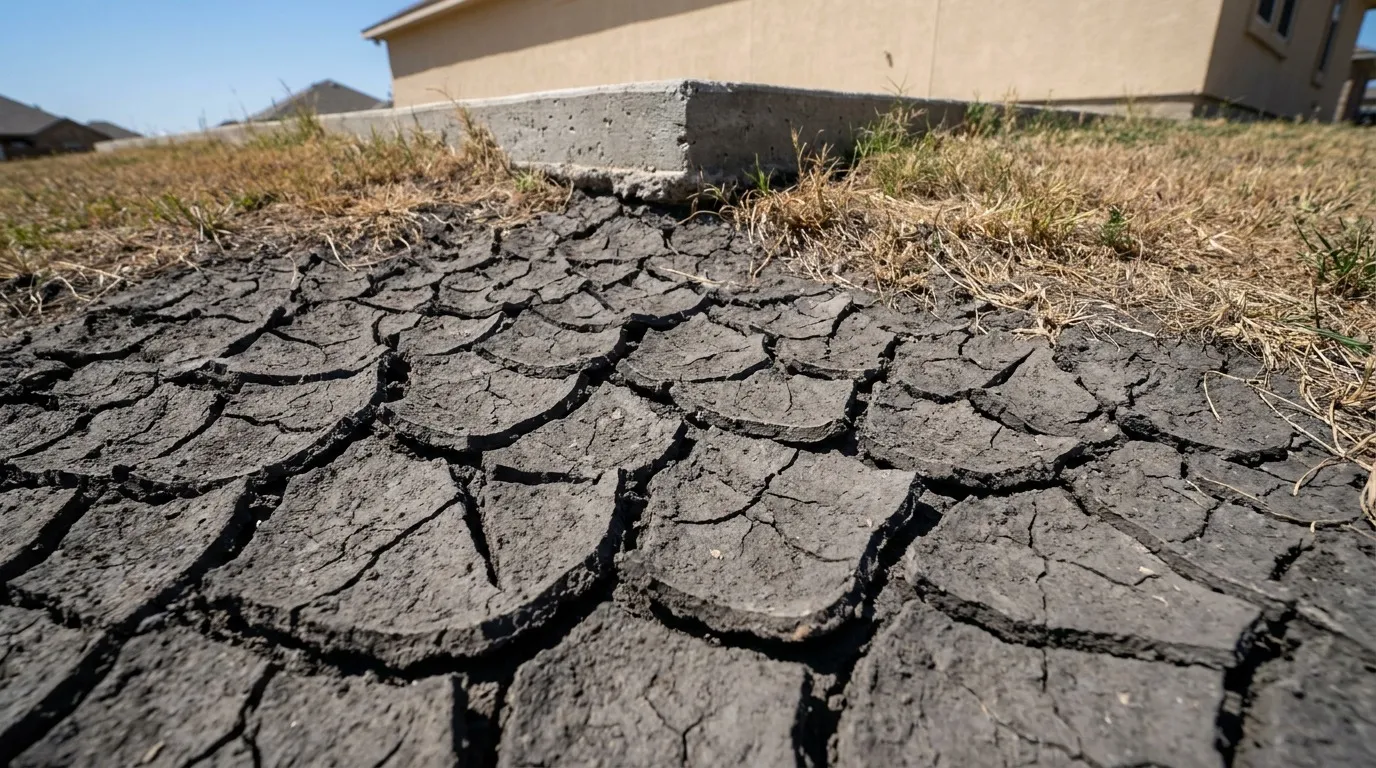
What this question tests: Whether the contractor understands North Texas clay and is willing to do the unglamorous prep work that makes the slab last.
What a good answer sounds like: "We strip the topsoil and organics, grade for proper drainage, run a proof roll with a loaded dump truck to find soft spots, condition the subgrade to optimum moisture content, and compact to 95 percent Standard Proctor. I will document each step with photos."
What should send you elsewhere: "Just grade and pour" or any answer that does not mention proof rolling, compaction testing, or moisture conditioning. Subgrade failures cause more early-age driveway problems on North Texas clay than any other single cause.
What this question tests: Whether the contractor plans where cracks will land or leaves it to chance.
What a good answer sounds like: "Sawcut control joints at 10 to 12 feet maximum spacing in both directions, depth equal to 25 percent of slab thickness, sawcut within 4 to 24 hours of pour using an early-entry saw. Expansion joints at the garage interface, sidewalk interface, and any retaining walls. Joint sealant applied after 14 days of cure with closed-cell backer rod and self-leveling polyurethane sealant."
What should send you elsewhere: Vague answers like "We add joints as needed," or any contractor who proposes joints at greater than 15 foot spacing on a 5-inch slab. Tooled joints (rather than sawcut) on a driveway-thickness slab are also a red flag.
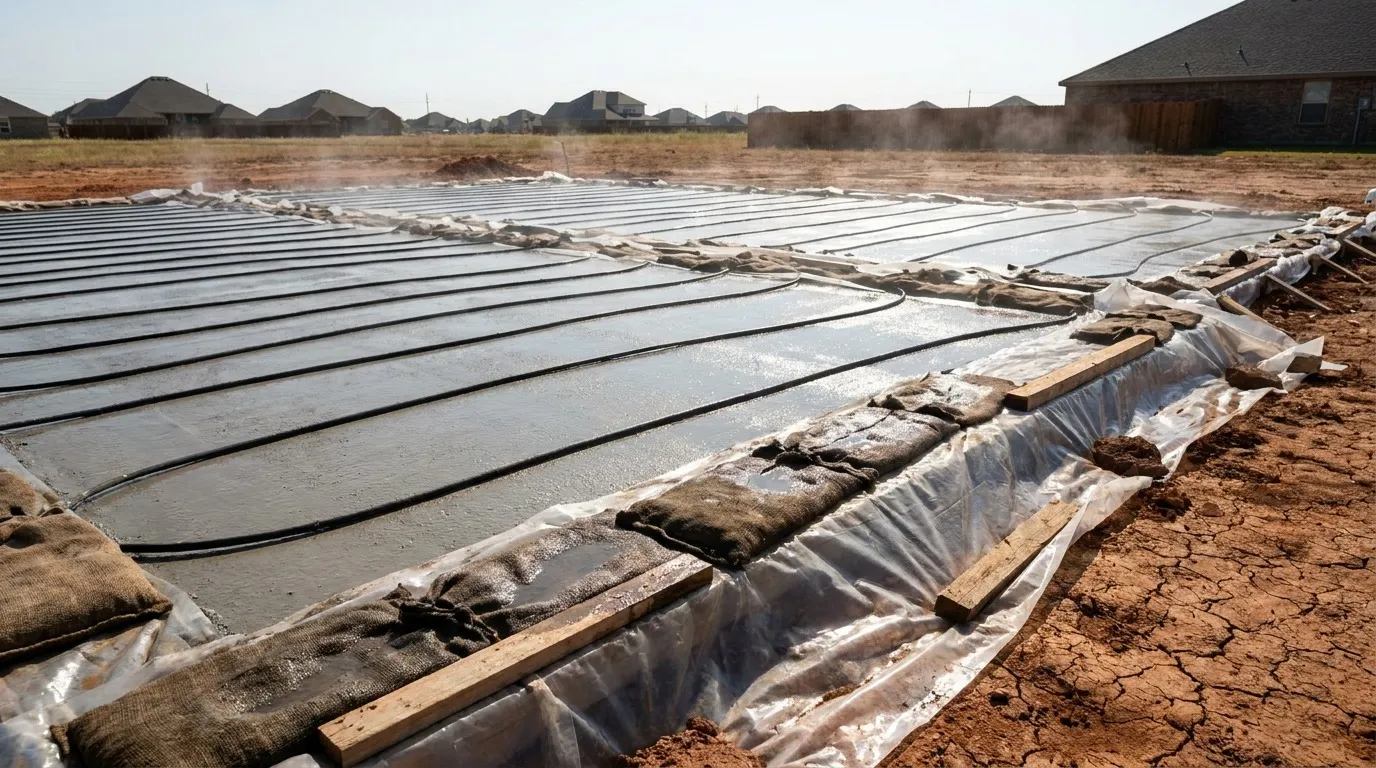
What this question tests: Whether the contractor takes curing seriously and adjusts for Denton's weather extremes.
What a good answer sounds like: "For standard mild-weather pours, we apply ASTM C309 curing compound within 30 minutes of finishing. For pours when daytime highs exceed 95 degrees, we use 7-day wet curing with burlap or curing blankets. For cold-weather pours below 40 degrees, we use insulating blankets and heated mix water. The cure protocol is in writing on every contract."
What should send you elsewhere: "We just spray it with compound and walk away." Or "Curing is not really needed." Or any answer that does not mention hot-weather protocols.
What this question tests: Whether the contractor stands behind the work and whether the warranty covers anything meaningful.
What a good answer sounds like: "We provide a 1-year workmanship warranty on installation, a 2-year warranty on joint sealant, and an industry-standard warranty against hairline cracks larger than 1/8 inch within the first 5 years. The warranty is in writing on the contract and lists specific exclusions for clay-heave damage that exceeds typical expansion patterns."
What should send you elsewhere: Verbal-only warranties. Warranties that exclude everything that could go wrong. Warranties from contractors who have been in business less than 5 years (the warranty is only as good as the company backing it).
What this question tests: Whether the contractor follows reasonable Texas industry standards for payment.
What a good answer sounds like: "We require a 25 to 30 percent deposit to secure materials and the pour date, 50 percent due at the pour completion, and the final 20 to 25 percent due after the cure window and final walkthrough. We do not request more than 30 percent up front."
What should send you elsewhere: Demands for 50 percent or more up front. Cash-only requirements. No payment schedule in writing. Demands for full payment before pour completion.
What this question tests: Whether the contractor has a defined process for scope changes or makes them up on the fly.
What a good answer sounds like: "Any change to the original scope is documented as a written change order, signed by both parties before the work proceeds. The change order specifies the change, the cost adjustment, and any schedule impact. We do not do verbal change orders. If something is discovered during prep that affects the scope (a soft spot in the subgrade that needs extra fill, for example), we stop, document, present options, and get your signature before continuing."
What should send you elsewhere: "We just handle it as we go" or any approach to changes that does not include written documentation and signature. Verbal change orders are one of the most common sources of post-project disputes.
What this question tests: Whether the person selling you the job is the same person making sure the job gets done right.
What a good answer sounds like: "I will be on site for the pour, and so will our crew lead who has been with us for 8 years. Both of us will inspect the prep the morning of, review the batch ticket on the truck, and oversee the pour and finish. For multi-day projects, our project manager is on site every day."
What should send you elsewhere: "The crew handles it." Or "I will check in." A pour without owner or senior supervision is where most preventable mistakes happen. The supervision question is one of the strongest indicators of how the contractor actually runs jobs.
What this question tests: Whether the contractor leaves the site in good condition and stands behind the final product.
What a good answer sounds like: "Site cleanup happens at the end of every workday, with full final cleanup including concrete washout removal and surrounding landscaping protection. After the 7-day cure window, we schedule a final walkthrough where we walk the slab with you, address any cosmetic touch-ups, and discuss long-term maintenance. The final payment is due after that walkthrough is complete and you are satisfied."
What should send you elsewhere: "Cleanup is on you," or contracts where final payment is due before any walkthrough. The walkthrough is your last chance to catch issues before the contractor is paid in full and disappears.
No single answer is definitive. The pattern across all 12 questions tells the real story. Three patterns to watch for:
The great contractor pattern: Specific, detailed, written answers across all 12 questions. References to specific ASTM standards, ACI documents, or local codes. A calm, confident discussion of the work. Photos and documentation as standard practice. The bid takes a few days to prepare because they are pricing the actual scope, not guessing.
The marginal contractor pattern: Verbal-only answers that vary depending on how the question is asked. Hedging on insurance or warranty specifics. Reluctance to provide references. The bid arrives quickly because they have a single "residential driveway" price they charge regardless of project specifics.
The avoid-at-all-costs pattern: Defensive or impatient responses to questions. Pressure to sign immediately. Cash-only payment. Promises that sound too good (lifetime warranty, no cracks ever, 24-hour drive-on). Bid significantly lower than competitive bids. These contractors are the ones who produce the failures that we get called in to repair.
For convenience, here is the full 12-question list in checklist form to print or save for your contractor conversations.
| # | Question Topic | Strong Answer Includes |
|---|---|---|
| 1 | Licensing and Insurance | $1M+ general liability, full workers' comp, COIs naming you as additional insured |
| 2 | Local References | 3+ Denton-area refs at least 3 years old, willing to share contact info |
| 3 | Mix Design | 4,000 psi minimum, 5% air, 0.45 max w/c, 4-inch slump, in writing |
| 4 | Reinforcement | #4 rebar at 16 in OC, chairs to mid-slab, 24-in lap splices |
| 5 | Subgrade Prep | Strip, grade, proof roll, moisture condition, 95% Proctor compaction |
| 6 | Joint Plan | 10-12 ft max spacing, 25% slab thickness depth, sawcut, sealed |
| 7 | Cure Protocol | ASTM C309 mild, 7-day wet curing for hot weather, frost protection cold |
| 8 | Warranty | 1-year workmanship in writing, defined coverage and exclusions |
| 9 | Payment Schedule | 25-30% deposit, no more than 50% before pour completion |
| 10 | Change Orders | Written, signed, no verbal scope changes |
| 11 | Supervision | Owner or senior supervisor on site for the pour |
| 12 | Cleanup and Walkthrough | Full cleanup, final walkthrough before final payment |
A good contractor will welcome these questions because the answers are how they differentiate themselves from the cheap competition. The questions show that you are an informed homeowner who is going to pay attention to the work and recognize quality. Reputable Denton contractors get more repeat business and referrals from informed homeowners than from price shoppers, and they know it.
No. Texas has no state-level license requirement for residential concrete contractors. There are licensing requirements for electrical, plumbing, and HVAC trades, but concrete and general contracting are not licensed at the state level. This makes the insurance verification step (Question 1) and the reference verification step (Question 2) even more important than they would be in a licensed state.
Find a different contractor. Three-year-old references are the strongest verification tool a homeowner has on a concrete project, because most of the failures from poor workmanship show up in years 2 to 5. A contractor who will not provide them either does not have driveways that aged well, or does not want you to talk to homeowners who experienced their actual long-term performance. Either reason is a reason to keep looking.
For Texas residential concrete work, 25 to 30 percent is standard. The deposit covers materials, scheduling, and the contractor's cost to hold your project on the calendar. Deposits above 50 percent are not industry standard and may indicate the contractor needs your money to pay for someone else's job. Deposits below 15 percent are also unusual and may indicate a contractor stretched too thin to materials-finance the project.
Yes, three is the standard minimum, and the three bids should be apples-to-apples. Use the 12-question framework to evaluate each bid, not just the price. A bid that is 30 percent below the others is almost always a sign of cut corners, not a sign of efficiency. The middle bid that comes with the most detailed answers to your questions is usually the right pick.
Question 3 (mix design) and Question 4 (reinforcement) are the most-important technical questions because they directly determine the structural quality of the slab. Question 1 (insurance) and Question 2 (references) are the most-important due diligence questions because they protect you from financial risk and identify aged-track-record contractors. If forced to ask only four questions, those would be the ones.
The bid difference between a great contractor and a marginal one is usually 10 to 25 percent on a residential driveway. On a $9,000 driveway, that is $900 to $2,250. The difference between a 30-year driveway and a 12-year driveway is the cost of replacing the entire driveway plus all the trouble of a failed project. The math of paying the premium for a better contractor is overwhelming.
A concrete driveway is one of the larger purchases most homeowners make outside of the home itself, and the contractor relationship is where almost all the long-term quality lives. The 12-question framework is the most-cost-effective way to evaluate contractors in Denton before signing. Use it, document the answers, compare across bids, and trust the patterns more than any single sales pitch.
If you would like to walk through these 12 questions with TriStar Built on your specific Denton driveway project, we welcome the conversation. Call (940) 381-2222 or visit www.tristarbuilt.com. We have been answering homeowner questions about concrete in Denton County for 18 years.


Whether you’re remodeling a home, expanding a business, or starting from the ground up, TriStar Built is here to guide you every step of the way. With a focus on craftsmanship, communication, and results that last, we make the construction process clear, smooth, and worth every investment.

LOCATION: 2126 James Street, Denton, TX 76205
PHONE: (940) 381-2222
© 2025 TRISTAR BUILT - ALL RIGHTS RESERVED | WEB DESIGN & SEO BY: Authority Solutions®