For residential concrete driveways in Denton, TX, 5 inches is the right thickness for standard passenger cars and light SUVs on properly prepared subgrade. Upgrade to 6 inches for trucks, RVs, and dually pickups, and reserve 4 inches for walkways and patios only. Slab thickness is the second-most-compromised line item on a driveway bid, after reinforcement, and the wrong choice can cause settlement cracks and edge spalling within five years.
A concrete driveway is essentially a load-bearing structure that must withstand 25-plus years of vehicle traffic, North Texas clay heave, and Texas weather extremes. Yet the most consequential structural decision on a driveway, the slab thickness, often gets handled in two words on a contractor's bid: "concrete driveway." No number. No spec. Just a word.
This guide explains exactly how thick a Denton residential driveway should be, why the difference between 4, 5, and 6 inches matters more than most homeowners realize, and how to match thickness to the real-world vehicles your driveway will carry. TriStar Built has poured driveways across Denton County for 18 years, and we have replaced more than one driveway that failed early because the original contractor used 4 inches where 5 or 6 was needed.
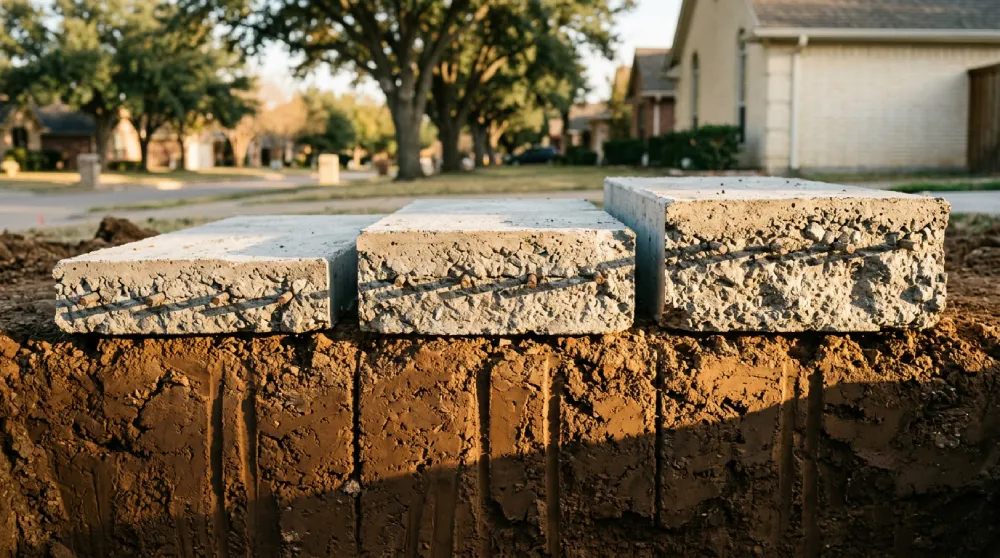
Concrete slab thickness affects three things in direct proportion: vehicle load capacity, resistance to clay heave, and useful service life. A 1-inch difference in slab thickness, from 4 inches to 5 inches, increases load capacity by approximately 56 percent and roughly doubles the slab's bending resistance against differential subgrade movement. The math is not linear with thickness, which is why the jumps from 4 to 5 and from 5 to 6 inches are both material upgrades, not cosmetic ones.
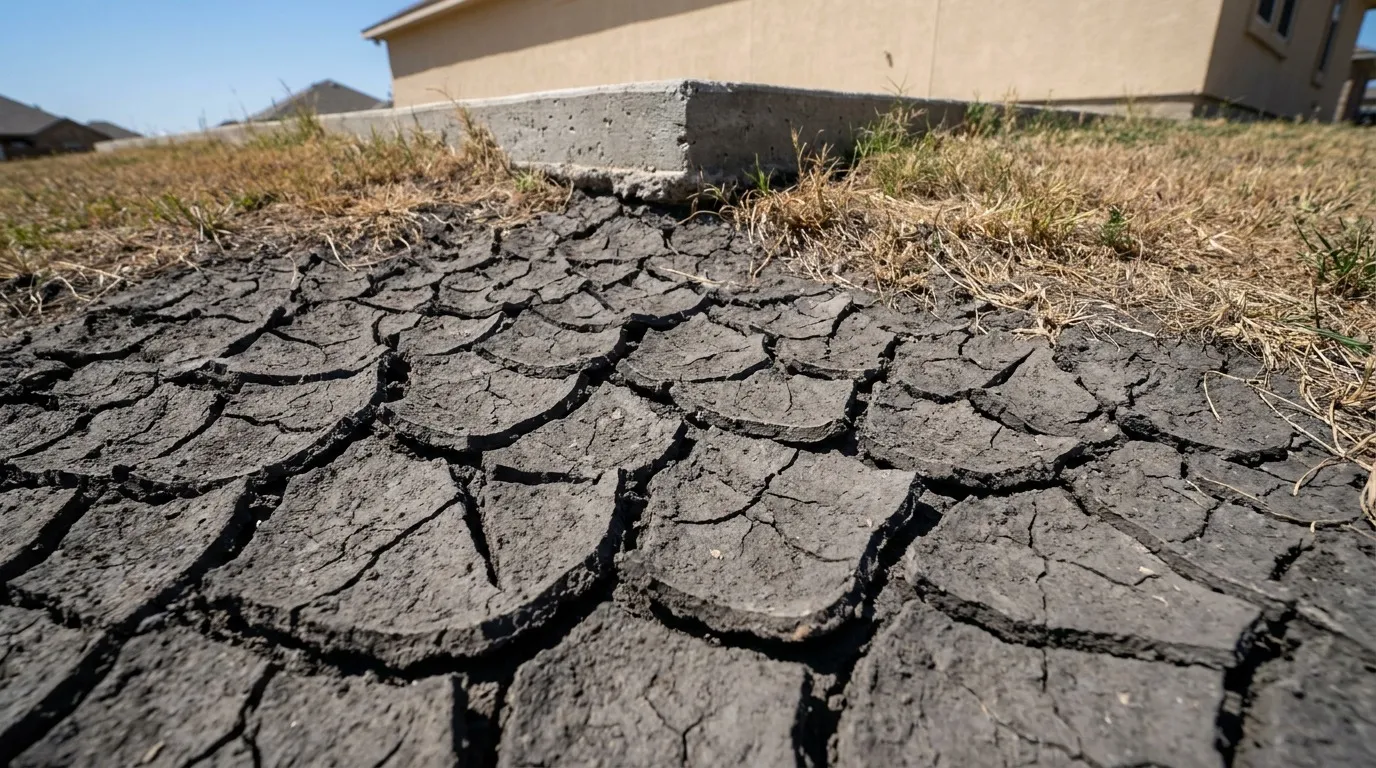
On North Texas clay, the second factor matters as much as the first. Denton County's Vertisol clay subgrade swells and shrinks with seasonal moisture. A thicker slab spans differential heave better and resists the cracking that follows. A 4-inch slab will telegraph clay movement quickly. A 6-inch slab can absorb the same movement with less visible damage.
Three slab thicknesses cover all residential applications in Denton County. There is no good reason to use anything thinner than 4 inches for any concrete flatwork, and there is rarely a need to go thicker than 6 inches for residential driveways.
A 4-inch concrete slab is the residential standard for non-vehicular applications. Patios, walkways, pool decks, and small shed pads up to about 200 square feet are all appropriate at this thickness, provided the subgrade is properly prepared and reinforcement is in place. ACI 330R lists 4 inches as the absolute minimum for residential driveways, but it recommends 5 inches as the design minimum under typical conditions.
In Denton, the only legitimate driveway application for 4-inch slabs is a very short residential apron leading to a garage in front of an existing 5- or 6-inch driveway, and only when no vehicle wheel load lands on the 4-inch section. For any actual driveway panel that carries a wheel, 4 inches is not enough.
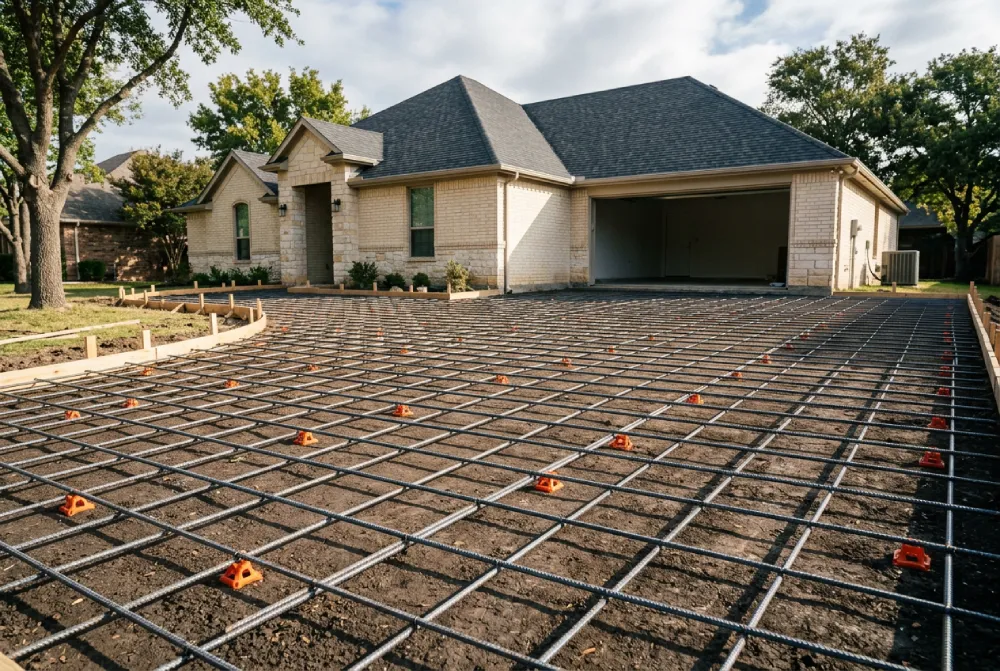
Five inches is the TriStar Built default for residential driveways in Denton, Argyle, Flower Mound, Highland Village, and across Denton County. This thickness handles passenger cars, mid-size SUVs, and the occasional service truck delivery without any structural concern. A properly poured 5-inch slab over a compacted clay subgrade with #4 rebar at 16 inches on center will comfortably and routinely support a 6,000-pound vehicle.
This is the thickness specified by most residential engineers in North Texas and by nearly every reputable HOA covenant addressing driveway construction. If your bid shows 5 inches and the subgrade is properly prepared, you are buying the right product for a standard residential vehicle load.
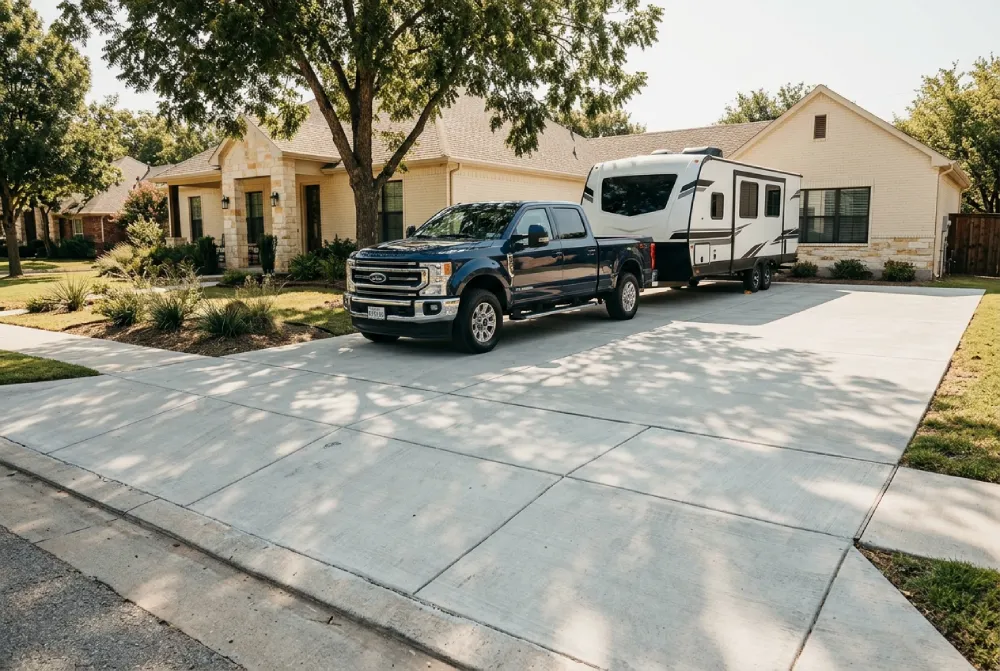
Six inches is the right thickness for driveways that regularly carry heavy loads. This includes:
A 6-inch slab also makes sense when the homeowner expects future vehicle changes. Adding 1 inch to a slab thickness at construction time costs $0.75 to $1.10 per square foot. Replacing the entire driveway 8 years later because a 5-inch slab failed under a new truck costs $7.00 to $9.00 per square foot. The math at construction is overwhelming.
The following table provides a practical mapping of common Denton-area vehicles to the recommended slab thickness, assuming standard subgrade preparation and #4 rebar reinforcement at 16 inches on center.
| Vehicle Type | Curb Weight | Recommended Thickness |
| Compact sedan (Civic, Corolla) | 2,800 to 3,200 lbs | 5 inches |
| Mid-size SUV (RAV4, CR-V, Outback) | 3,500 to 4,200 lbs | 5 inches |
| Full-size SUV (Tahoe, Expedition, Suburban) | 5,400 to 6,000 lbs | 5 inches |
| Half-ton pickup (F-150, Silverado 1500, RAM 1500) | 5,000 to 5,700 lbs | 5 inches (6" if towing) |
| 3/4-ton pickup (F-250, Silverado 2500, RAM 2500) | 6,000 to 7,200 lbs | 6 inches |
| 1-ton pickup (F-350, Silverado 3500, RAM 3500) | 7,000 to 8,500 lbs | 6 inches |
| Dually truck (F-350 dually, etc.) | 7,500 to 9,500 lbs | 6 inches |
| Class A motorhome | 18,000 to 30,000 lbs | 6 inches + engineered design |
| 5th-wheel travel trailer (loaded) | 12,000 to 18,000 lbs | 6 inches |
| Boat trailer + boat (loaded) | varies; 3,000 to 8,000 lbs | 5 to 6 inches |
For mixed vehicle households, design for the heaviest vehicle. A driveway that will park a F-250 weekly and an Accord daily needs to be 6 inches everywhere, not 6 inches in one spot and 5 inches elsewhere.
ACI 330R-08 Design and Construction of Concrete Parking Lots and Site Paving is the most-cited industry reference for residential and light commercial flatwork design. Its core thickness recommendations for residential driveways are:
The TriStar Built thickness specification aligns with ACI 330 and Texas Department of Transportation guidelines for light traffic residential flatwork. We do not pour driveway panels less than 5 inches on Denton clay, regardless of what the bid specifies. The cost difference is small and the performance difference is enormous.
Thickness alone is not the whole structural picture. A 6-inch slab on poorly compacted subgrade will fail before a 5-inch slab on properly prepared subgrade. A 5-inch slab with no reinforcement will fail before a 4-inch slab with proper #4 rebar at 16 inches on center.
The right structural package for a typical Denton residential driveway is:
Each element contributes to a service life of 25 to 30 years. Compromising any one of them shortens the life of the whole system.
Thickness affects the total cost of a driveway in two ways: more concrete volume and slightly more rebar to space across the increased perimeter and edge reinforcement. For a typical 600 square foot Denton residential driveway in 2026:
Driveway Cost by Thickness (600 sq ft):
The difference from 5 to 6 inches is approximately $1,100 to $1,300 on a typical driveway, which is about 12 to 14 percent of the contract. That premium buys roughly double the load capacity, materially better resistance to clay heave, and a service life extension that often exceeds 10 years.
For homeowners with a long driveway where vehicle access patterns vary across sections, a mixed-thickness driveway can be cost-effective. The classic case in Denton is a long driveway from the street to a detached garage where:
This requires careful joint design between thickness transitions to prevent stress concentrations at the step. Mixed-thickness driveways need to be engineered, not guessed at, and the joint detail should be on the bid drawings before signing.
The thickness specification on a concrete driveway bid should always be a specific number in inches, ideally with reinforcement and mix design listed adjacent to it. Watch for these problematic bid phrases:
A reputable Denton concrete contractor will write something specific like: "Residential driveway, 5 inches thick, #4 rebar at 16 inches on center each way, elevated on chairs, 4,000 psi concrete with 4 lbs/yd macro fiber." That is what you want to see.
You can save approximately $1,200 to $1,600 on a typical 600-square-foot driveway by reducing the thickness from 5 inches to 4 inches. You will pay that savings back, often several times over, when the slab cracks and fails within 5 to 10 years on Denton clay. The right place to economize on a driveway project is not in the structural specification. If the budget is tight, consider a smaller footprint at 5 inches rather than a full 4-inch footprint.
Walk away or insist on 5 inches in writing. A 4-inch slab will technically carry a passenger car, but it has no margin for clay heave, joint stress, or future heavier vehicles. ACI 330R lists 4 inches as the absolute minimum for residential driveways, but the design minimum is 5 inches for typical conditions. North Texas clay is not typical conditions; it is more demanding than the ACI baseline. There is no scenario in Denton where 4 inches is the right call for a driveway panel.
Six inches is the minimum for any RV pad in Denton County, and many engineers specify 7 or 8 inches for Class A motorhomes and fifth-wheels in the 12,000-pound and up loaded weight range. The RV pad should also have tighter rebar spacing at 12 inches on center, and the subgrade preparation should be slightly more extensive than for a passenger car driveway. Plan for a $0.75 to $ 1.50-per-square-foot premium over a standard 5-inch driveway.
Not significantly. The clay subgrades and climate are consistent enough across Denton, Argyle, Flower Mound, Highland Village, Lewisville, and surrounding communities that the same 5-inch residential and 6-inch heavy-load specifications apply broadly. The exceptions are sites with engineered fill conditions or properties built on rock-shelf areas (rare in central Denton, more common in the southern and western parts of the county) where engineering judgment may modify the recommendation.
Adding concrete on top of an existing slab is generally not recommended for driveways. The new layer rarely bonds reliably to the old slab, and any cracks in the old slab will telegraph through. The better answer for an aging driveway is replacement, not topping. If the existing slab is structurally sound and only cosmetically tired, consider an overlay system like decorative micro-topping for appearance, but note that it adds no structural capacity.
Modestly. Thicker slabs cure slightly more slowly in the early days because their internal mass holds heat and moisture longer. A 5-inch slab reaches 75 percent of design strength at about 7 days and 90 percent at 28 days. A 6-inch slab reaches the same milestones approximately 1 day later. For practical purposes, the curing schedule and traffic windows are the same. The cure time matters more for hot weather pours, which is a separate discussion.
If the HOA covenant does not specify thickness, the local industry standard applies. In Denton, the standard is 5 inches for residential driveways and 6 inches for heavier-load driveways. Many newer HOAs in Argyle, Flower Mound, and Highland Village have updated their covenants to explicitly specify a 5-inch minimum residential thickness. When the covenant is silent, ask the architectural review committee what they expect. They will almost always confirm 5 inches.
Driveway thickness is one of the three structural decisions that determine whether a concrete driveway in Denton lasts 12 years or 30. Five inches is the right thickness for standard residential driveways on properly prepared subgrade. Six inches is the right thickness when trucks, RVs, or heavy loads are involved. Four inches belongs on patios and walkways, not on a driveway panel.
If you are evaluating concrete driveway bids in Denton, Argyle, Flower Mound, Highland Village, Corinth, or anywhere across Denton County and want to talk through the right thickness for your vehicles, soil conditions, and long-term plans, TriStar Built is happy to discuss it. Call (940) 381-2222 or visit www.tristarbuilt.com.


Whether you’re remodeling a home, expanding a business, or starting from the ground up, TriStar Built is here to guide you every step of the way. With a focus on craftsmanship, communication, and results that last, we make the construction process clear, smooth, and worth every investment.

LOCATION: 2126 James Street, Denton, TX 76205
PHONE: (940) 381-2222
© 2025 TRISTAR BUILT - ALL RIGHTS RESERVED | WEB DESIGN & SEO BY: Authority Solutions®