For Denton, TX residential concrete driveways, a 4,000 psi mix with 4 to 6 percent air entrainment, a 0.45 maximum water-to-cement ratio, and a 4-inch slump delivers the durability needed for North Texas freeze-thaw cycles and clay heave. The batch ticket that arrives with the truck serves as the homeowner's proof that the correct concrete was delivered. Knowing how to read it is one of the most underrated skills in driveway oversight.
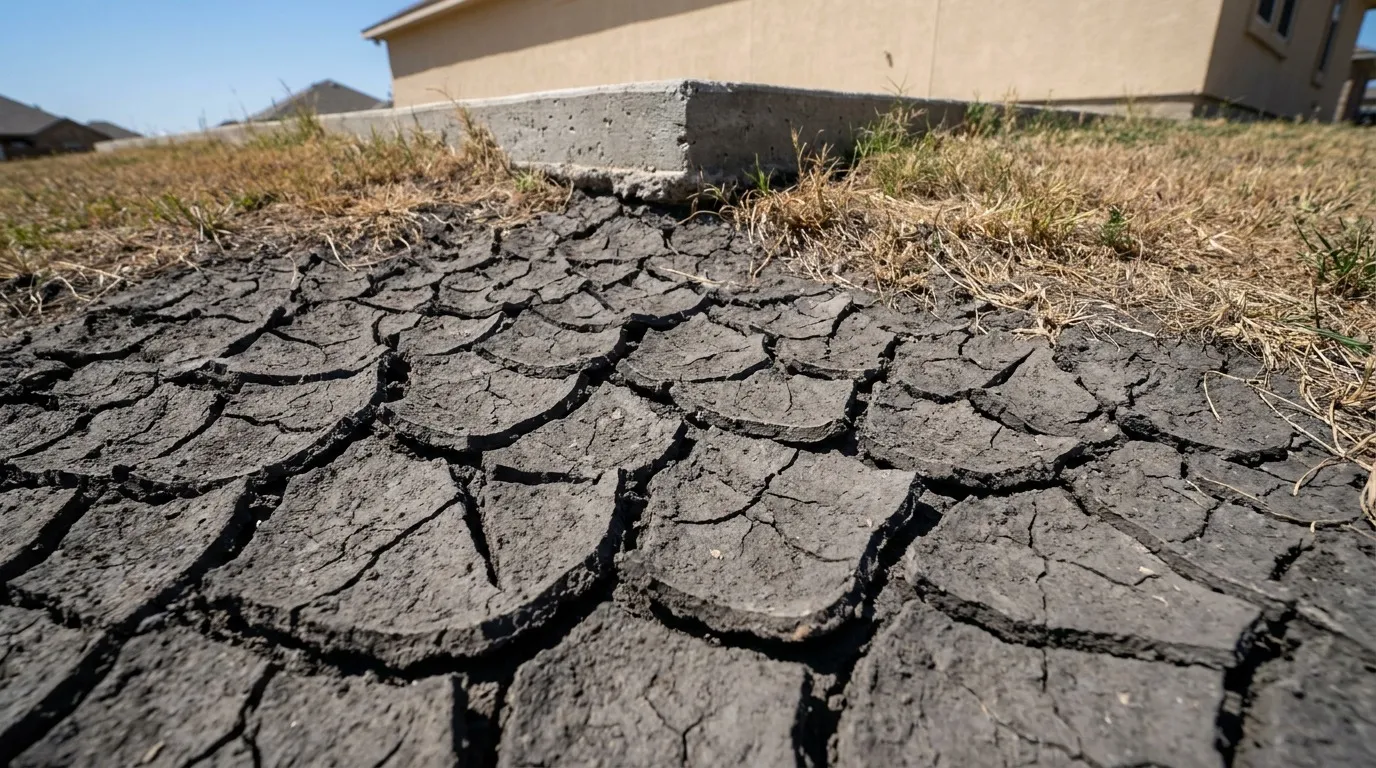
A concrete driveway in Denton is not just concrete. It is a specific recipe of cement, aggregates, water, admixtures, and air, designed to perform under the realities of North Texas: high summer heat, occasional hard winter freezes, expansive clay subgrades, and 25-plus years of vehicle loading. Get the mix right, and the driveway lasts a generation. Get the mix wrong and the same slab spalls, scales, and cracks within a decade.
This guide walks through what a proper Denton residential driveway concrete mix should specify, why each element matters, and how to read the batch ticket that the ready-mix truck driver hands to your contractor at the pour. TriStar Built has spent 18 years specifying concrete mixes for driveways across Denton County, and we have seen the long-term difference between thoughtful mix design and "whatever was on the truck."
A concrete mix design is a written specification that tells the ready-mix plant exactly how much of each ingredient to put in every cubic yard. Every reputable Denton concrete contractor will have a standard residential driveway mix design they request by name or by number from their preferred plant.
The core components of a mix design are:
Each one of these matters. A homeowner does not need to be a concrete chemist to evaluate a driveway bid, but knowing what each element does and what the right specification looks like in Denton makes it possible to ask the right questions.
Compressive strength, measured in pounds per square inch (psi) at 28 days of cure, is the single most-cited spec on a concrete mix. It is also widely misunderstood.
The psi rating is a measurement of the concrete's ability to resist crushing under load. ASTM C39 testing breaks concrete cylinders that were cast at the same time the slab was poured and cured under controlled conditions, then loads them to failure 28 days later. The breaking force divided by the cylinder cross-section gives the psi number.
3,500 psi is the absolute minimum TriStar Built will accept for a residential driveway in Denton. Below this number, the concrete lacks the durability and freeze-thaw resistance needed for outdoor exposure in North Texas. Some contractors will quote 3,000 psi mixes for residential work. We recommend politely declining.
4,000 psi is the TriStar Built standard for residential driveways in Denton County, and it is the recommendation we put in writing on every contract. The 500 psi difference between 3,500 and 4,000 psi yields roughly 14 percent more compressive strength, better resistance to abrasion from tire scuffing, and notably better long-term durability under freeze-thaw exposure. The price difference for the batch is approximately $7 to $12 per cubic yard, which works out to $80 to $130 for a typical 600-square-foot driveway. That is among the cheapest performance upgrades on the entire project.
4,500 psi or 5,000 psi mixes are appropriate for driveways with heavier load expectations: RV pads, commercial vehicle parking, dually truck pads, or any slab that will see frequent heavy equipment. The premium is $15 to $25 per cubic yard, and the durability benefit shows up in resistance to surface scaling and reduced micro-cracking under repeated heavy loads. For a standard residential driveway, 4,000 psi is enough. For a heavy-duty pad, 4,500 psi is the right call.
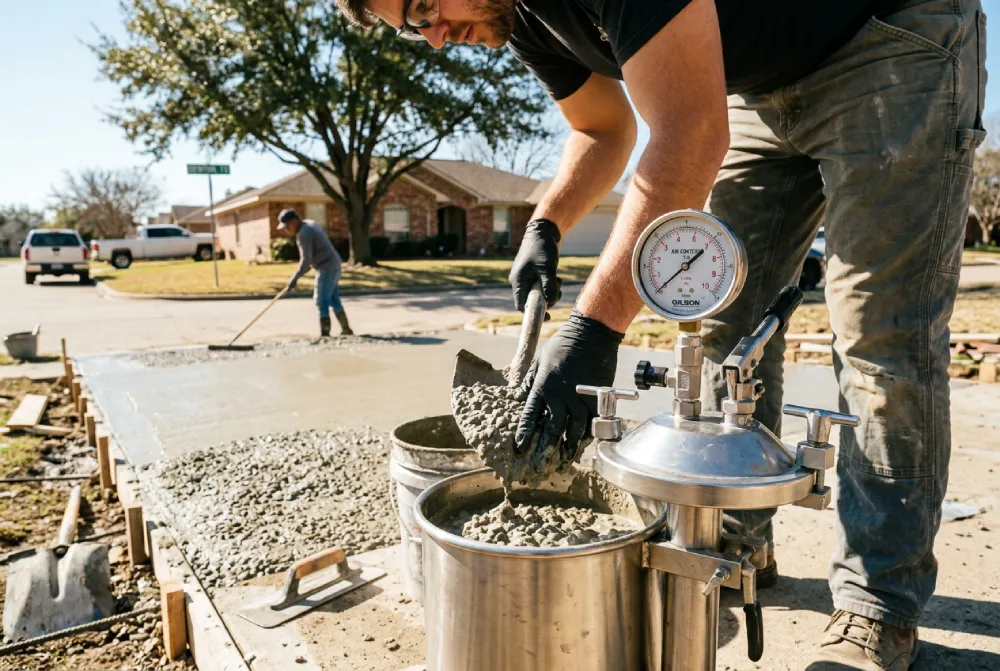
Air entrainment is the deliberate introduction of microscopic air bubbles into the concrete during mixing. These tiny air voids, distributed evenly through the slab, are critical to the long-term durability of any outdoor concrete in a freeze-thaw climate like North Texas.
Here is why. When water in the concrete pore structure freezes, it expands roughly 9 percent. Without somewhere for that expansion pressure to relieve, the concrete surface scales and spalls. The tiny air bubbles created by air-entraining admixture act as pressure relief valves. Water can expand into them as it freezes, and the concrete surface stays intact.
North Texas sits in the ACI 318 "moderate exposure" category for freeze-thaw. The correct air content range is:
The TriStar Built specification is 5 percent plus or minus 1 percent air content, achieved with an ASTM C260-compliant air-entraining admixture (Sika AEA-15, Master Builders MB-AE 90, or equivalent). The actual air content gets tested at the pour site with a pressure meter (ASTM C231) before the truck unloads.
The bad news is that air content failures are invisible once the slab is finished. A driveway poured with 2 percent air will look identical to one poured with 5 percent air. The difference shows up 3 to 7 years later, when the 2 percent slab starts scaling and surface-peeling after a hard freeze cycle. By then, the contractor is gone and the warranty is expired. This is exactly why getting air content right on day one matters.
The water-to-cement ratio, often called the w/c ratio, is the weight of water divided by the weight of cement in the mix. It is the single most important factor controlling the long-term durability of concrete, even more so than the psi rating.
A lower water-to-cement ratio produces denser, less permeable, more durable concrete. A higher water-to-cement ratio produces concrete that flows easier on pour day but is weaker and far more permeable to moisture, salt, and freeze damage over the long term.
The TriStar Built specification is:
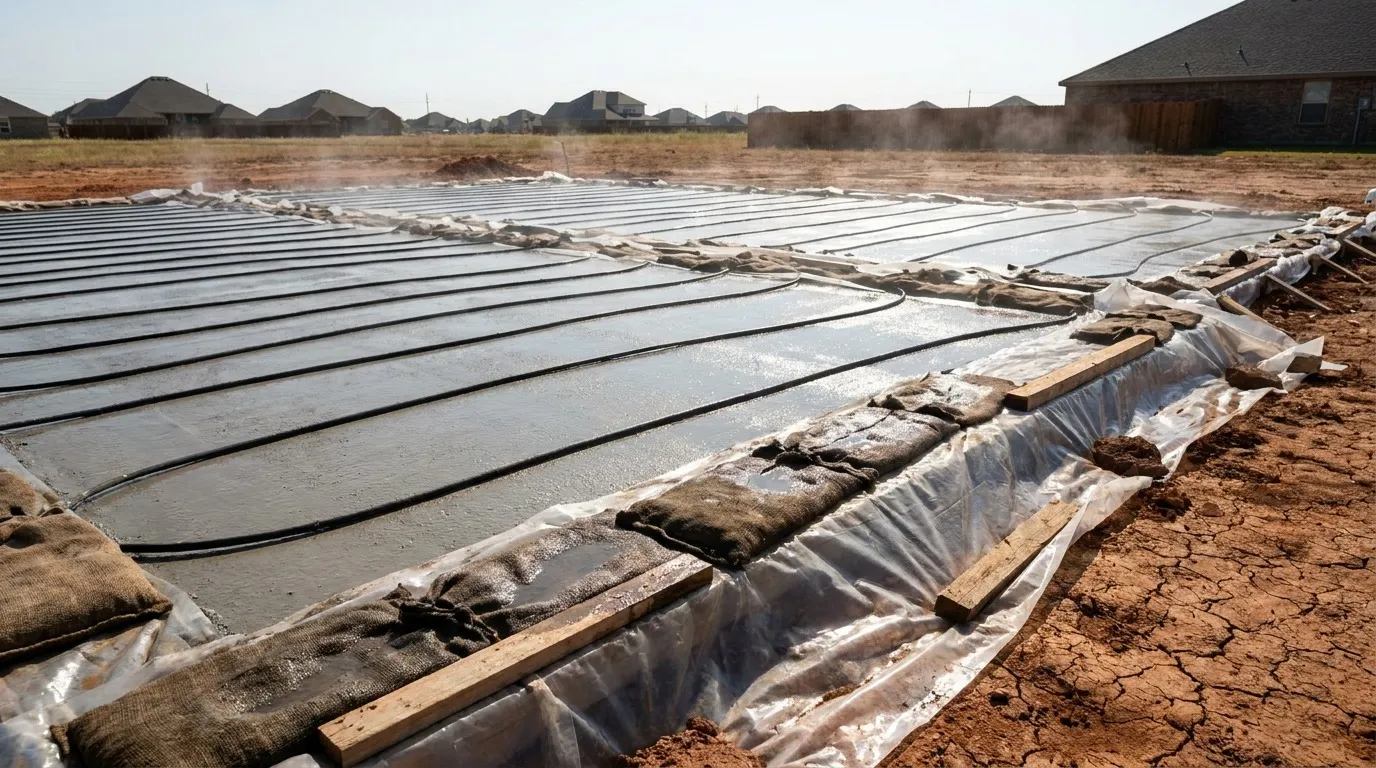
Here is the practical problem: workers on a pour will sometimes add water to the truck to make the mix flow easier. This is called "tempering the mix," and it raises the water-to-cement ratio, weakens the concrete, and reduces long-term durability. Every reputable Denton concrete contractor refuses to add water to the pour site. The proper solution to a low slump is a high-range water-reducing admixture, not a bucket of water.
Slump is the measurement of how much fresh concrete sags when a slump cone (a standardized 12-inch cone) is filled with fresh mix and lifted. It is a quick field test for the workability of the concrete.
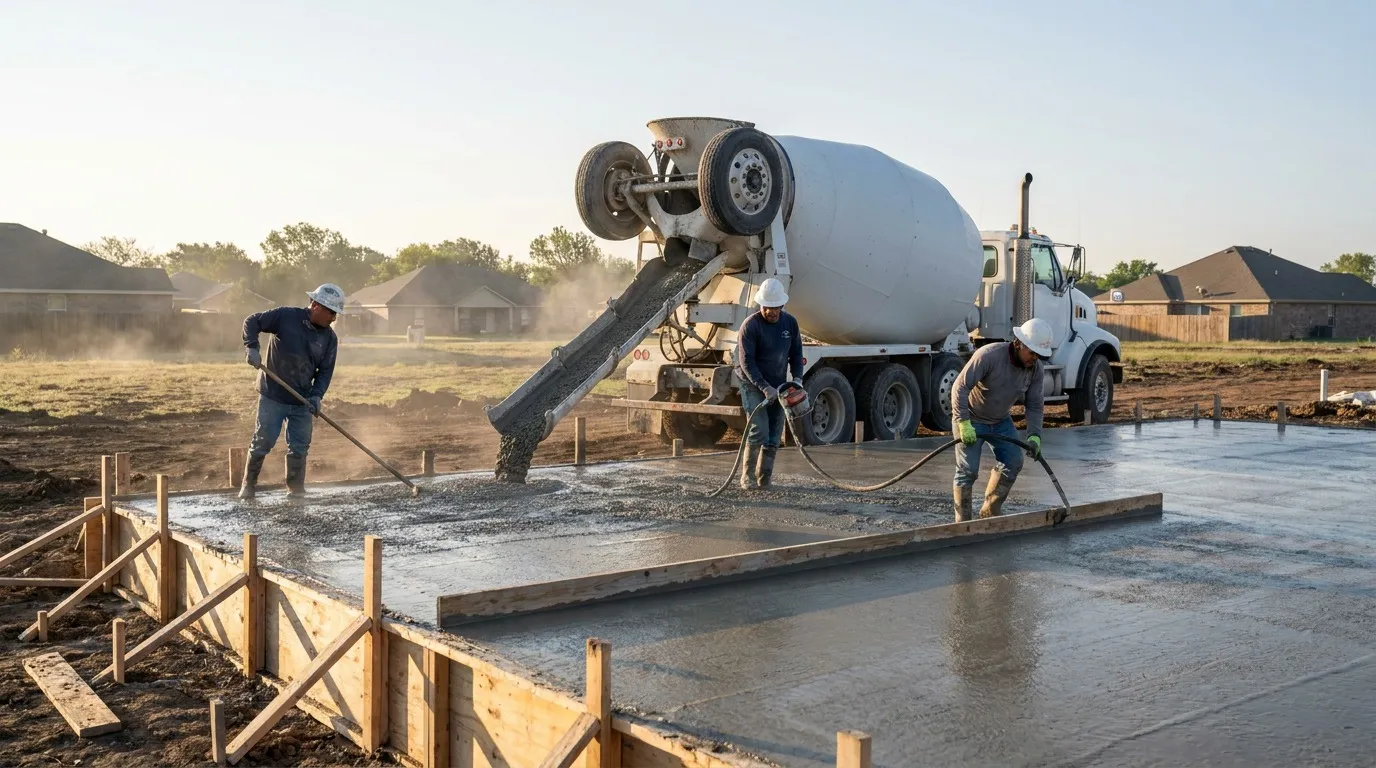
The Denton driveway standard is a 4-inch slump, plus or minus 1 inch. That measurement means the concrete is workable enough to place, screed, and finish without effort, but stiff enough to hold its shape and not segregate (water rising to the surface, aggregates settling to the bottom).
Lower slumps (2 to 3 inches) are stiffer and harder to place but produce denser, stronger concrete. Higher slumps (5 to 7 inches) flow easily but indicate either too much water (bad) or the use of a high-range water reducer (fine).
For a homeowner watching the pour, a contractor who refuses water additions at the truck and uses high-range water reducers when more workability is needed is signaling that mix design discipline matters to them. That is the kind of practice that produces 30-year driveways.
Modern concrete mixes often include fly ash or slag cement as a partial replacement for portland cement. These supplementary cementitious materials (SCMs) bring real durability benefits:
The TriStar Built specification allows up to 20 percent Class F fly ash replacement of portland cement, or 30 percent ground granulated blast furnace slag, in standard residential driveway mixes. The properly dosed mix performs as well or better than 100% Portland cement and costs slightly less per cubic yard.
What homeowners should not accept is fly ash dosed at more than 25 percent unless the engineer has specifically approved the mix. Overdoses slow strength gain in cool weather and can lead to set-time complications.
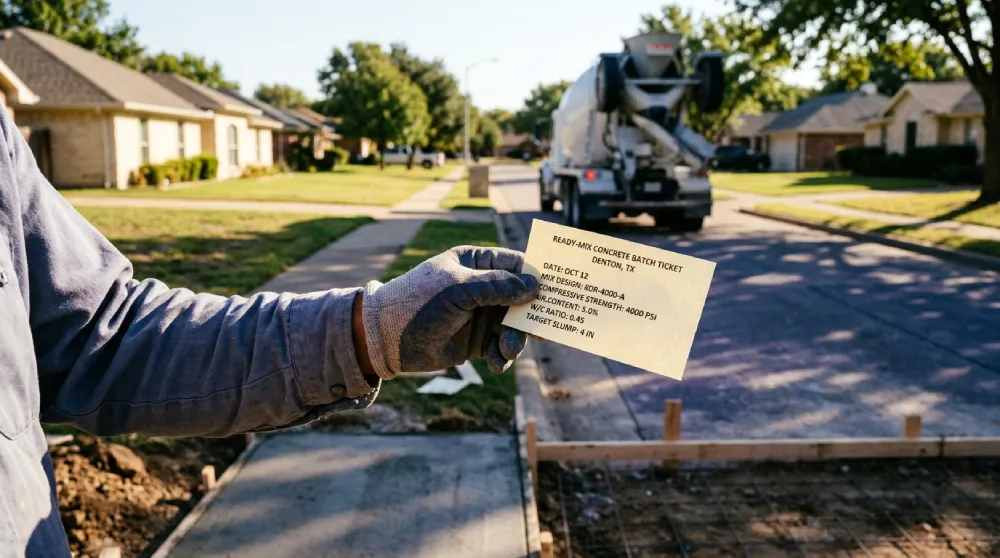
When the ready-mix truck arrives at your driveway pour, the driver hands the contractor a batch ticket, a printed receipt from the ready-mix plant listing every ingredient in the load. This is the primary documentation of what concrete actually showed up. Every reputable contractor reads it. Every homeowner should be able to read it, too.
A standard batch ticket from TXI, Martin Marietta, or Holcim will list:
What to verify on the batch ticket:
| Specification | What to Look For |
| Mix design | Matches the mix specified in the bid (4,000 psi typical) |
| Cement weight | Approximately 550-600 lb/yd for 4,000 psi mix |
| Water-cement ratio | Should be 0.45 or lower |
| Air-entraining admixture | Sika AEA, MB-AE 90, or equivalent, dosed per spec |
| Fiber | If specified in bid, fiber bag count should match |
| Total water | Plant water plus any noted truck additions should match spec |
If the contractor will not show you the batch ticket, that is a red flag. If the batch ticket shows a mix you did not bid for, stop the pour and call the supplier. Concrete mistakes are correctable in the first 90 minutes after batching. They are catastrophic after the slab sets.
For a typical Denton residential driveway, the TriStar Built standard concrete specification is:
This specification is on every TSB residential driveway contract. The local ready-mix plants in Denton, Sanger, and Argyle all have this mix on file as our standard pull, which makes ordering and verification simple.
In our 18 years of pouring in Denton County, the most common mix-related problems we see on competitor work are:
Every one of these failures is preventable with a mixed-discipline approach and a contractor who takes the specification seriously.
4,000 psi is the right specification for a Denton residential driveway. This provides adequate compressive strength, good durability under freeze-thaw cycles, and reasonable cost. 3,500 psi is the absolute minimum we recommend. Anything below that, including the 3,000 psi mixes some contractors quote, is inappropriate for an outdoor driveway slab in North Texas.
Air entrainment is the deliberate introduction of microscopic air bubbles into concrete during mixing to provide pressure relief space when water in the concrete freezes and expands. In North Texas, where freeze-thaw cycles happen 10 to 25 times a winter, properly air-entrained concrete resists the surface scaling and spalling that destroys non-air-entrained outdoor slabs. The right range for Denton driveways is 5 percent plus or minus 1 percent.
No, and this is one of the most important points in the entire mix discussion. Adding water at the truck increases the water-to-cement ratio, weakens the concrete, and reduces long-term durability. The proper way to increase workability is with a water-reducing admixture, not a bucket of water. Any contractor who allows or asks for water additions at the truck is compromising the long-term quality of the slab.
Fly ash is a byproduct of coal-fired power plants that, when used as a partial replacement for Portland cement, improves long-term concrete durability and reduces permeability. Up to 20 percent Class F fly ash replacement is acceptable for Denton residential driveways. Higher percentages are appropriate only with specific engineering review, particularly in cool-weather pours where setting time becomes a factor.
Yes, absolutely. The batch ticket is the primary documentation that the correct mix design was actually delivered. A reputable contractor will share it without question. Any reluctance to show the batch ticket should raise suspicion. Photograph it for your records, and verify that the mix design number, psi rating, water-cement ratio, and air-entraining admixture all match what was specified on your bid.
There are legitimate variations in concrete mix design across different contractors and ready-mix plants. The specific brand names and admixtures change, but the core specifications, 4,000 psi minimum, 5 percent air content, 0.45 maximum water-cement ratio, 4-inch slump, are industry standards that apply broadly across North Texas residential driveway construction. If your contractor's mix differs significantly on one of those four core specifications, ask why. There may be a good reason. Or there may be a savings calculation you should be aware of.
By industry convention, the rated psi (4,000 psi for our standard driveway spec) is the strength at 28 days of moist curing under controlled conditions. The slab reaches roughly 70 percent of design strength at 7 days, 85 percent at 14 days, and the full 100 percent at 28 days. The slab continues to gain strength gradually beyond 28 days, but the 28-day number is the specification benchmark.
Concrete mix design is the invisible specification on a driveway contract. The slab looks the same whether the mix was right or wrong, and the difference between a 30-year driveway and a 10-year driveway is largely determined by the ready-mix batch ticket, which almost no homeowner reads. The right mix costs a few hundred dollars more than the wrong one and adds decades to the slab's life.
If you are planning a concrete driveway project in Denton, Argyle, Flower Mound, Highland Village, Corinth, or anywhere across Denton County and want to see the TriStar Built mix specification on your contract before you sign, call (940) 381-2222 or visit www.tristarbuilt.com to start a conversation.


Whether you’re remodeling a home, expanding a business, or starting from the ground up, TriStar Built is here to guide you every step of the way. With a focus on craftsmanship, communication, and results that last, we make the construction process clear, smooth, and worth every investment.

LOCATION: 2126 James Street, Denton, TX 76205
PHONE: (940) 381-2222
© 2025 TRISTAR BUILT - ALL RIGHTS RESERVED | WEB DESIGN & SEO BY: Authority Solutions®