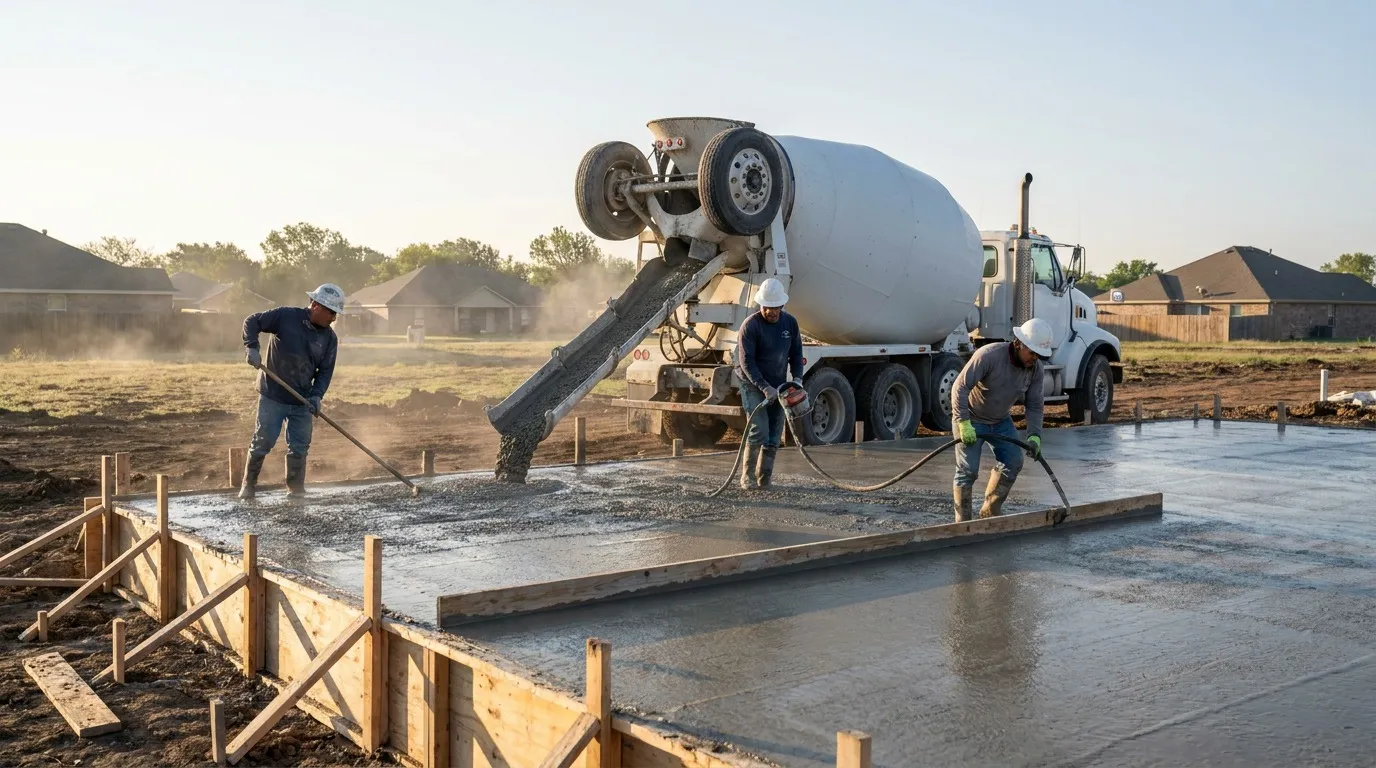
Post-tension slabs use high-strength steel cables tensioned after the concrete cures, providing continuous compression that resists cracking from soil movement. They are the dominant choice for production home construction in Denton and North Texas. Rebar-reinforced slabs use conventional deformed steel bars placed before the pour and rely on concrete tensile strength and rebar bond. Both work when engineered and installed correctly for expansive Blackland Prairie clay. The choice usually comes down to design intent, custom vs production build, and repair philosophy over the foundation's life.
Ask five foundation contractors in Denton whether post-tension or conventional rebar is the better choice for a residential slab, and you'll get five confident answers plus five different reasons. The truth is more nuanced. Both systems perform well on Denton's Blackland Prairie clay when engineered correctly, and both fail predictably when they aren't. Understanding the real tradeoffs helps homeowners and builders make the right call for the specific project.
At TriStar Built, we've installed both systems across Denton, Argyle, Corinth, Flower Mound, and the surrounding North Texas cities since 2006. This guide walks through the honest performance, cost, and practical differences between post-tension and rebar slabs so homeowners can have an informed conversation with their contractor and structural engineer.
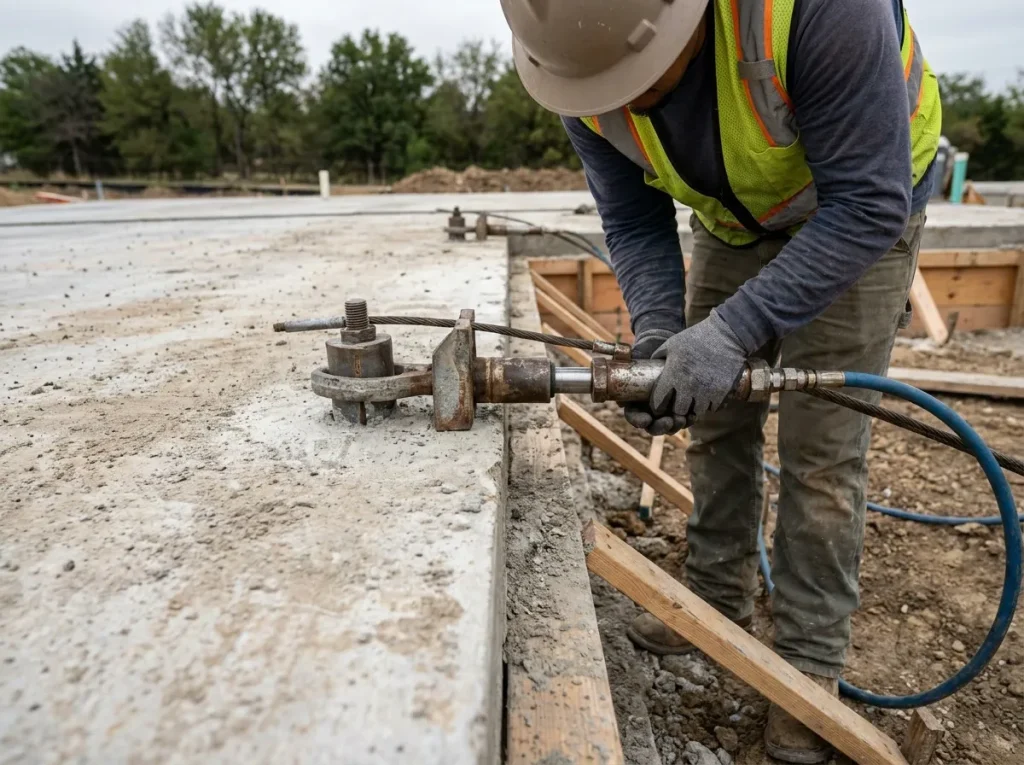
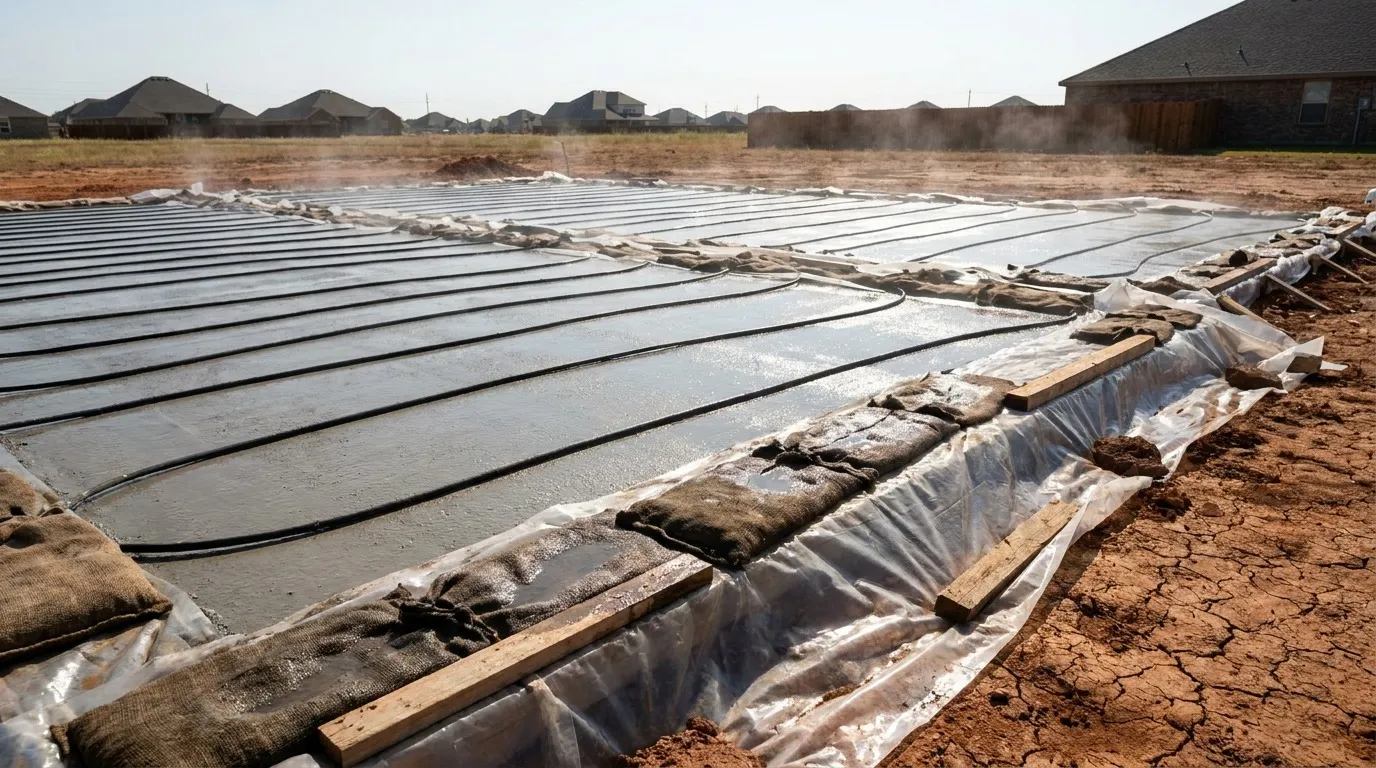
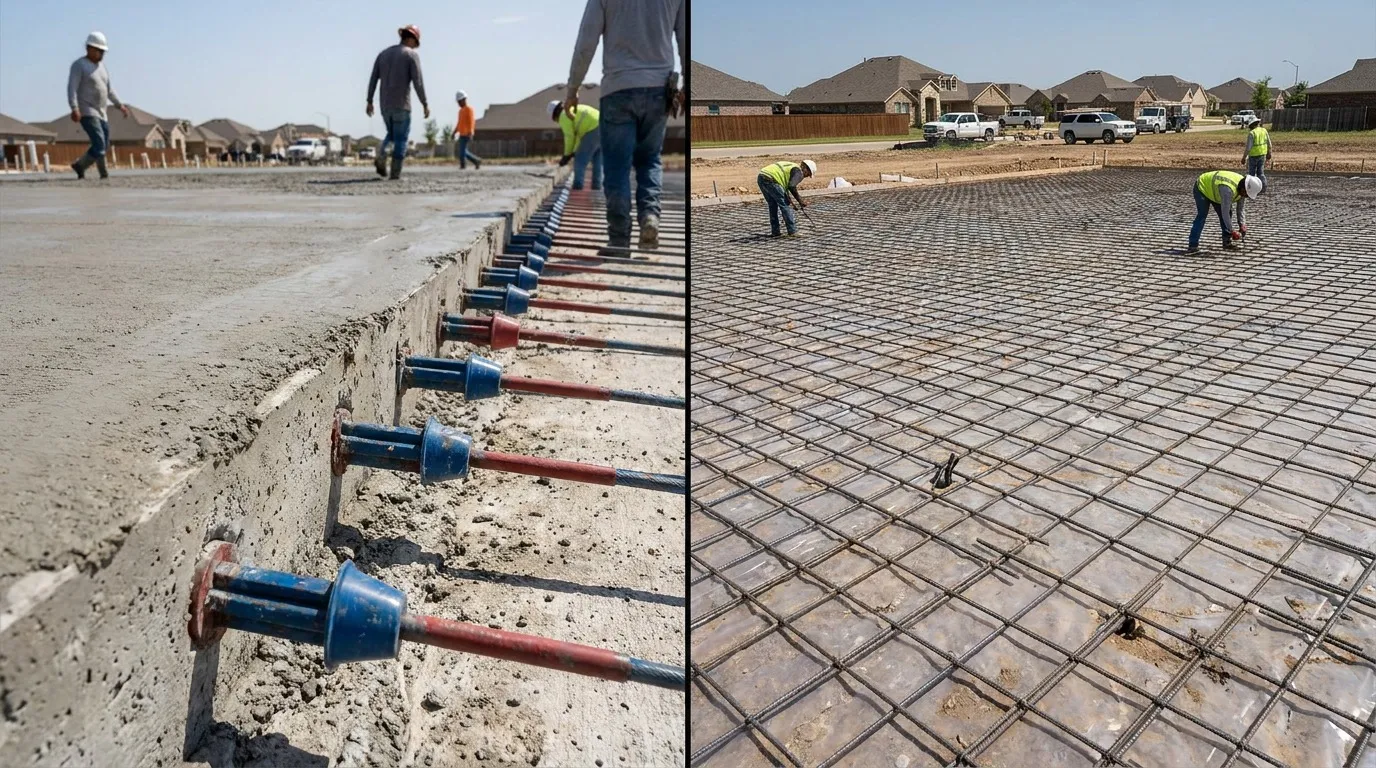
A post-tension slab is poured over a plastic sheath containing high-strength steel cables (tendons) arranged in a grid pattern typically 3 to 5 feet apart. Once the concrete cures to design strength (usually at 7 days), each cable is tensioned by a hydraulic ram at anchor points along the slab edge, typically to 33,000 pounds of force per cable. The cured concrete is then held in continuous compression by the tensioned cables, which dramatically increases the slab's ability to resist tension cracking from soil movement.
Post-tension technology was developed for commercial and highway applications and has become the dominant residential foundation choice across Texas and other high-shrink-swell soil regions. The Post-Tensioning Institute standards adopted by most Texas municipal codes, and reputable installers work within those guidelines. On Denton's Blackland Prairie clay, a properly engineered post-tension slab handles up to 3/4 inch of vertical soil movement without visible cracking.
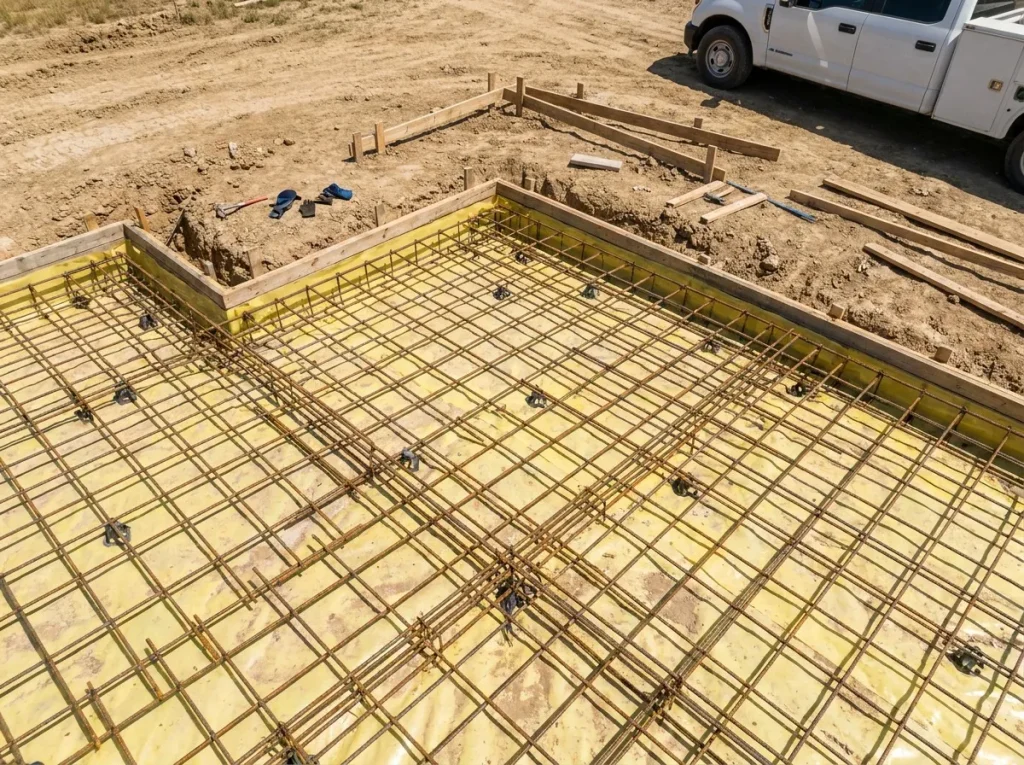
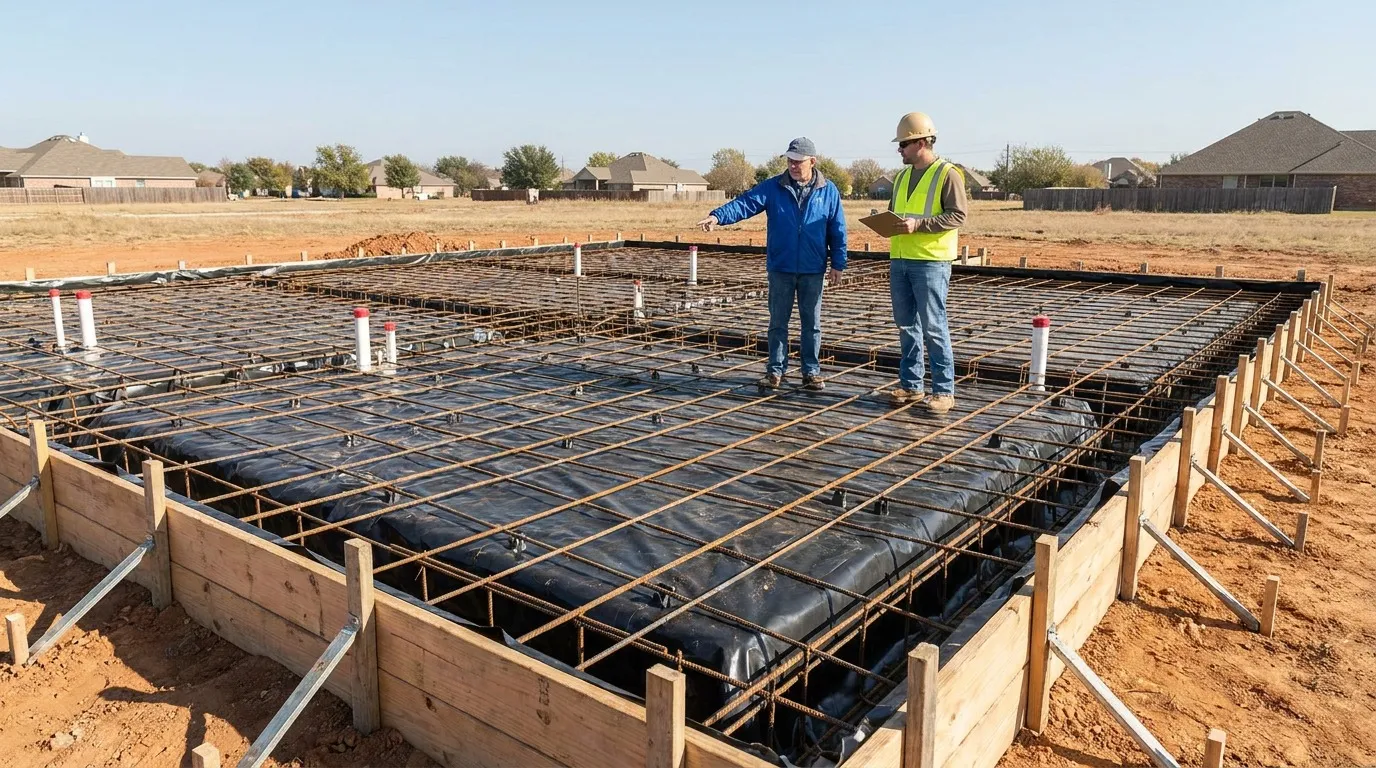
A conventional rebar slab uses deformed steel bars (typically #4 or #5, size referring to 1/8-inch diameter increments) placed on chairs above the vapor barrier before the pour. The bars are tied into a grid at 12- to 18-inch centers and lapped 30 diameters where they splice. Additional reinforcement is added around openings, at edges, and at load-bearing points per the structural engineer's design.
The concrete provides compression strength; the rebar handles tension. When the slab experiences tensile stress from soil movement, the bond between the rebar and the surrounding concrete transfers load to the steel, which resists elongation. Rebar slabs have been the historical residential standard across the United States and remain common in custom builds where flexibility and future modification value are prioritized.
Head-to-head on the factors that matter to Denton homeowners.
| Factor | Post-Tension | Conventional Rebar |
|---|---|---|
| Typical residential use | Production homes, most new subdivisions | Custom builds, additions, garage slabs |
| Installed cost (per sq ft, 2,400 sq ft slab) | $8.00 to $12.50 | $9.00 to $14.00 |
| Design life | 40-plus years | 40-plus years |
| Crack resistance on Denton clay | Excellent | Very good |
| Cutting or coring later (kitchen island, plumbing) | Requires specialist; risk of tendon strike | Standard concrete cutting |
| Repair complexity if damaged | Higher; specialty contractor needed | Lower; conventional repair techniques |
| Field flexibility during install | Lower; requires exact engineering | Higher; easier to adjust in field |
| Insurance and warranty availability | Standard for Texas market | Standard for Texas market |
Both slab types are covered under standard Texas residential warranty programs. Insurance underwriting treats them equivalently. The real differences show up in cost, install precision, and post-construction modification flexibility.
Post-tension makes the most sense on:
Production home construction where slab designs are repeated across many houses and the engineering has been optimized for local soil conditions. Denton subdivisions in Robson Ranch, Pecan Creek, and newer developments in Argyle predominantly use post-tension because of the cost efficiency at scale.
Large slabs over 3,000 sq ft where the crack-resistance advantage translates directly to fewer cosmetic issues over the slab's life.
Cost-sensitive projects where the 10 to 20 percent savings on a large slab is meaningful to the project budget.
Standardized floor plans where post-construction modifications like adding an island or moving a wet wall aren't anticipated. Any coring or cutting near tendons after tensioning is a specialty job.
Conventional rebar makes the most sense on:
Custom home builds where the owner may want future modification flexibility, including moving plumbing lines, adding structural loads, or coring for stair openings. The foundation site preparation works for both, but rebar accepts field changes more easily.
Additions to existing rebar-slab homes where matching the existing system is structurally cleaner.
Small slabs (garages, detached workshops, ADUs) under 1,200 sq ft where post-tension mobilization costs don't pay back.
Projects requiring conventional local trades for maintenance and repair. Denton has more general concrete contractors than post-tension specialists, so repair calls tend to be faster and less expensive on rebar slabs.
Whichever system is chosen, a licensed structural engineer should stamp the foundation plan. Texas Board of Professional Engineers licensing requirements apply to any foundation design for a permitted residential structure in Denton County. Homeowners considering a foundation contractor should ask specifically about the engineer of record, review the stamped plans, and understand the specifications before pour day.
Common engineering specifications to verify: concrete strength (typically 3,000 PSI minimum for post-tension, 3,500 PSI for rebar), reinforcement placement (tolerances typically 1/2 inch), post-tension tendon load (32,000 to 34,000 pounds), edge distance, and rebar chair spacing. The ICC IRC 2021 foundations chapter set the code minimums; the engineer's stamped plan sets the project-specific requirements.
Three questions Denton homeowners should ask before committing to either foundation type.
"What's the geotechnical soil report say?" The engineer designs the foundation based on the soil profile. Without a soil report, the design is generic and often over-conservative or under-designed. Related reading: our foundation site preparation.
"What's your quality control process during install?" For post-tension: cable placement documentation, tensioning force logs, and tendon condition verification. For rebar: chair spacing, tie quality, and clearance checks. Both should be documented in writing.
"What happens if the slab needs future modification?" If a homeowner plans to add a kitchen island, expand a bathroom, or add a wet bar down the road, a rebar slab is much friendlier to those changes. Post-tension coring requires specialty scanning and often creative workarounds.
For homeowners looking to vet the contractor overall, our vetting a driveway contractor covers a similar framework applicable to foundation work.
Actual pricing for the Denton area as of mid-2026 for a standard 2,400 sq ft residential slab.
| Cost Component | Post-Tension | Conventional Rebar |
|---|---|---|
| Materials | $8,900 to $13,600 | $10,200 to $15,800 |
| Labor | $6,800 to $10,400 | $7,200 to $11,600 |
| Engineering | $2,400 to $4,200 | $2,400 to $4,200 |
| Site prep | $11,800 to $24,900 | $11,800 to $24,900 |
| Concrete pump and finishing | $2,600 to $4,200 | $2,600 to $4,200 |
| Total foundation | $32,500 to $57,300 | $34,200 to $60,700 |
The cost gap narrows significantly on smaller slabs and can reverse (rebar cheaper) on very small slabs where post-tension mobilization is a fixed overhead. For a typical Denton residential foundation, expect a 3 to 8 percent cost advantage to post-tension.
Both perform well when engineered correctly. Post-tension has a slight edge in crack resistance under aggressive soil movement; rebar has an edge in field flexibility and repair simplicity. Choice depends on project priorities.
No. Post-tension is the dominant residential foundation type in Texas and is recognized as standard by every major real estate market participant.
Only with proper tendon scanning and either careful placement between tendons or specialty coring techniques. Striking a tensioned cable is a serious safety and structural issue.
The cables themselves are designed for 40-plus years of service. Failures are rare when the installation was done correctly. Long-term monitoring is not typically required for residential slabs.
Not usually. Reputable Denton foundation contractors offer 1- to 10-year workmanship warranties on both systems. Structural warranty programs (like 2-10 HomeBuyers Warranty) cover both.
Very rare. If it happens, the affected zone is diagnosed by specialty inspection and either re-anchored or supplemented with additional external reinforcement. Cost is typically $1,500 to $6,000 depending on scope.
Nearly identical. Slab thickness (typically 4 to 6 inches for both systems) is dictated by the load design, not the reinforcement type.
For most Denton homeowners, the post-tension vs rebar question ends up being decided by the builder's standard practice more than by an active homeowner decision. Both systems work. What matters more is whether the engineer of record designed the foundation for the specific soil profile, whether the installer followed the design, and whether quality control was documented at each step.
TriStar Built has been engineering and installing residential foundations across Denton, Argyle, Corinth, Flower Mound, and the surrounding North Texas cities since 2006. Whether the project calls for post-tension or conventional rebar, our team handles design coordination, licensed engineering, and documented installation quality. See our foundation and slab services page for scope and process.


Whether you’re remodeling a home, expanding a business, or starting from the ground up, TriStar Built is here to guide you every step of the way. With a focus on craftsmanship, communication, and results that last, we make the construction process clear, smooth, and worth every investment.

LOCATION: 2126 James Street, Denton, TX 76205
PHONE: (940) 381-2222
© 2025 TRISTAR BUILT - ALL RIGHTS RESERVED | WEB DESIGN & SEO BY: Authority Solutions®