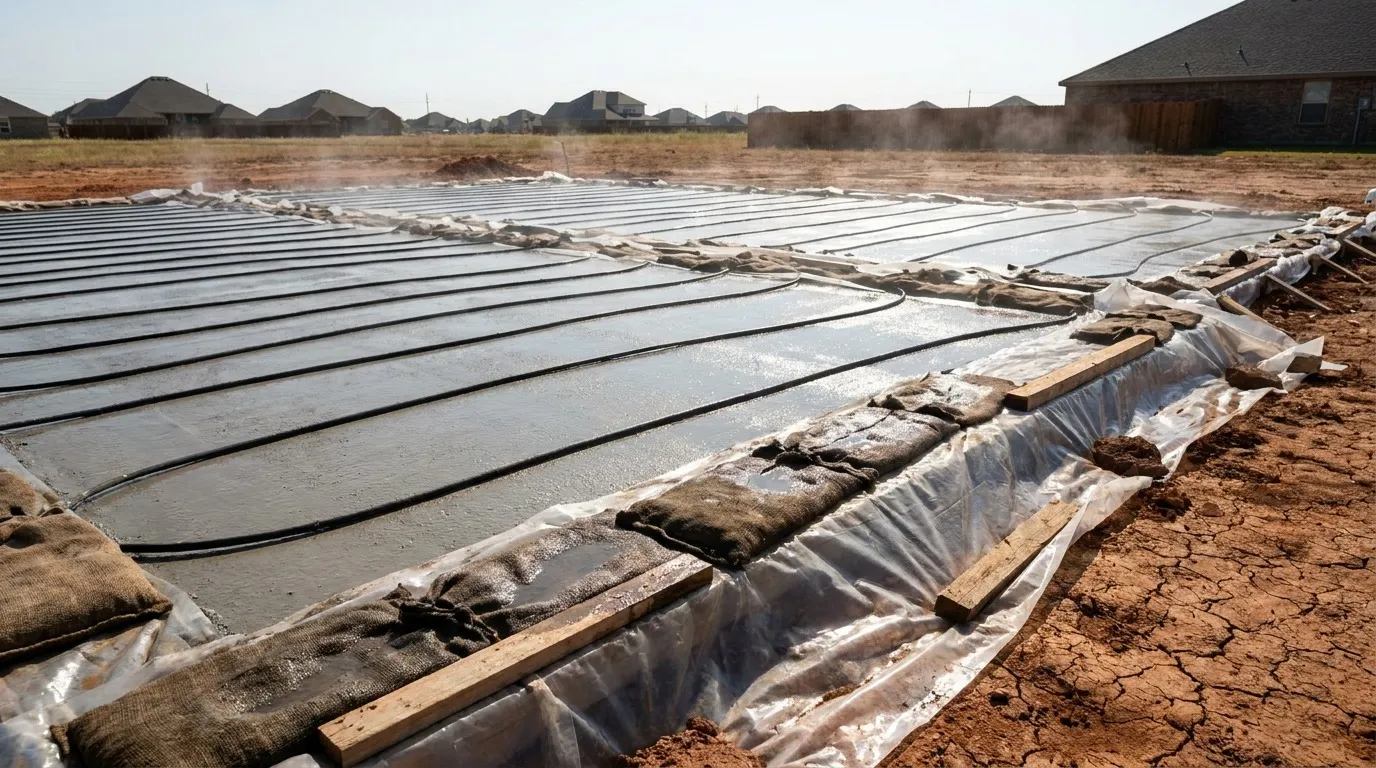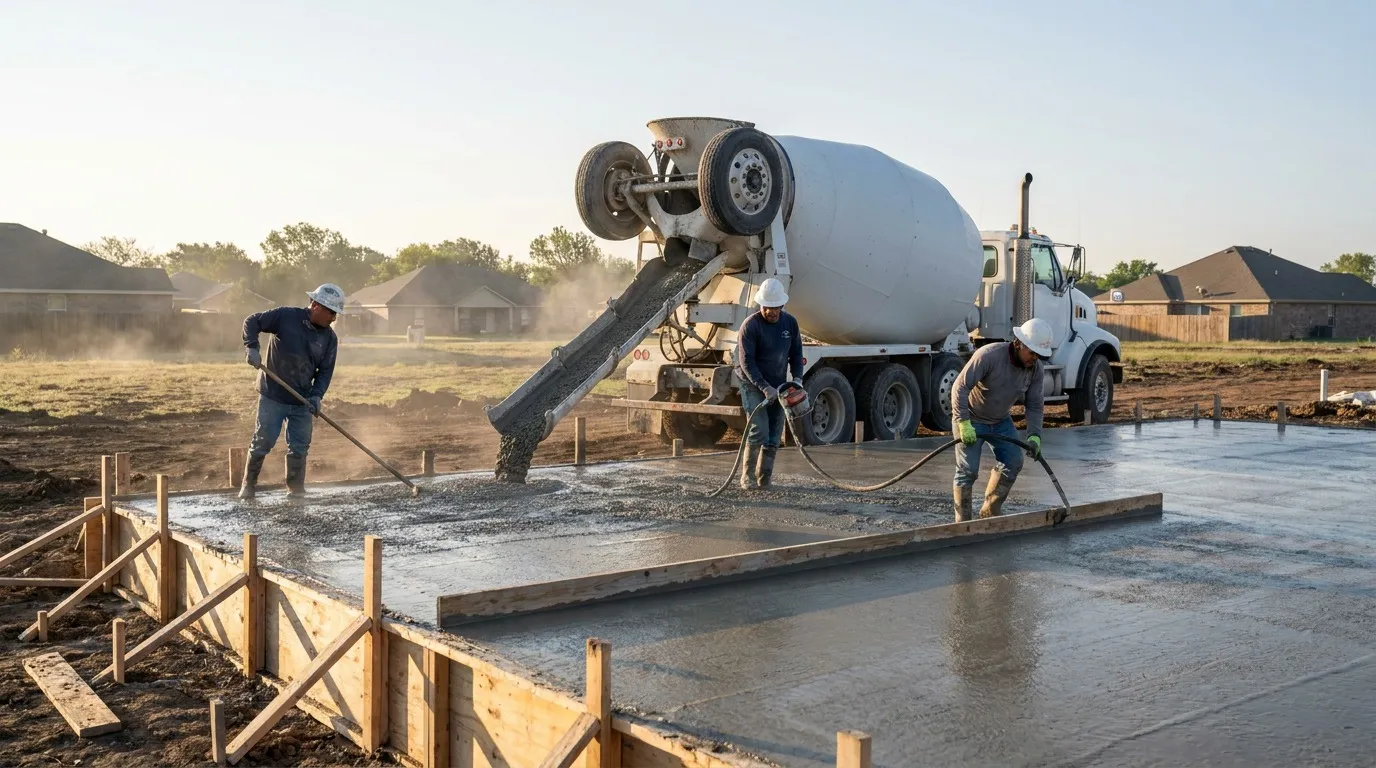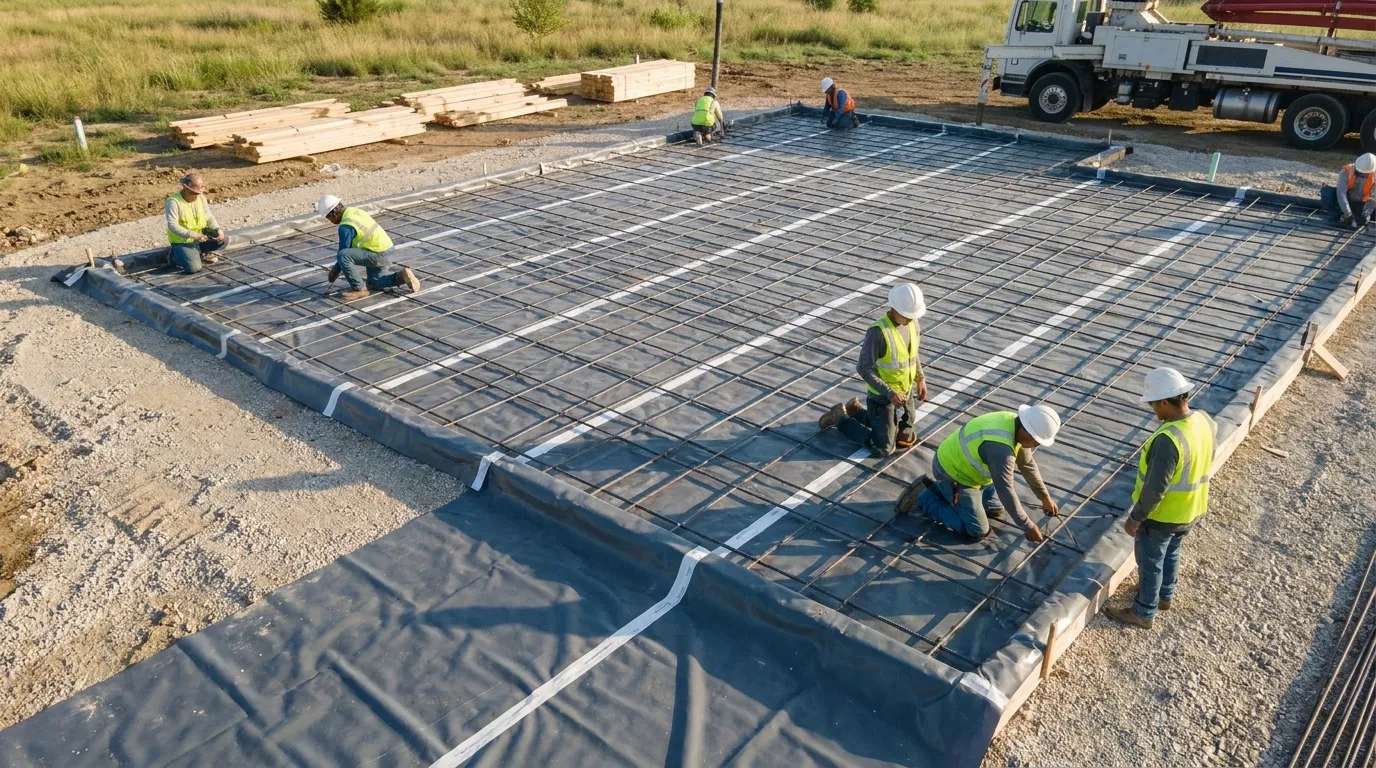
Every residential slab in Denton should have a 10-mil (minimum) polyethylene vapor barrier installed directly beneath the concrete with all seams overlapped 12 inches and taped, penetrations sealed, and no punctures. The vapor barrier prevents ground moisture from wicking up through the slab, protects the finished flooring installed later, and creates a slip surface that allows the slab to move independently of the base during seasonal soil expansion. Skipping or damaging the vapor barrier is one of the most common installation shortcuts in Denton residential construction and shows up as flooring failure, mold, and slab moisture problems within 3 to 7 years.
The vapor barrier under a concrete slab is a $200 to $600 material line item on a foundation project. That's roughly one-half of one percent of the total foundation cost. Yet it's the single most impactful moisture protection element on the finished house. Concrete is porous. Without a barrier between the slab and the ground below, ground moisture slowly migrates up through the slab, delivers water vapor to the finished floor, and causes hardwood cupping, laminate delamination, tile grout darkening, and adhesive failure on any glue-down flooring.
At TriStar Built, we install vapor barriers on every foundation we pour. This guide walks through what a proper vapor barrier is, why Denton conditions make it non-negotiable, and how to spot the shortcuts that cause long-term problems.
A vapor barrier is a continuous, impermeable sheet placed between the compacted aggregate base and the concrete slab. It performs three simultaneous jobs, all critical to long-term foundation and floor performance.
Ground moisture in Denton soil is nearly always present. During Denton spring and fall, saturated soil pushes water vapor upward at rates that would be measurable in gallons per year through an unprotected slab. A quality vapor barrier drops that migration by 95 percent or more.
The barrier creates a very-low-friction interface between the slab and the base. When Blackland Prairie clay expands or contracts seasonally, the slab can slide slightly rather than being restrained by direct contact with the base. This flexibility reduces cracking.
In areas where radon or other soil gases are a concern, a properly sealed vapor barrier significantly reduces migration into the living space. Denton is not a high-radon zone, but the EPA still recommends vapor barrier installation on all slab-on-grade construction.
The Environmental Protection Agency's EPA radon-resistant construction guide documents the technical requirements, and the ICC IRC 2021 foundations chapter set the code minimum specifications.
North Texas has three regional characteristics that make vapor barrier installation more important than in many other climates.
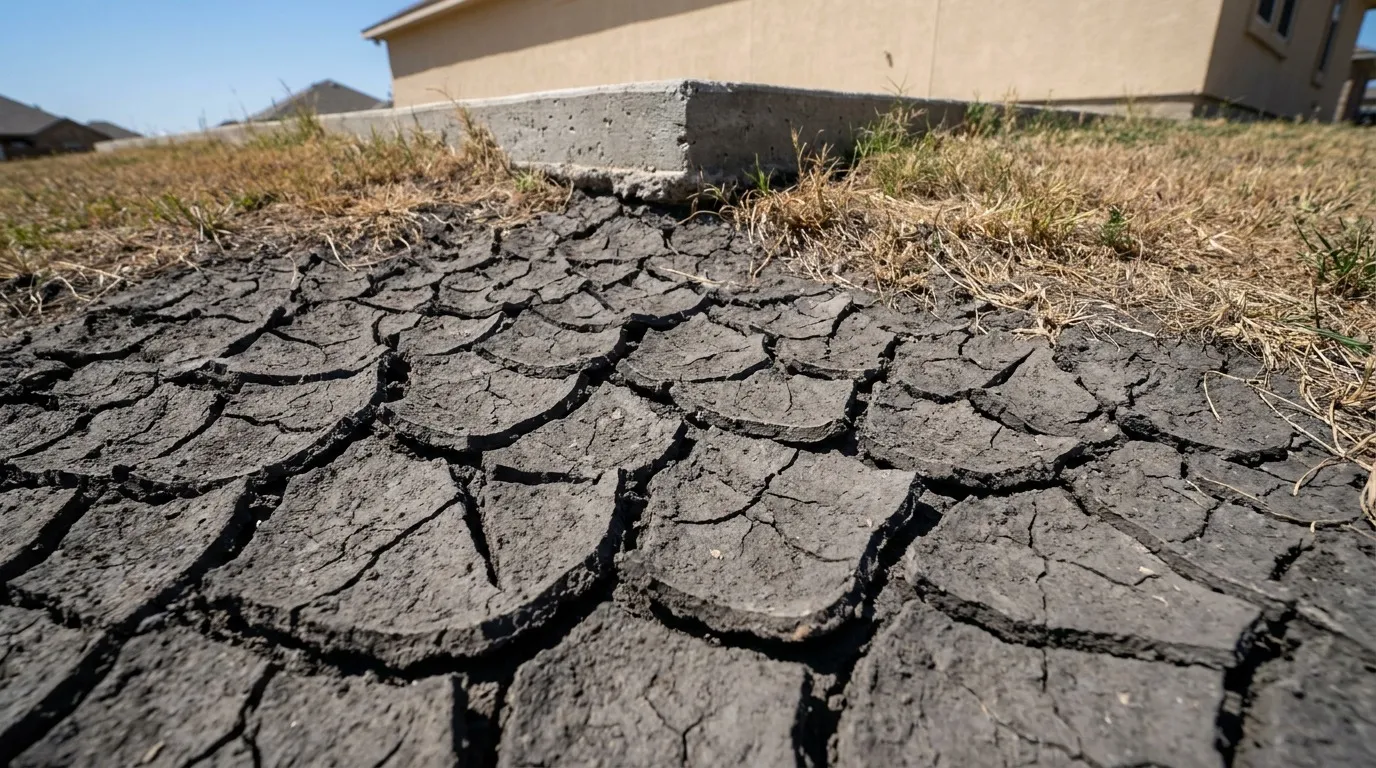
Denton County soils hold moisture for extended periods after wet weather. Even during summer, clay depths of 12 to 24 inches often remain moist. That constant reservoir feeds continuous vapor migration into any unprotected slab above.
Denton's climate averages 65 percent relative humidity year-round. A slab that absorbs moisture from below and re-emits it into the interior air adds significantly to indoor humidity load, which stresses HVAC systems and can trigger mold behind flooring.
Because Denton clay drives significant seasonal slab movement, the slip-layer function of the vapor barrier becomes structurally important, not just a moisture control benefit. Foundations installed without a vapor barrier tend to develop stress cracks at panel edges more quickly than those installed with one. Our foundation site preparation covers where the vapor barrier fits into the site prep sequence.
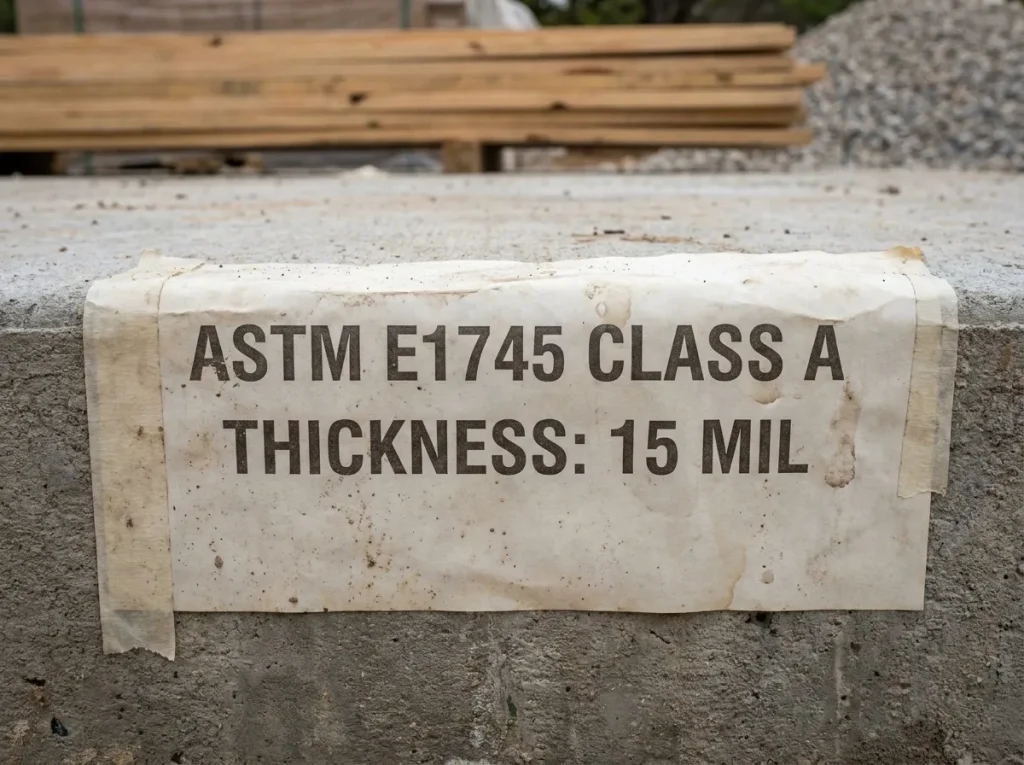
Not all vapor barriers are equal. The specifications that matter for Denton residential construction.
This is the code minimum in most Denton-area jurisdictions. Premium construction routinely uses 15-mil or 20-mil reinforced sheeting for tear resistance during installation.
Recycled polyethylene has more inclusions and pinholes than virgin material. Look for the manufacturer's certification.
Perm rating measures water vapor transmission. Class A vapor barriers per ASTM E1745 have perm ratings under 0.03. Look for the ASTM classification on the product spec sheet.
Testing per ASTM D1709 (dart drop) or ASTM E154 (puncture resistance) is documented on quality product spec sheets. Reinforced barriers (like Stego Wrap or Vaproshield) resist tears from foot traffic during rebar installation.
Tape has to match the barrier material and carry adhesive rated for concrete slab environments. Standard duct tape or house-wrap tape is not acceptable.
For homeowners overseeing a build, ask the contractor for the vapor barrier product spec sheet and confirm it meets the ASTM E1745 Class A standard. A contractor who can't produce that documentation is using a cheaper material than the project deserves.
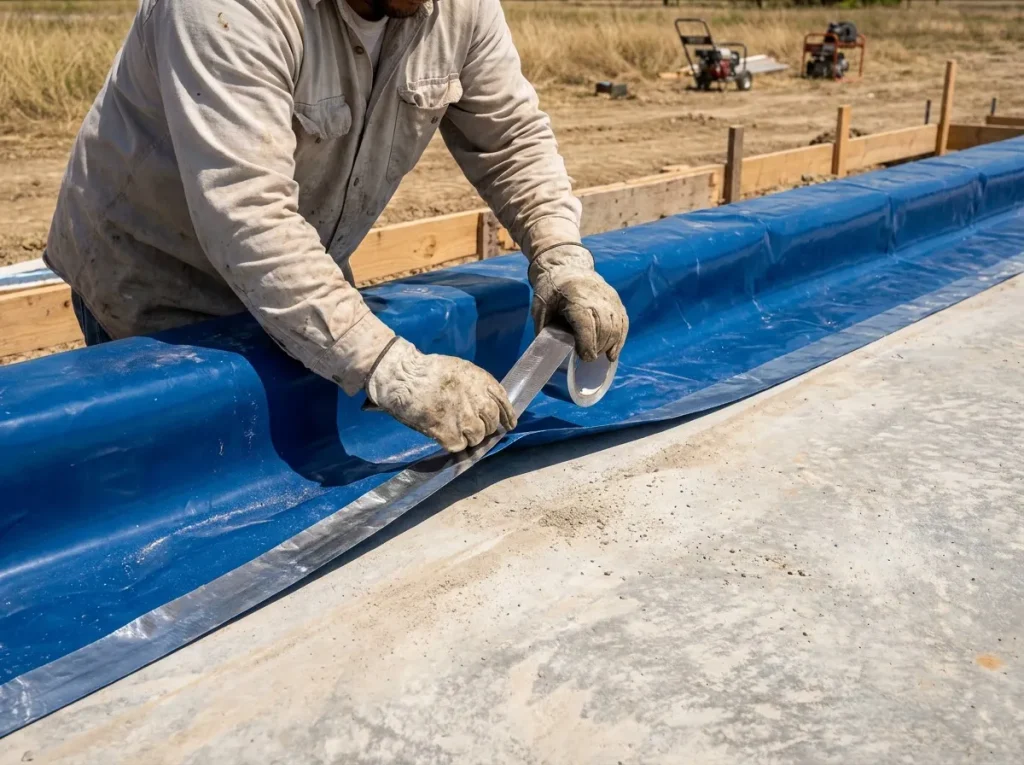
A vapor barrier only performs if it's installed correctly. Six installation details separate a working barrier from a decorative one.
The compacted aggregate base under the vapor barrier has to be smooth, with no sharp aggregate points sticking up. Sharp points puncture the barrier during installation and pour. A leveling course of finer material (screenings) is standard.
Sheets are rolled out with 12-inch minimum overlap at all seams. Overlap should be aligned so any incidental water flow moves away from the seam, not into it.
Every seam gets a continuous strip of manufacturer-approved seam tape. Half-lap taping (bottom tape and top tape) is standard on premium installations.
Plumbing rough-in, pier penetrations, and edge conditions all get boot flashings or manufacturer-approved seal details. Cut-and-fold detailing is not acceptable for penetrations; use molded boots.
The vapor barrier is the most vulnerable to damage during rebar tie-off. Workers should wear soft-soled boots, chairs should have plastic feet (not bare rebar cut-offs), and any tears should be patched immediately with matching material.
During the pre-pour inspection, the vapor barrier condition is verified. Any tears, tape failures, or penetration issues get corrected before concrete is placed. This inspection is the last chance to catch problems that will otherwise cause 30 years of moisture issues.
Three shortcuts are so common in Denton residential construction they deserve specific attention.
6-mil poly is what's sold as a general-purpose ground cover at home improvement stores. It's roughly 60 percent thinner than code-minimum vapor barrier material, tears easily during installation, and has significantly higher perm ratings. Yet it's routinely used on low-bid installations. Homeowners can spot this by asking to see the vapor barrier product label before pour day.
Untaped seams are permeable to vapor even if the sheet material itself is Class A. Untaped installations transmit roughly 3 to 5 times more moisture than taped ones. This shortcut saves the contractor about $80 in materials and $200 in labor and costs the homeowner tens of thousands in flooring repairs.
Every plumbing stub-up, every column penetration, every edge condition is a moisture entry point. Contractors who don't detail these areas (or who use black tape and hope for the best) are creating leak points that will affect the finished floors above.
For homeowners in the middle of a build, the foundation site prep article covers when to look for these installation details, and the twelve questions to ask a contractor provides a vetting framework.
Homeowners often don't realize a vapor barrier problem until years later. The signals that indicate poor vapor barrier installation include: cupping or crowning of hardwood floors (edges rising or falling), delamination of engineered wood or laminate, dark staining or bubbling of vinyl and LVT products, adhesive failure on glue-down flooring, persistent musty odor near the floor, and elevated humidity that HVAC struggles to control.
Any of these signals showing up 3 to 7 years after a build should trigger a moisture test at the affected areas. Concrete moisture meters (like Tramex CMEX II) give quick readings; calcium chloride test kits per ASTM F1869 give definitive quantitative results. Elevated readings indicate either poor vapor barrier installation or subgrade drainage issues. The FHWA concrete moisture guidance documents the technical thresholds.
Yes. Section R506.2.3 of the International Residential Code, which Denton has adopted, requires a vapor retarder (not less than 6-mil polyethylene or equivalent) under all interior concrete floors. Best practice exceeds code with 10-mil minimum Class A material.
Retrofit vapor barriers are possible using topside epoxy moisture mitigation systems applied to the slab surface before flooring installation. They're less effective than under-slab installation but functional for aging slabs.
Vapor retarder is the code term for materials up to 0.10 perms; vapor barrier is the industry term for Class A materials under 0.03 perms. Denton residential best practice specifies Class A (true vapor barrier) despite the code minimum being lower.
Not required by code, but recommended for heated garages and garage floors where any interior finishing (workshop conversion, etc.) may be added later.
It should be patched immediately with matching material and manufacturer tape. Small tears left unrepaired become large moisture entry points once the slab is poured.
Once encased between the aggregate base and the concrete slab, polyethylene vapor barriers are effectively permanent for the life of the foundation.
No. House wraps are designed for above-grade wall moisture control (letting vapor escape while blocking liquid water) and are the opposite of what a slab needs.
Vapor barriers are one of the highest-ROI decisions in slab construction. A $200 to $600 material investment during site prep prevents tens of thousands of dollars in flooring damage and mold remediation over the home's life. Homeowners overseeing a new build should insist on 10-mil minimum Class A material, verify installation quality at pre-pour inspection, and keep the product documentation with the closing package.
TriStar Built has been installing quality vapor barriers on every foundation we pour in Denton, Argyle, Corinth, Flower Mound, and the surrounding North Texas cities since 2006. See our foundation and slab services page for our full specification and process.


Whether you’re remodeling a home, expanding a business, or starting from the ground up, TriStar Built is here to guide you every step of the way. With a focus on craftsmanship, communication, and results that last, we make the construction process clear, smooth, and worth every investment.

LOCATION: 2126 James Street, Denton, TX 76205
PHONE: (940) 381-2222
© 2025 TRISTAR BUILT - ALL RIGHTS RESERVED | WEB DESIGN & SEO BY: Authority Solutions®