For a new residential concrete driveway in Denton, TX, light foot traffic is safe after 24 hours, normal foot traffic and bicycles after 3 days, passenger cars after 7 days, and trucks, RVs, and heavy loads after 28 days. These windows assume properly cured concrete in mild Denton weather. Hot weather, cold weather, and shaded slabs can extend each milestone by 1 to 3 days. Driving on concrete before these windows is the single fastest way to permanently damage a brand-new driveway.
The most common question we field after a residential concrete driveway pour in Denton is the most reasonable one: "When can I park on it?" The homeowner has been parking on the street or the lawn for two weeks, the contractor is gone, and the new driveway looks fully solid. The temptation to test it with the car is real.
Driving on concrete before it has reached the right strength is also the single fastest way to permanently damage a driveway you just paid $8,000 to $12,000 for. The damage is often invisible the day of the early-drive event. It shows up as cracks, depressions, and surface failures weeks or months later, and by then the failure cannot be traced back to the cause. This guide explains exactly how long to wait, what is happening inside the concrete during the curing window, and the day-by-day usage matrix TriStar Built provides to every homeowner whose driveway we pour.
Fresh concrete looks solid within a few hours of pour, but the strength is misleading. Concrete gains compressive strength over time as the cement hydration reaction proceeds. The strength curve is steep at first and flattens out, reaching:
For a 4,000 psi residential driveway mix, those numbers translate to:
Driving a 5,000-pound passenger car on a 24-hour-old slab is essentially asking 640-psi concrete to do the work that 2,600-psi concrete is designed to do. The slab can punch through, crack through, or visibly compress under the wheel load.
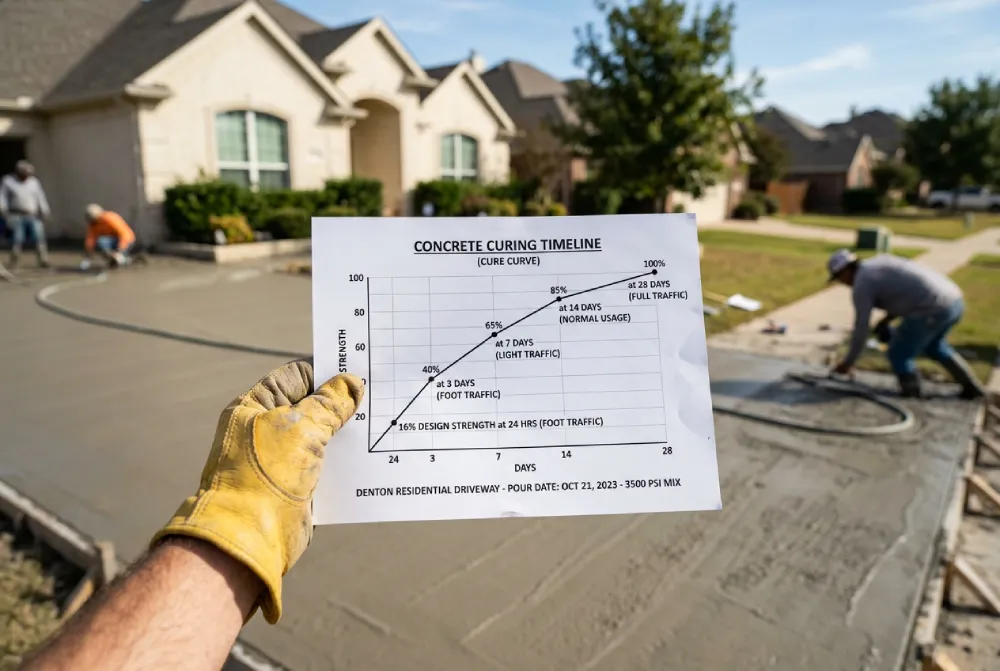
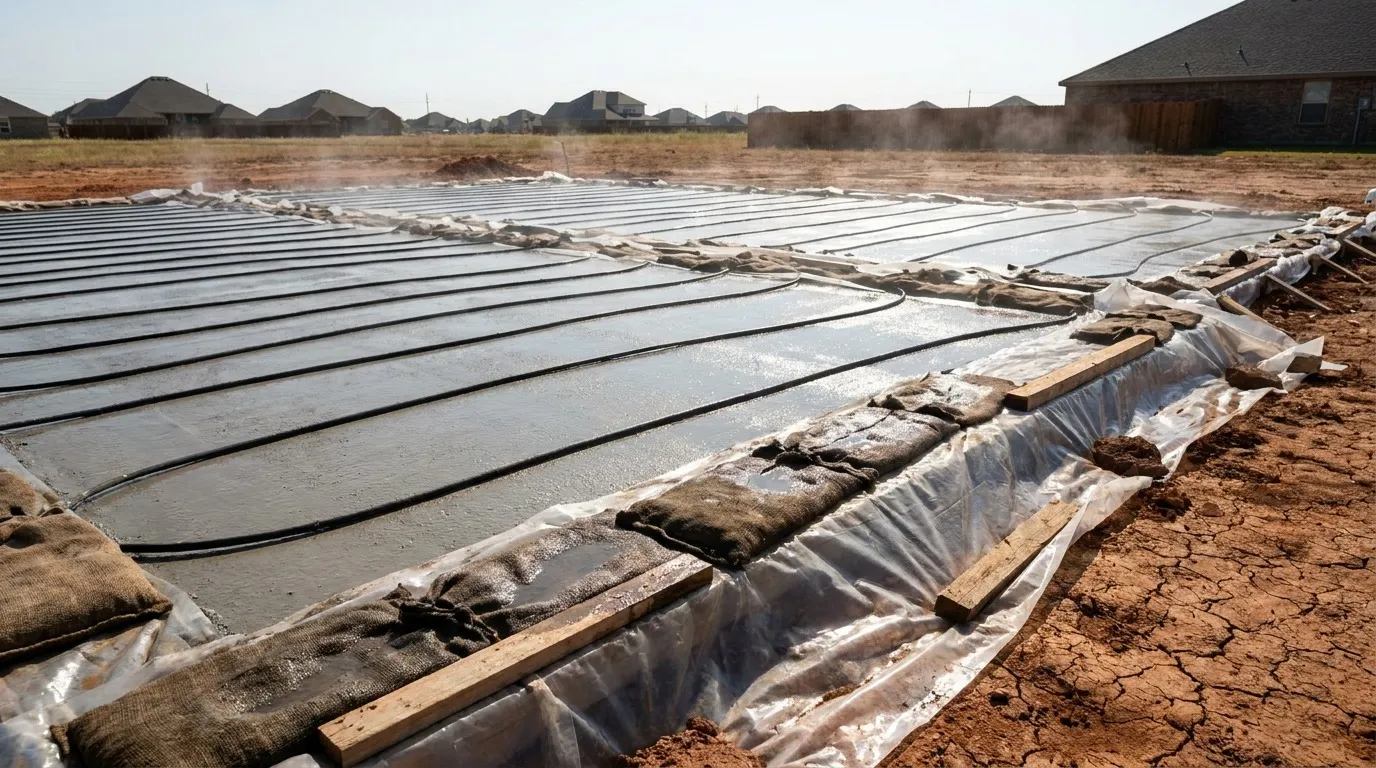
The following table is the standard usage timeline TriStar Built provides to every homeowner whose driveway we pour in Denton County. It assumes mild Denton weather (50 to 85 degree daytime highs), proper subgrade preparation, and standard ASTM C309 curing compound or 7-day wet curing.
| Time After Pour | Allowed Use | Caution |
| 0 to 4 hours | None | Do not walk on the slab; do not touch the surface |
| 4 to 24 hours | Light foot traffic | Workers only; no children or pets; no objects placed |
| 24 to 72 hours | Foot traffic, light wheelbarrow | No bicycles; no skateboards; no edge load |
| 3 to 7 days | Bicycles, foot traffic, light objects | No vehicle traffic of any weight |
| 7 to 14 days | Passenger cars, light SUVs | No turning loads at panel edges; no trucks |
| 14 to 28 days | Half-ton pickups, mid-size trucks | No 3/4-ton or heavier pickups; no RVs |
| 28+ days | Full design load (all vehicles per spec) | Continued normal use; first sealer at 30 days |
These windows are conservative for the standard Denton 4,000 psi residential mix. Heavier mixes (4,500 to 5,000 psi) reach each milestone slightly faster. Lower-strength mixes reach each milestone more slowly, and we do not recommend driveways with a psi below 4,000.
The standard timeline assumes mild Denton weather: daytime highs between 50 and 85 degrees, nights above freezing, and proper curing protocols. Three weather conditions extend the timeline.
When pour-day and curing-period highs exceed 95 degrees, and proper hot-weather protocols were followed:
When hot-weather protocols were NOT followed (no wind protection, no fog spray, no wet curing), the timeline is moot because the slab is already compromised. Treat as a suspect and consult with a concrete specialist.
When pour-day or curing-period nights drop below 40 degrees:
Cold-weather pours in Denton are rare and typically require insulating blankets, heated water, and set accelerators. If your driveway was poured in cold weather, ask your contractor for the specific cure timeline they recommend for your project.
A driveway poured in heavy tree shade, on the north side of a structure, or under a permanent shade cover, cures more slowly because surface temperatures stay lower throughout the day. Extend each milestone by 1 to 2 days. Shaded slabs gain strength to the same final values; they just take slightly longer to get there.
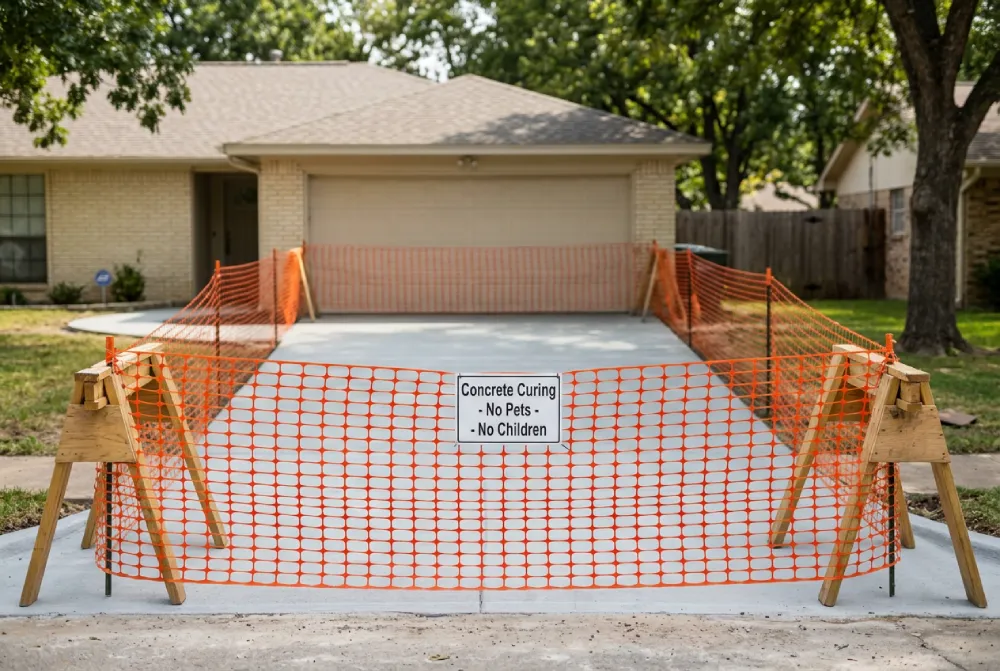
Children typically test new concrete with running, jumping, and dragging objects. Keep them off until day 3 minimum. After day 3, normal walking and play are safe. Bicycles and scooters are safe from day 5 to 7.
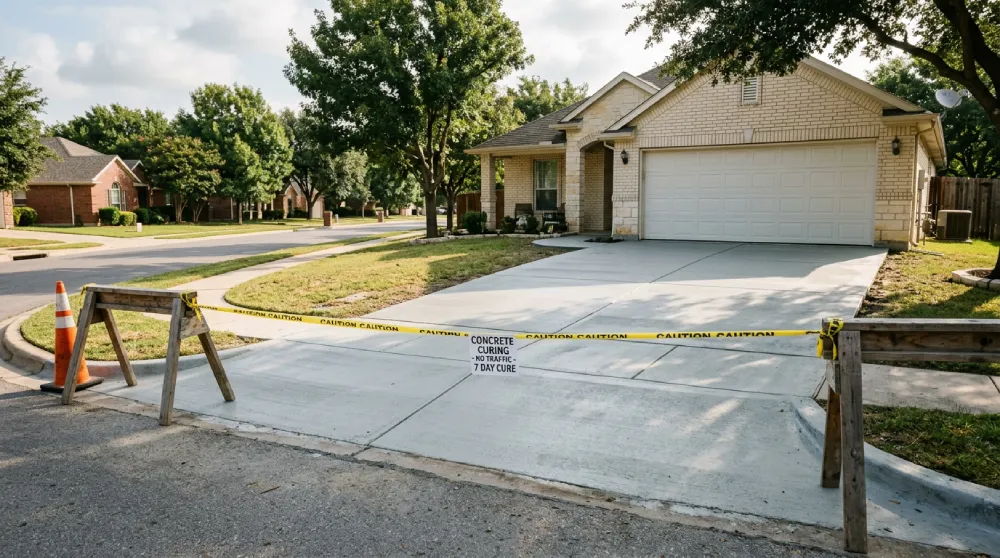
Pets present a different concern: paw prints. Cats and dogs walking on fresh concrete in the first 6 to 12 hours leave permanent paw-print impressions. The standard mitigation is to fence off the slab with temporary barriers (sawhorses, caution tape, plastic mesh) for the first 24 hours and inspect for any tracks before removing the fence. The footprint of even a small dog on green concrete is essentially permanent.
Most Denton-area mail carriers deliver from a vehicle without driving onto the driveway. If your delivery normally drives onto the driveway, place a note at the curb for the first 7 to 10 days asking them to deliver to the front porch or stop at the street. Garbage trucks, recycling pickup, and other service vehicles should not drive onto the new slab. The 7,000 to 15,000-pound axle loads are enough to crack 7-day-old concrete.
If your daily-driver vehicle is parked inside the garage and your new driveway connects the garage to the street, you have a coordination problem. Options:
The 7-day no-vehicle window is non-negotiable for a passenger car on a standard residential driveway. There is no shortcut. Skipping it produces visible damage by week 4 to 8.
If you have additional construction work planned (landscaping equipment, dumpster delivery, roofing material delivery), schedule it after the 28-day mark. Roll-off dumpsters in particular weigh 5,000 to 15,000 pounds empty and significantly more when loaded. They cannot be placed on a new driveway under 28 days old.
Early-drive damage shows up as one of three signatures, usually weeks after the event:
A vehicle wheel on green concrete can leave a faint visible depression around the contact patch that becomes more obvious after the slab has fully cured and the slight settlement is locked in. The depression may not be deep enough to notice on day one, but becomes visible under raking sun angles within a few weeks.
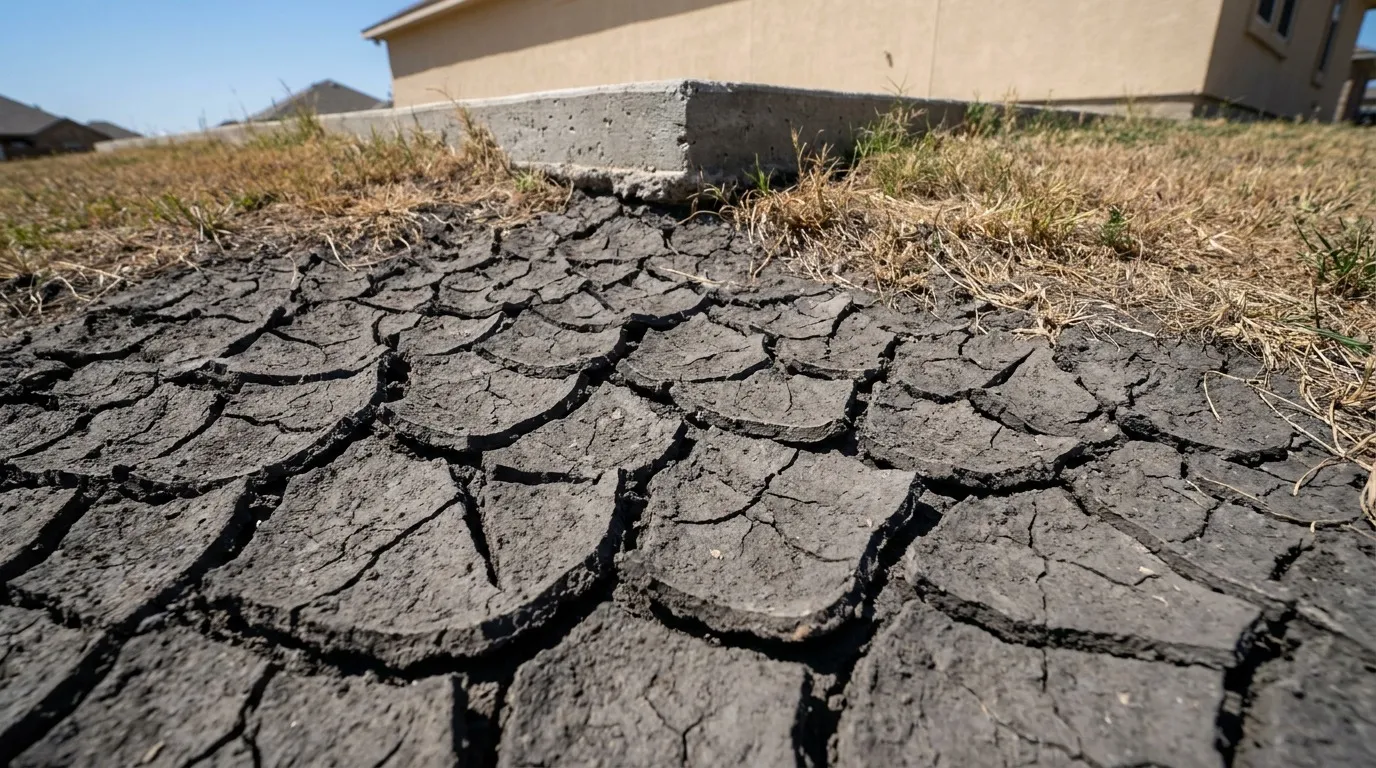
A wheel point load on a green slab can cause a crack to radiate from the loaded area outward toward the panel edges. The crack is often hairline-fine on day one and widens over the following weeks as the concrete continues to cure and the damaged zone moves slightly. These cracks are essentially impossible to differentiate from clay-heave or shrinkage cracks after the fact, which is why early-drive damage is rarely diagnosed correctly.
Driving across a panel edge or control joint before the slab has reached 14 to 21 days of cure can crush the panel corner. The damage appears as a small chipped triangle at the joint and may not be visible for several weeks as the compromised aggregate is eventually exposed by tire scuffing and weather.
In all three cases, the homeowner often does not connect the damage to the early-drive event. The contractor's warranty may have expired. The repair cost falls to the homeowner.
A new concrete driveway in Denton benefits from sealer application, but the timing matters. Penetrating sealer (lithium silicate, sodium silicate) can be applied as early as 14 days. Film-forming sealer (acrylic, polyurethane) should wait at least 28 days to ensure the slab has cured to full strength and surface moisture has equalized.
The TriStar Built recommendation is:
Sealer applied too early traps moisture in the slab, which can cause discoloration, blistering, or premature failure of the sealer film. Wait the recommended period.
Decorative concrete driveways (stamped patterns, integral color, acid stain, dye, or staining) have a slightly different timeline because the surface treatments are applied during finishing or shortly after the pour, and they require additional cure before traffic.
If your driveway received decorative treatment, your contractor should provide a specific cure timeline for that project. Follow it. Decorative slabs are more expensive and more susceptible to traffic damage in the first 30 days than plain gray concrete.
If you drove on the slab before the recommended window, the realistic options are:
There is no shortcut to undo an early-drive event. The slab does not "heal." But proper management from that point forward prevents additional damage.
You can walk on the slab carefully, approximately 4 to 6 hours after the pour ends, with care and a limited footprint. Workers typically need to walk on the slab to apply curing compound or place wet burlap, so this much foot traffic is expected. What you should avoid in the first 24 hours is concentrated weight (children jumping, pets running, anything heavier than a person walking normally).
For a standard 4,000 psi residential concrete driveway in Denton, the minimum wait is 7 days from the day of pour. The slab reaches roughly 65 percent of design strength at this point, which is enough to safely carry passenger vehicle loads without cracking or compression damage. This window assumes mild weather and proper curing.
No. The 7-day window is appropriate only for passenger cars and light SUVs. Trucks (3/4-ton and up), RVs, fifth-wheel trailers, and any vehicle with axle loads above approximately 4,000 pounds need to wait at least 28 days to ensure the slab has reached full design strength. Driving a heavy vehicle on a 14-day or 21-day-old slab can cause cracking and compression damage that does not show up until weeks later.
Damage typically appears 4 to 12 weeks after the early-park event. Common signatures include wheel-shaped depressions in the surface, hairline cracks radiating from where the wheel landed, and edge spalling at control joints near the parked location. The damage is often confused with normal aging or clay-heave damage and is rarely repaired correctly. Waiting the full window is the only prevention.
Yes. Concrete cured in hot weather (above 95 degrees) reaches each milestone slightly slower than concrete cured in mild weather, even with proper hot-weather protocols. Cold-weather pours (below 40 degree nights) significantly slow the cure and often require insulating blankets and set accelerators. For specific timeline extensions, your contractor should provide a project-specific curing schedule that accounts for the weather window during your pour.
For penetrating sealers (lithium silicate, sodium silicate), as early as 14 days from pour date. For film-forming sealers (acrylic, polyurethane), wait at least 28 to 30 days, ideally 45 to 60 days in mild weather, and 60 to 90 days for hot-weather pours. Sealing too early traps moisture in the slab and can cause discoloration, blistering, or premature sealer failure.
Get the recommendation in writing. The standard industry guidance for Denton residential 4,000 psi concrete driveways is a 7-day window before passenger car traffic, and 24 hours is unsafe for any wheel load. If your contractor is recommending 24-hour drive-on, ask specifically what concrete mix design was used and what cure protocol was followed. There are very-rapid-set mixes used in commercial work that can take traffic at 24 hours, but they cost roughly 2 to 3 times standard residential concrete and are rarely used on a residential driveway. If the answer does not clearly explain the basis, default to the standard 7-day window.
The cure timeline on a new concrete driveway in Denton is the most important rule to follow after the truck leaves. Foot traffic at 24 hours, bicycles at 3 to 5 days, passenger cars at 7 days, trucks and heavy loads at 28 days. These windows are conservative for the standard residential mix in mild Denton weather, and they protect the investment from the kind of damage that shows up weeks after the cause and cannot be undone.
If you have a new concrete driveway in Denton, Argyle, Flower Mound, Highland Village, Corinth, or anywhere across Denton County and want a project-specific cure schedule, TriStar Built will provide one for any project we pour. Call (940) 381-2222 or visit www.tristarbuilt.com.


Whether you’re remodeling a home, expanding a business, or starting from the ground up, TriStar Built is here to guide you every step of the way. With a focus on craftsmanship, communication, and results that last, we make the construction process clear, smooth, and worth every investment.

LOCATION: 2126 James Street, Denton, TX 76205
PHONE: (940) 381-2222
© 2025 TRISTAR BUILT - ALL RIGHTS RESERVED | WEB DESIGN & SEO BY: Authority Solutions®