For a residential concrete driveway in Denton, TX, #4 rebar on chairs at 16 to 18 inches on center delivers the strongest, longest-lasting result. Welded wire mesh is acceptable for light-duty applications when properly elevated, and macro synthetic fiber is a useful supplement but not a structural substitute. The reinforcement choice directly determines whether a driveway lasts 10 years or 30 years on North Texas clay soil.
Walk down any older Denton neighborhood, and you can spot the difference between a well-reinforced concrete driveway and a poorly reinforced one without bending down. The well-reinforced driveways have straight panel edges, show tight hairline cracks that stayed put, and have withstood decades of vehicle traffic without spalling at the joints. The poorly reinforced ones have wandering cracks that widened, panel corners that dropped, and surface failures that telegraph the steel below failed long ago.
Reinforcement is the single most consequential decision homeowners control on a driveway pour, and it is the easiest place for a contractor to quietly cut cost. This guide walks through the three real options for residential driveway reinforcement in North Texas, explains where each one belongs, and lays out the TriStar Built reinforcement spec we put in writing on every contract.
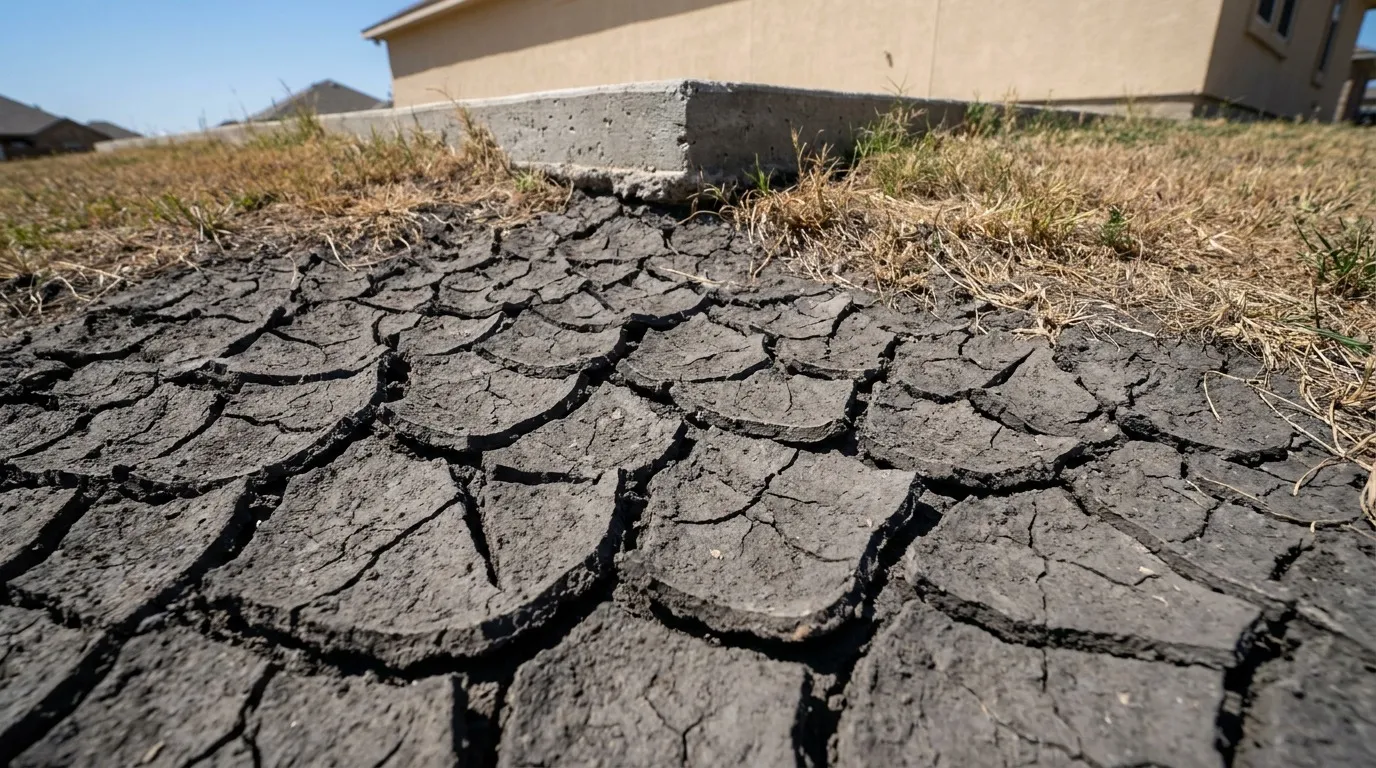
Concrete is enormously strong in compression and remarkably weak in tension. A concrete driveway on stable rock subgrade would require very little steel. A concrete driveway sitting on the high-plasticity Vertisol clays that dominate Denton County is a different problem entirely. North Texas clay swells when wet and shrinks when dry, lifting and dropping the slab through every seasonal cycle. Those movements pull and push the concrete in ways that create tension stresses across the slab.
Steel reinforcement does not stop cracks from forming. It does something more useful. It holds the two sides of any crack together so the slab continues to behave as a connected panel rather than two free pieces drifting apart. Without that load transfer across cracks, panel corners drop, joints widen, and the driveway fails section by section. With proper reinforcement, hairline cracks stay tight, panels stay aligned, and the driveway carries vehicle loads for 25 to 30 years.
There are exactly three reinforcement strategies a competent North Texas concrete contractor will propose for a residential driveway, plus a fourth option that should raise a red flag.
Deformed steel reinforcement bar, commonly called rebar, is the structural workhorse of residential driveway construction in North Texas. The number designation refers to the bar diameter in eighths of an inch. A #4 bar is 4/8 inches, or 1/2 inch in diameter. For Denton residential driveways, #4 is the standard that ACI 330 (the American Concrete Institute guide for parking lot and driveway design) and most regional engineers recommend.
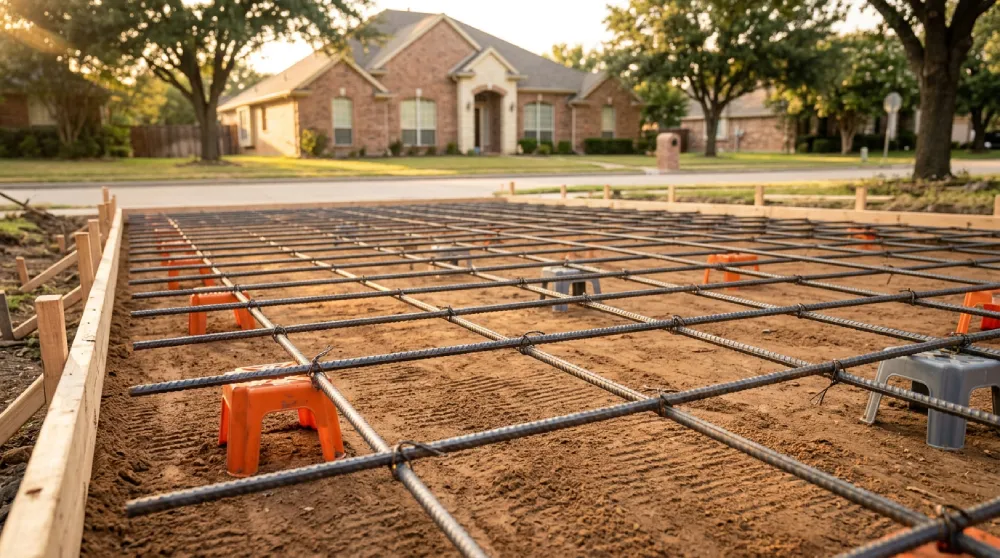
Rebar is tied together on the ground in a grid pattern, then lifted onto plastic or wire chairs so it sits in the middle third of the slab thickness during the pour. For a 5-inch slab, the rebar grid sits roughly 2.5 inches above subgrade. That placement is critical. Rebar at the bottom of the slab does almost nothing useful. Rebar in the middle does everything.
Welded wire mesh is a factory-fabricated grid of smaller-diameter wires welded at the intersections. The two common residential grades are 6x6 W2.9xW2.9 (6-inch grid with 0.192-inch diameter wires) and 6x6 W1.4xW1.4 (smaller wire). It comes in flat sheets or rolls.
Wire mesh is faster and cheaper to install than rebar. When properly elevated on chairs to sit in the middle of the slab, it provides legitimate crack control for light-duty applications such as walkways, patios, and driveways for compact cars under stable subgrade conditions. The structural capacity is significantly lower than #4 rebar at the same spacing, which is why TriStar Built does not specify wire mesh for primary driveway panels on Denton clay.
Macro synthetic fiber is a polypropylene or copolymer fiber, typically 1.5 to 2 inches long, mixed directly into the concrete at the batch plant. Common dosage rates are 4 to 7.5 pounds per cubic yard. Fiber distributes three-dimensionally throughout the slab and provides tensile strength at the micro-crack scale.
Macro fiber is excellent at controlling plastic shrinkage cracking (the very early cracks that form within the first 24 hours of placement) and at distributing stress in the early curing phase. It is not a structural replacement for rebar. A fiber-only driveway on North Texas clay will outperform a no-reinforcement slab, but it will not match the long-term performance of a properly reinforced rebar slab.
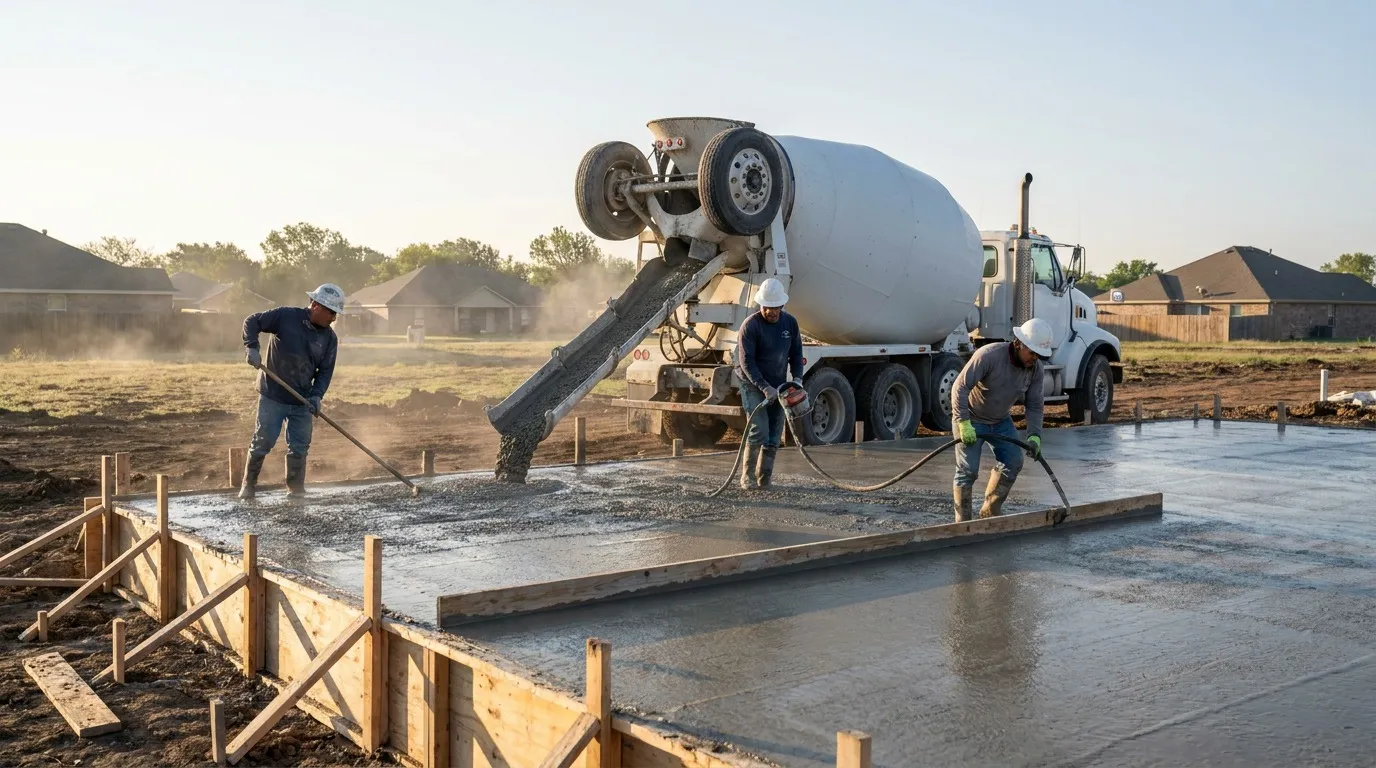
If any contractor tells you that a residential concrete driveway in Denton does not need reinforcement, end the conversation. A pour without reinforcement may briefly look identical to a properly reinforced slab. Within three to seven years on North Texas clay, the difference becomes unmistakable. Walk away from any bid that omits steel reinforcement entirely.
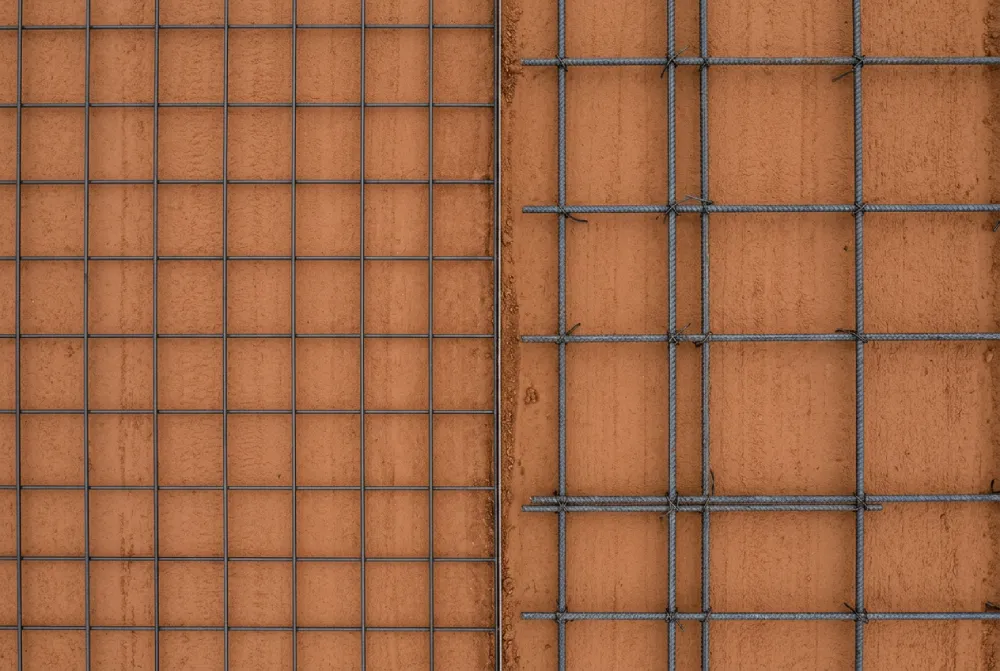
The table below summarizes the practical differences between the three reinforcement options for a typical Denton residential driveway.
| Property | #4 Rebar (16-18" OC) | 6x6 W2.9 Wire Mesh | Macro Synthetic Fiber |
| Material cost (per sq ft) | $0.65 to $0.95 | $0.30 to $0.45 | $0.40 to $0.70 |
| Labor cost (per sq ft) | $0.80 to $1.20 | $0.40 to $0.60 | $0.00 (mixed at plant) |
| Tensile capacity | High | Moderate | Low to Moderate |
| Crack-width control | Excellent | Good if elevated | Excellent for micro-cracks |
| Long-term load transfer | Excellent | Marginal | Minimal |
| Resistance to clay heave | Excellent | Poor to Moderate | Poor |
| Typical lifespan in Denton | 25 to 30+ years | 12 to 18 years | 10 to 15 years (alone) |
| Best application | Primary driveway panels | Walkways, light patios | Supplement to rebar |
After 18 years of pouring concrete in Denton County, our standard residential driveway reinforcement specification is the same on every contract. We write it in plain language so homeowners can verify what they are paying for.
Standard Spec for Residential Driveways:
That specification is not theoretical. It is the same rebar layout we have used for 18 years on Denton County clay, and it is the reason our oldest driveways from 2008 to 2010 are still flat, tight, and crack-controlled today.
Wire mesh is not a scam product. It has a legitimate place in residential concrete work. The keyword is "place," meaning where it belongs and where it does not.
Wire mesh belongs on:
Wire mesh does not belong on:
If a contractor proposes wire mesh on your primary driveway and discounts the bid by $400 to $700 compared to a rebar bid, the savings are real but the long-term cost is much larger. Expect 12 to 18 years of service from wire mesh, versus 25 to 30 years from properly placed rebar on the same subgrade.
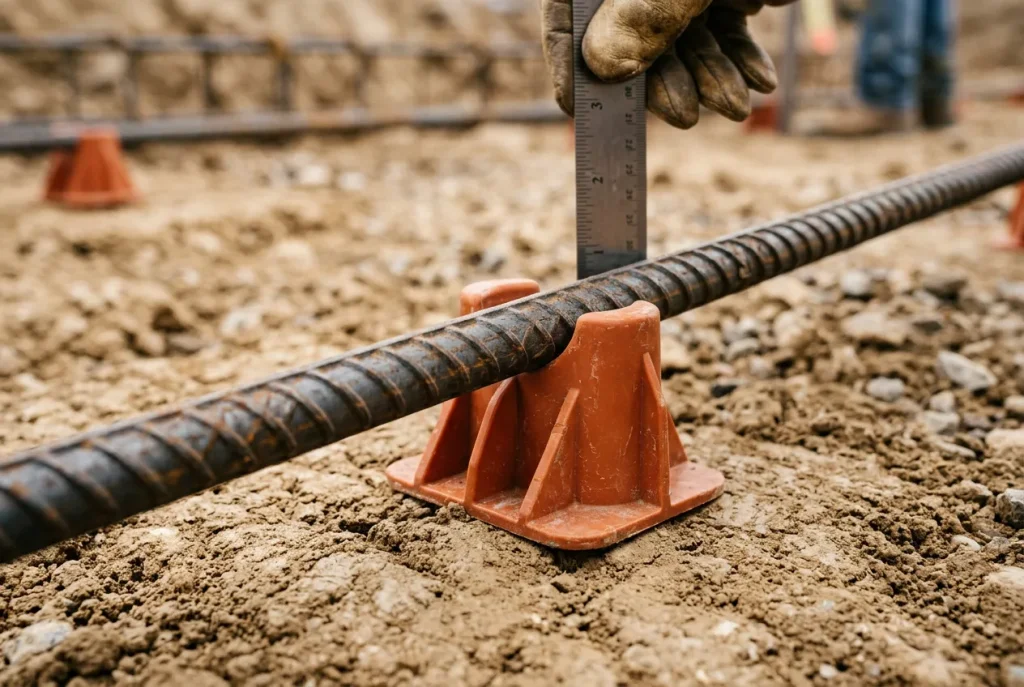
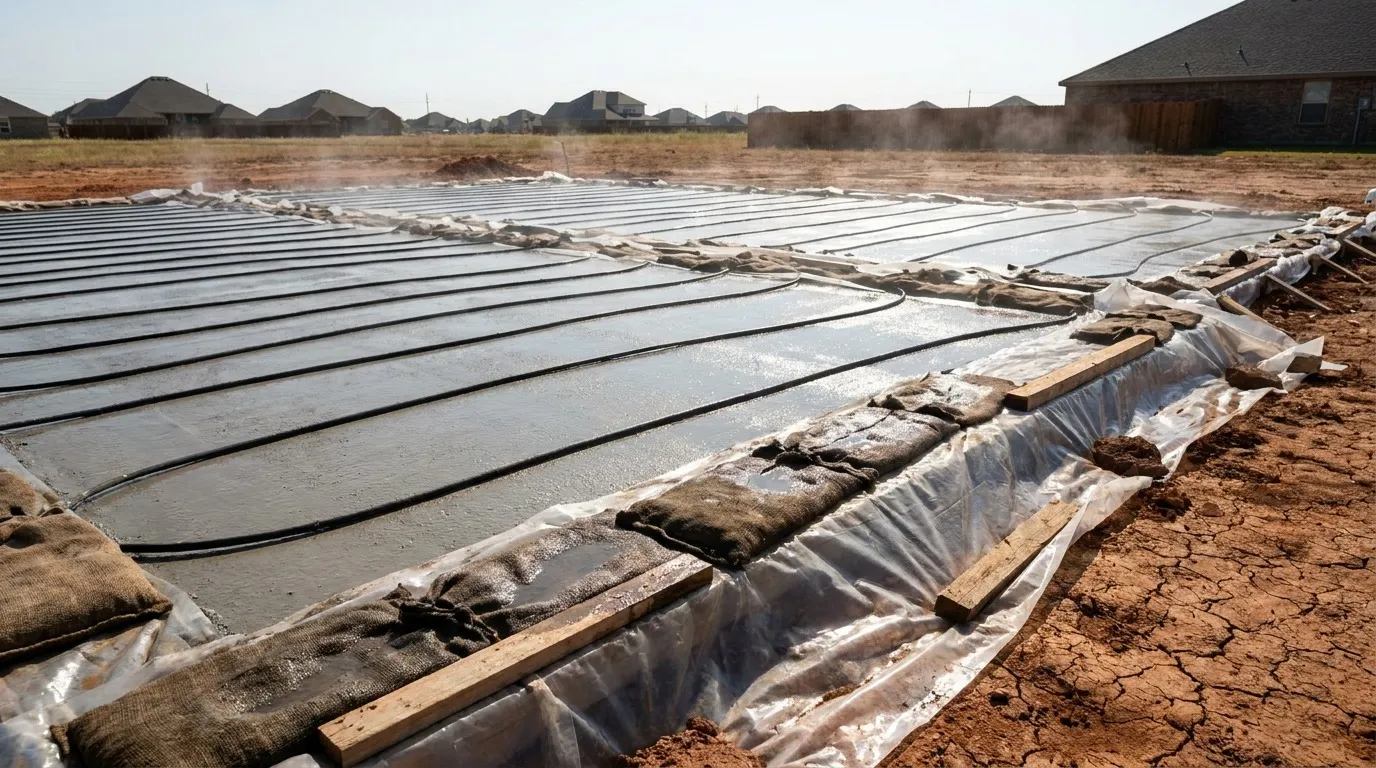
The single most common reinforcement failure on Denton driveways has nothing to do with which type of steel was used. It has to do with where the steel ended up during the pour.
Steel that sits on the ground at the bottom of the slab provides almost zero structural benefit. Steel needs to be in the middle third of the slab thickness to do its job, and that requires elevation onto chairs. The two acceptable methods are:
The walk-in technique alone, where workers pull mesh or rebar up into wet concrete with hooks during the pour, is not reliable for residential pours. The pulled-up steel never stays consistently at mid-depth because the concrete grabs and holds it at whatever depth the hook released it. Insist on chairs, not pull-up. Any reputable Denton contractor will install chairs as standard practice.
For homeowners comparing contractor bids, here is the realistic 2026 cost picture for reinforcement of a typical 600-square-foot residential driveway (24 feet long by 25 feet wide, 5 inches thick) in Denton, TX.
Reinforcement Cost on a 600 sq ft Driveway:
On a total driveway pour cost of approximately $7,500 to $9,500, reinforcement is 12 to 17 percent of the contract. That is the wrong line item to economize. The cost difference between wire mesh and proper rebar is $460 to $660, and that single decision determines whether the driveway lasts 12 years or 30.
When you review a concrete driveway bid in Denton, the reinforcement section should answer every one of these questions in writing:
If the bid says only "reinforced concrete" or "with rebar" without specifying spacing, size, or an elevation method, the contractor leaves themselves room to install the cheapest possible reinforcement. Push for the specifics in writing before signing.
Most Denton County residential driveway projects are not formally inspected because they fall under the threshold for permit and engineering oversight. That puts the verification burden entirely on the homeowner. For larger projects, engineered driveways, or driveways supporting heavy equipment, the City of Denton building inspectors and Denton County engineers will look at three things specifically:
The fact that small residential driveways are not inspected is exactly why contractor accountability and written specifications matter so much. There is no third-party review catching a wire-mesh substitution or a rebar-on-the-ground installation. The homeowner is the inspector by default, which is the entire reason this article exists.
For a primary driveway on Denton County clay soils, yes. Rebar provides higher tensile capacity, better crack-width control, and longer-term load transfer across cracks than wire mesh. Wire mesh has legitimate uses on lighter applications, but a primary driveway is not one of them. The cost difference is small, and the lifespan difference is substantial.
No, not for a residential driveway on North Texas clay. Macro synthetic fiber is excellent at controlling micro-cracking and plastic shrinkage cracks, but it cannot match the tensile capacity of properly placed steel rebar across large cracks caused by clay heave. Fiber is best used as a supplement to rebar, not as a replacement. Any contractor who proposes fiber-only on a driveway should be questioned about long-term performance expectations.
For standard residential driveways, #4 rebar (1/2-inch diameter) is the appropriate specification. For heavier applications such as RV pads, truck-frequented driveways, or wider panels over 12 feet, the same #4 rebar at a tighter spacing of 12 inches on center is preferred over upgrading to #5 rebar. #5 and larger bars are appropriate for commercial and industrial slabs.
Inspect before the pour. The day before concrete arrives, the rebar grid should be visible, tied together, and elevated on chairs above the prepared subgrade. Use a tape measure to verify spacing matches the bid (typically 16 inches on center). Check that lap splices at bar ends are at least 24 inches. Confirm chairs hold the steel at roughly mid-slab depth. Take photos for your records. Any reputable Denton contractor will welcome this inspection.
Yes, modestly. Macro fiber at 4 to 5 pounds per cubic yard reduces plastic shrinkage cracking in the first 24 hours after placement, which is when the most visible early cracks form. The combination of rebar and fiber provides both long-term structural performance and early-age crack mitigation. The additional cost is $200 to $350 on a typical driveway, which is a reasonable insurance against early-age cracking.
Concrete fails in tension long before it fails in compression. For a slab on grade, such as a driveway, the tension zone shifts depending on the load and support conditions. When the slab spans a small soft spot or heave, the bottom is in tension. When a vehicle wheel applies a point load to the top, the top is in tension. Placing the steel in the middle third of the slab depth means the rebar can resist tension from either direction. Steel on the ground only helps with bottom-tension cases, and even then, it loses effectiveness because concrete in direct contact with soil is in the worst environment for long-term bond.
ACI 330R, the American Concrete Institute design guide for parking lots and driveways, recommends a minimum 4-inch slab thickness with reinforcement for residential driveways, and provides specific recommendations on reinforcement sizing and spacing based on subgrade conditions and load. For high-plasticity clay subgrades typical of Denton County, the recommendations align closely with the TriStar Built specification: #4 rebar at 16 to 18 inches on center, elevated to mid-slab, with 24-inch lap splices. ACI 330 is not a building code, but it is the most-cited industry reference for this type of work.
The reinforcement decision is the most consequential and most quietly compromised line item on a residential concrete driveway bid in Denton. Wire mesh is legitimate for walkways and patios. Macro fiber is a useful supplement. Neither is a structural substitute for properly sized, properly placed steel rebar on North Texas clay.
If you have a driveway project coming up in Denton, Argyle, Flower Mound, Highland Village, Corinth, or anywhere across Denton County and want a written reinforcement specification you can hold a contractor to, TriStar Built is happy to walk you through what to expect. Call (940) 381-2222 or visit www.tristarbuilt.com to start a conversation about your project.


Whether you’re remodeling a home, expanding a business, or starting from the ground up, TriStar Built is here to guide you every step of the way. With a focus on craftsmanship, communication, and results that last, we make the construction process clear, smooth, and worth every investment.

LOCATION: 2126 James Street, Denton, TX 76205
PHONE: (940) 381-2222
© 2025 TRISTAR BUILT - ALL RIGHTS RESERVED | WEB DESIGN & SEO BY: Authority Solutions®