A concrete driveway quote in Denton, TX should specify exact slab thickness, reinforcement type and spacing, concrete mix design (psi, air content, slump), joint plan, cure protocol, payment schedule, and warranty terms in writing. Missing any of these specifications is a red flag. Vague language, surprise cash discounts, door-to-door solicitations, deposits above 50 percent, and bids more than 30 percent below competitors are the warning signs that separate professional contractors from corner-cutters who leave failed driveways behind.
Most homeowners who have been burned by a bad concrete contractor say the same thing afterward: "The quote looked normal. The price was a little lower than the others. I wish I had known what to look for." This guide is what they wish they had known.
After 18 years of pouring driveways in Denton County and repairing competitor work that failed within 5 years of installation, TriStar Built has seen the patterns. Bad driveway projects almost always start with bad driveway quotes. The corner-cutting that produces failed slabs is documented (or not documented) on the proposal that the homeowner signs. This article walks through the specific red flags that should make you slow down, ask more questions, and often walk away.
We focus on what is in the quote and what is missing from the quote, because the document itself is the proof that a contractor either takes the work seriously or does not.
A professional concrete driveway quote specifies exact slab thickness in inches. "5-inch slab" or "5 inches thick" or "5 in." should appear somewhere in the scope of work.
What to look for instead:
The reason this is a red flag is simple economics. A 4-inch slab on a 600 square foot driveway uses approximately 7.4 cubic yards of concrete. A 5-inch slab uses 9.3 cubic yards. The savings to a contractor who quotes "concrete driveway" without specifying thickness and then pours 4 inches everywhere is roughly $300 to $400 on a typical Denton residential project. Multiply that across a year of jobs and you understand why vague thickness language is so common on cheap quotes.
The fix is to require a specific number in inches on every quote. If the contractor cannot or will not provide one, find a different contractor.
Reinforcement is the second most-substituted line item on concrete driveway quotes, after thickness. A professional quote specifies:
What to look for instead:
The cheapest reinforcement strategy a contractor can use is none at all, which is why the substitution cycle goes: no reinforcement, then wire mesh laid on the ground, then wire mesh elevated, then rebar at 24-inch spacing, then rebar at 16-inch spacing. The professional standard is the last option. The unprofessional substitutions all share one thing: they cost less than the standard but produce a measurably worse driveway.
A professional concrete driveway quote specifies the mix design used:
What to look for instead:
The mix design difference between a cheap 3,000 psi mix and a quality 4,000 psi mix with proper air entrainment is approximately $15 to $25 per cubic yard. On a typical driveway, that is $130 to $200. The lifespan difference between the two mixes in Denton's freeze-thaw climate can be 8 to 15 years. The mix specification belongs in writing on every quote.
A contractor who offers a 10 to 20 percent discount for cash payment is signaling one of several problematic things:
What to look for instead:
A reputable concrete contractor accepts checks, credit cards, and certified funds. They provide receipts. They report income. They have nothing to hide. The legitimate small discount for non-credit-card payment is 2 to 3 percent. Anything beyond that is a flag.
Concrete contractors who knock on doors offering "leftover concrete from a nearby job" or "we noticed your driveway needs work" are one of the most-cited consumer complaints in Denton. The pattern usually goes:
This pattern is documented by the Better Business Bureau, the Texas Attorney General's office, and Denton-area consumer protection organizations. After a major storm, the term "storm chaser" appears, as out-of-state contractors flood Denton, offering quick driveway, roof, and repair work to storm-affected homeowners.
The rule: Never sign a concrete driveway contract with a contractor who knocked on your door uninvited. Reputable Denton contractors do not solicit door-to-door. They build their business through referrals, ratings, and inbound calls. The door-to-door pattern is almost universally associated with corner-cutting and post-payment problems.
If you collect three concrete driveway bids in Denton and one is 25 to 50 percent below the other two, the low bid is almost always missing something specific. The most common omissions:
In some cases, the low-bid contractor simply does not understand the scope and will surprise the homeowner with change orders during the project. In other cases, the low bid is a deliberate strategy to win the contract, knowing that the work will be marginal.
What to do: Compare the bids line-by-line, not bottom-line. The low bid may be 30 percent lower because it omits $2,000 in work and quality. If the same scope of work is specified on the low bid, that is a different conversation, but the same scope is rarely what you find on close inspection.
Texas industry standard for concrete contractor deposits is 25 to 30 percent. A deposit secures materials and the pour date, and provides the contractor with reasonable cash flow to start the project. Anything above 50 percent is a red flag for one of three reasons:
What to look for:
The fix is to insist on Texas industry-standard payment terms: 25 to 30 percent deposit, 50 percent at pour completion, and the balance after walkthrough.
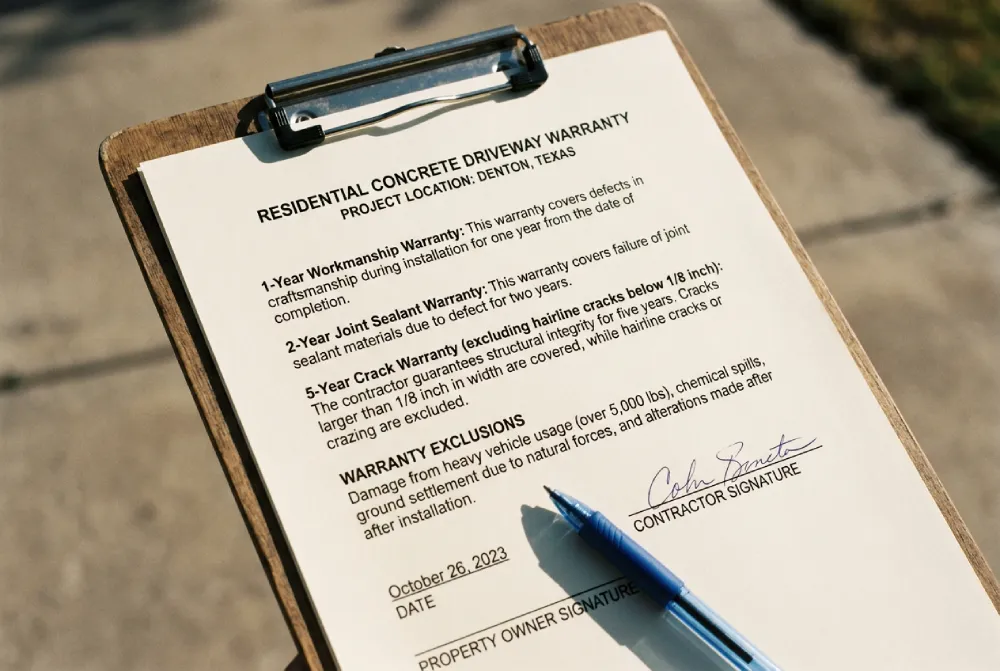
A concrete driveway warranty must be in writing in the contract, with specific coverage terms, a defined duration, and exclusions. Verbal warranties are unenforceable. "We back our work," or "We stand behind everything we do" or "Lifetime warranty on our workmanship," without written terms are worthless.
What a written warranty should include:
What should send you elsewhere:
A professional concrete driveway in Denton requires:
Total: 4 to 6 days minimum, often spread across 1 to 2 weeks. A contractor offering to pour your driveway tomorrow or the day after is skipping critical preparation steps. The pour itself takes 1 day; the preparation that produces quality slabs takes 3 to 5 days beforehand.
What to look for:
The exceptions are very small slabs (small approach repairs, partial replacements) that genuinely can be done in a day. For a full residential driveway, a one-day timeline is a hard stop.
Some Denton-area municipalities and HOAs require permits or architectural review for driveway replacement. The requirement varies by city and neighborhood, but generally:
What to look for:
A reputable contractor checks permit and HOA requirements before bidding and either includes permit fees in the bid or specifies them as a line item. The contractor handles the permit application as part of their professional service, not as a homeowner's homework.
A Denton-area concrete contractor should be able to provide 3 or more local references from driveways poured within the last 5 years, with at least 2 references from work done at least 3 years ago.
What to look for:
A contractor without aged local references either has not been doing work in Denton long enough to have them or has driveways that did not hold up well. Either case is a reason to be cautious.
A professional concrete driveway bid in Denton includes specifics to your project:
What to look for:
A contractor who has visited your property should be able to produce a bid that reflects what they actually saw, not a one-size-fits-all template. Generic bids often indicate the contractor did not actually look closely at your site, or that they price every job the same regardless of project specifics.
Any individual red flag may or may not indicate a problem. A single instance might be explained by a busy quoting process or an unfamiliar contractor norm. Multiple red flags in combination are the strong signal.
| Red Flag Count | Recommended Action |
| 0 to 1 | Proceed with normal due diligence; ask the 12 vetting questions |
| 2 to 3 | Slow down; request specific clarifications in writing; compare to other bids |
| 4 to 5 | Strong concern; this is not a contractor for a 30-year investment |
| 6 or more | Walk away; this is the profile of contractors who produce failed driveways |
Use this not as a rigid algorithm but as a directional guide. The patterns that show up across multiple categories are more meaningful than any single warning sign.
For contrast, here is what a professional concrete driveway quote in Denton looks like, summarized:
Project Header:
Scope of Work:
Payment Terms:
Warranty:
Documentation:
If your bid includes most or all of these elements, you have a professional contractor. If multiple elements are missing or vague, that is the signal to keep looking.
Missing slab thickness specification. A quote that does not state "5 inches" or another specific number in inches leaves the contractor free to pour 4 inches without any contractual constraint, saving them $300 to $400 in concrete cost and producing a measurably inferior driveway. If the quote does not specify the slab thickness, request it before signing. If the contractor will not commit to a specific number, find another contractor.
Not all, but most. There are legitimate reasons one contractor can quote lower than another (more efficient operations, lower overhead, established crew). However, a bid that is 25 to 50 percent below competitive bids is almost always achieved by reducing the specification, not by efficiency. Compare bids line-by-line. The legitimate efficiency bid has the same scope as the competitors at a lower price; the corner-cutting bid has a different scope.
Texas industry standard for concrete contractor deposits is 25 to 30 percent. Deposits above 50 percent typically signal one of three problems: the contractor needs your money to pay for materials for another project, the contractor has cash flow issues, or the contractor knows the work will be marginal and is collecting as much up front as possible before quality issues become apparent. The fix is to insist on standard payment terms (25 to 30 percent deposit, 50 percent at pour, balance at completion).
Politely decline. Door-to-door concrete contractor solicitations are one of the most frequent consumer complaints in Denton, and the pattern is almost universally associated with corner-cutting work and post-payment problems. Reputable contractors do not solicit door-to-door. They build their business through referrals, ratings, and inbound calls. If you need driveway work, identify reputable Denton contractors by checking references and ratings, and reach out to them directly.
Verbal "lifetime warranty" promises are red flags because they are unenforceable. Written warranties from companies that have been in business for less than 5 years are also weak because the company backing the warranty may not exist in 10 years. A reasonable warranty for residential concrete driveway work in Denton is 1 to 5 years for workmanship, with specific coverage and exclusions outlined in the contract. Be wary of "lifetime" promises that lack written backing.
It depends on your specific situation. City of Denton typically does not require permits for in-kind residential driveway replacement, but new driveways, expansions, and changes of significant width or length often do require permits. HOAs in many Denton-area planned communities (Argyle, Flower Mound, Highland Village, Corinth, Bartonville) require approval from the architectural review committee. A reputable contractor checks the permit and HOA requirements as part of their bid preparation and either handles the permit or specifies it as a line item.
Ask the contractor's insurance agent for certificates of insurance (COIs) naming you as an additional insured for the duration of the project. The COIs should show general liability ($1 million minimum) and workers' compensation. Verify the carrier is legitimate by checking the Texas Department of Insurance website. A contractor who provides COIs only as a paper copy from their own files (not directly from the agent) is a red flag. The agent-issued certificate is a verifiable document.
The concrete driveway quote you sign is the most important document of the entire project. The specifications written into that quote determine the structural quality of the slab, the materials used, the timeline, the warranty, and the recourse available if something goes wrong. Red flags on the quote are the warning signs that something is missing.
If you are reviewing concrete driveway quotes in Denton, Argyle, Flower Mound, Highland Village, Corinth, or anywhere across Denton County and want a second opinion on what you are seeing, TriStar Built is happy to walk through your quotes with you. Call (940) 381-2222 or visit www.tristarbuilt.com. After 18 years of pouring driveways in North Texas, we know what a professional quote should look like and what corners get cut on the rest.


Whether you’re remodeling a home, expanding a business, or starting from the ground up, TriStar Built is here to guide you every step of the way. With a focus on craftsmanship, communication, and results that last, we make the construction process clear, smooth, and worth every investment.

LOCATION: 2126 James Street, Denton, TX 76205
PHONE: (940) 381-2222
© 2025 TRISTAR BUILT - ALL RIGHTS RESERVED | WEB DESIGN & SEO BY: Authority Solutions®